SpaceX Releases Photos from Historic Ocean Barge Landing
On Friday, SpaceX made history by performing its first successful ocean barge landing following a resupply mission to the ISS. Today, they released the photos.
On Friday, SpaceX made history by performing its first successful ocean barge landing following a resupply mission to the ISS. Today, they released the photos.
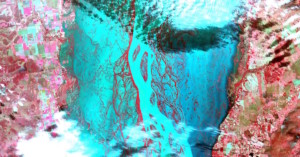
NASA just gave satellite imagery nerds a very big present: along with a bunch of other scientific data, the space agency just made 2.95 million images of Earth changing surface available to the public at no cost.
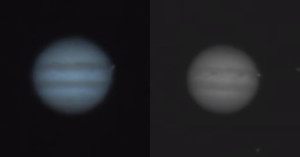
Two amateur astronomers have captured what appears to be an explosion on Jupiter that resulted from a large asteroid impacting the planet.
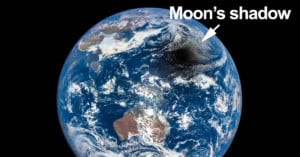
During the total solar eclipse on March 8th and 9th, NASA had a camera documenting it from a very special perspective -- one that's 1 million miles away.
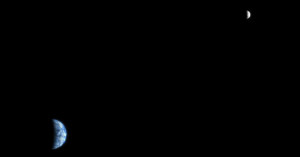
Here's a beautiful photo of the Earth and Moon in a single frame, captured back on October 3, 2007 by the HiRISE camera on NASA's Mars Reconnaissance Orbiter. Our planet was about 88 million miles away from the camera.
Photographer Nao Tharp of Los Angeles, California, just released this short video that shows something neat he captured on a freezing cold winter night back on December 12th, 2015. While shooting a time-lapse of the Geminid meteor shower at Red Rock Canyon State Park in California's Mojave desert, his camera caught a bright meteor explosion and a resulting orange glowing plume that lingered for about 40 minutes.
A group of 5 friends recently attached 5 cameras to a stratospheric weather balloon and launched it from the Presidio in San Francisco. The rig traveled to 91,470 above Northern California, popped, and then landed over 100 miles away.
Deal alert: if you use Google's services for your photos, emails, or life in general, you can snag an extra 2GB of permanent storage space for free today. All you need to do complete Google's simple Security Checkup to verify that your account is secure -- it takes just a few clicks of your mouse.
ISS Transit Finder is a new web app that's designed to help astrophotographers figure out when and where the International Space Station will fly across the face of the Sun from a vantage point on the ground.
NASA astronaut Scott Kelly has attracted over 700,000 followers on Twitter by regularly sharing beautiful snapshots of Earth, as seen from the International Space Station.
Yesterday, SpaceX successfully launched its Falcon 9 rocket, delivered 11 satellites into orbit, turned it around, and safely landed the first stage booster back to the ground at Cape Canaveral, Florida. It's the first time this has been ever done with an orbit-capable rocket.
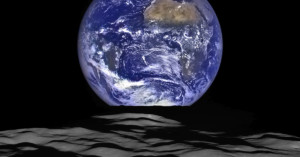
NASA just released an amazing new high-resolution photo of the Earth "rising" above the horizon of the Moon. It was captured by the camera onboard the Lunar Reconnaissance Orbiter from its orbit around the moon.
When you think of the planet Jupiter, you probably think of that giant striped planet with the Great Red Spot anticyclonic storm swirling across the face. But that's just one way of looking at Jupiter.
Back in July, we shared an eye-popping roundup of some of the best space photos captured by NASA's Cassini space probe. If you're the type that enjoys quantity over quality, here's a nearly 4-hour-long rapid-fire slideshow that contains 341,805 images -- every single photo captured by the probe from between February 6, 2004 and September 15, 2015.
If you have a telescope or lens that's powerful enough, you can watch the moon transit the sky through the live view on your DSLR's LCD screen.
In 2012, 35 years after its launch in 1977, NASA's Voyager 1 space probe left the Solar System and became the first human-man object to enter interstellar space. On board is a Golden Record with sounds and images that show life on Earth. 116 images were selected for inclusion by a committee led by Carl Sagan.
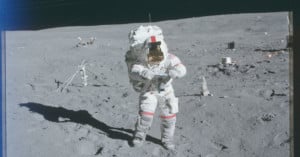
You know those iconic photos of NASA Apollo astronauts posing with the US flag on the moon? The 3-minute video above is a "behind-the-scenes" video that shows some of the portraits being shot.
Last year, NASA released a 20-gigapixel photo of the Milky Way that was made up of over 2 million infrared photos. Back in January, NASA published a 1.5-gigapixel photo of the Andromeda Galaxy. If you thought those were big photos, get this: German astronomers have created the largest astronomical photo ever made: a ridiculously big 46-gigapixel photo of the Milky Way that took 5 years to make.
People are having fun remixing those 8,400 Apollo moon mission photos that were uploaded to Flickr last week. A couple of days ago, we shared a video that brought the photos to life with faux slow-motion that was added with Photoshop and After Effects.
Did you know the International Space Station has a RED Epic Dragon in its camera arsenal now? The 6K camera was delivered to the station back in January 2015, allowing astronauts to capture footage at 300 frames per second and 6 times more detail than before.
Last week, a treasure trove of 8,400 photos by Apollo astronauts was uploaded to Flickr, making the archive easily accessible to the public. Director of photography Tom Kucy decided to put a unique spin on the images: he added 3D motion to stills to make them look at like out-of-this-world slow-motion clips. The 2-minute 4K short film above is titled "Ground Control." …
Want to browse the entire collection of photos captured on the moon by Apollo astronauts with their chest-mounted Hasselblad cameras? You can now do so right on Flickr.
We've shared a number of times in the past about how NASA uses Adobe Photoshop to create many of the dazzling space photos released to the public. Earlier this week, Adobe also published an interesting article that reveals 4 different ways the space agency uses image editing software to "reveal the unseeable."
The Tiny1 is a new camera that's being developed by a three-person startup called TinyMOS over in Singapore. The tiny aluminum-bodied camera aims to do for astrophotography what the GoPro did for action video, bringing space imaging to the masses.
Renowned French astrophotographer Thierry Legault captured one of the most remarkable images of the supermoon lunar eclipse yesterday. He managed to shoot the world's first photo of the International Space Station passing in front of the moon during the eclipse.
Back in 2009, Samantha Cristoforetti was selected by the European Space Agency to become Italy's first female astronaut. She went on to spend 200 days aboard the International Space Station, setting the record for the longest continuous space flight by a woman.
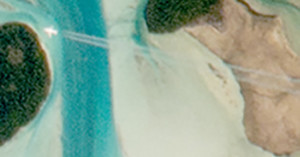
Every day, NASA releases a photograph from their collection that allows us to admire the great blue and green planet we call Earth. Recently, the agency released a picture of a group of small island cays in the Bahamas. The most interesting aspect of the photo is not the location, but a little bit of detail that reveals itself when you closely examine the photo.
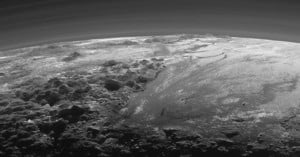
NASA has released a spectacular new photo of Pluto that was captured by its New Horizons spacecraft during the flyby on July 14th, 2015. This latest one shows a near-sunset view of the icy mountains on Pluto surface, poking up on a curved horizon.
Last week, NASA released a number of new close-up photos captured by its New Horizons spacecraft during its historic flyby of Pluto back in July. Many of the images showed the details of specific regions of Pluto's surface.
Back in 2013, five friends in Arizona decided to capture some photos and video from the edge of space by sending a GoPro up on a weather balloon. The camera made it to 98,000 feet, but the guys lost track of it after it landed out of cell phone tower range. All seemed lost, and the team spent months wondering if they'd ever find the camera.
The composite photo above shows the International Space Station zipping across the face of the Sun on September 6th, 2015. Traveling at 5 miles per second and carrying 9 crew members, the Space Station appears as nearly a tiny silhouette in the transit.
NASA's New Horizons probe shot a number of close-up photos of Pluto during the first every flyby back on July 14, 2015. Björn Jónsson took those photos and turned them into this smooth and breathtaking animation of the flyby.
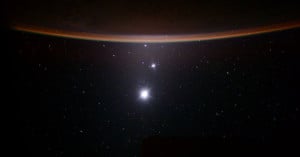
On July 19th, after NASA astronaut Scott Kelly's 114th day on the International Space Station, Kelly pointed his camera out a window and captured this gorgeous photo that shows the Earth, the Moon, Venus, and Jupiter lined up in a row.
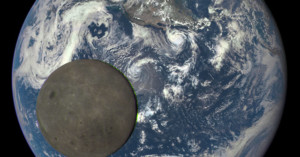
Last month, NASA shared the first full photo of Earth captured with its new DSCOVR camera that's floating 1 million miles away. Today it released another amazing series of shots, with this one showing the moon floating across the face of the Earth. The 20-second video above strings a number of the pictures together.
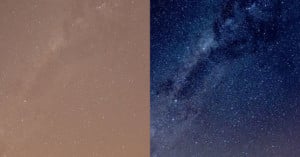
Adobe's new Dehaze slider has been wowing photographers since it was launched for Lightroom and Adobe Camera RAW last month. We've seen what it can do for haze, rainy days, and blizzards, but there's yet another interesting application: enhancing photos of the starry night sky.
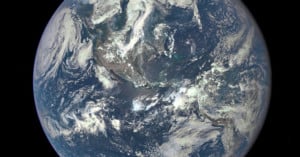
NASA's new Deep Space Climate Observatory Satellite (DSCOVR) has captured its first photo (shown above) of our planet from one million miles away. By comparison, the similar and iconic Blue Marble photo captured by the crew of the Apollo 17 was just 28,000 miles away when that picture was snapped in 1972.
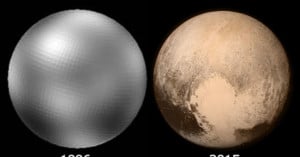
Pluto was first discovered on February 18, 1930, by a 23-year-old man named Clyde Tombaugh, who compared photos captured 6 days apart and discovered the dwarf planet moving between the two shots. Since then, scientists have created numerous photos of Pluto over the years, but none clearer than the ones NASA made over the past week with the New Horizons space probe.
NASA's New Horizons probe dazzled the world with a detailed photo of Pluto today, but another probe has been beaming back stunning shots of space for over a decade already. The Cassini space probe has captured its fair share of eye-popping photos since launching in 1997 and arriving in Saturn's orbit in 2004.
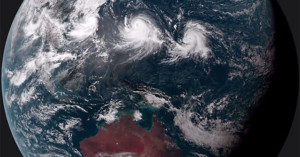
Since late 2014, Japan's Himawari 8 weather satellite has been in stationary orbit above New Guinea, 22,000 miles out (Earth's average diameter is 7,918 miles). It shoots one photo of Earth every 10 minutes, capturing 144 pictures of our planet over the course of a day.
Prior to this year, humankind didn't have a good idea of what Pluto looked like. NASA's New Horizons spacecraft is working to change that. It has been steadily flying toward the dwarf planet over the past many months, and on July 14th, during a flyby, we'll be seeing the first-ever clear photos of Pluto.
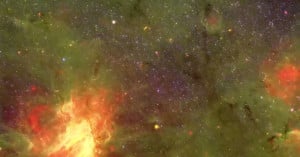
Want to be blown away by the size and beauty of the Milky Way? daveachuk of Vancouver, Canada, created this 8-minute-long flythrough of our galaxy in 3D. It may look like a CGI rendering, but it's not: it's actually the result of combining over 400,000 photos captured by the Spitzer Space Telescope across various wavelengths and over 6 years. Gigapixels upon gigapixels of photos were processed and manipulated over 5 months of spare-time work to create what you see above.
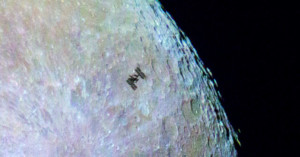
Amateur photographer Dylan O’Donnell recently captured this beautiful photograph of the International Space Station flying across the face of the moon over Australia. The silhouette of the station can be seen in the upper right hand corner.
Saturn has 62 known moons, and NASA recently captured three of the more prominent ones together in the same frame. This photograph, taken by the Cassini spacecraft's narrow-angle camera on March 25, 2015, shows the moons Titan (Saturn's largest moon), Mimas, and Rhea.
Russian urban exploration photographer Ralph Mirebs recently paid a visit to the Baikonur Cosmodrome, where inside a giant abandoned hangar are decaying remnants of prototypes from the Soviet space shuttle program.
Now here's a neat use of Canon's lenses: the University of Toronto owns one of the smallest professional astronomical telescopes in the world that uses an array of photographic camera lenses instead of a single lens. Called the Dragonfly Telephoto Array, it uses ten ordinary Canon 400mm f/2.8L IS II lenses that cost $9,999 each. That's $100,000 in photo gear.
Finnish photographer Tiina Törmänen wanted to capture how small and fragile humans are in the unfathomable expanse of space, so she shot a series of stunning self-portraits showing her silhouette dwarfed by a backdrop of stars and the Northern Lights. The series is titled "Wanderer."
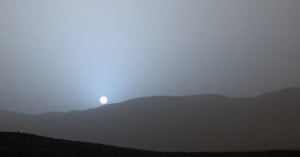
This NASA photo roughly shows what a sunset on Mars would look like to our eyes if we were standing there to witness it. The agency released this true color image after earlier sharing a black-and-white version that was captured by the Curiosity rover in the middle of April 2015.
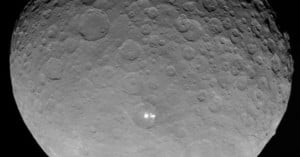
This is the closest photo ever shot of the dwarf planet Ceres, the largest object in the asteroid belt. It was captured on May 4th by NASA's Dawn spacecraft while orbiting from 8,400 miles away.
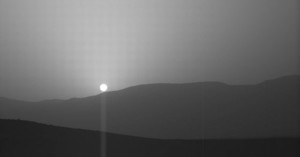
NASA's Curiosity rover on Mars recently captured this surprisingly artistic photograph of a Martian sunset. Mountains in the horizon are seen as silhouettes in a shot that looks like it could have been shot somewhere here on Earth, except in this case, the camera was one that's around 140 million miles away from us.
It's amazing the kinds of space photos that amateur photographers can create from their own backyards these days. Case in point: the high-resolution moon photo above was captured last week by Polish photographer Bartosz Wojczyński. It was stacked together using 32000 separate photos.