Camera Traps Catch Newly Discovered Howler Monkey Crossing Rope Bridge
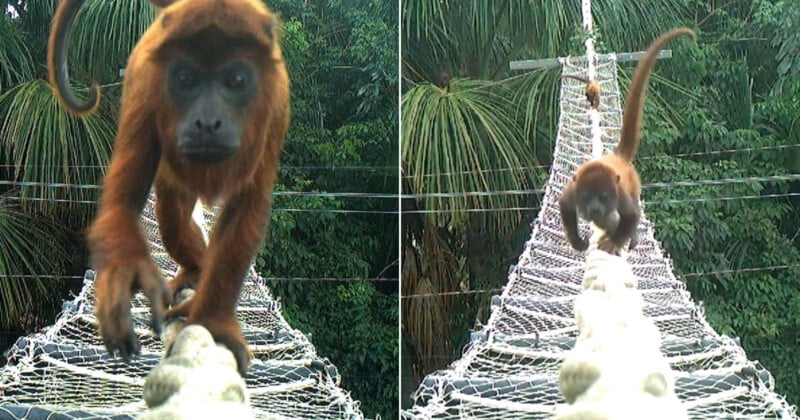
A new species of howler monkey has been discovered in Brazil and has already been spied crossing life-saving rope bridges built by conservationists.
When a new species is discovered in 2026, there are often two viable explanations for why it took so long to be found. First, it is extremely similar to known species and can only be disentangled through complex, time-consuming genetic analysis. Second, the species lives in such a remote place and in such sparse numbers that it has simply never been observed before.
In the latter case, the species is usually already facing an existential threat. Today, to evade detection for so long typically means there are barely any individuals alive.
That’s part of what makes this story about a newly described howler monkey species so special. Yes, it is in low numbers, but heartwarming and effective conservation efforts were already underway long before the species was officially described.
As National Geographic explains, one of the world’s newest howler monkey species, Alouatta matogrossensis, was recently spotted in thousands of camera-trap photos in Brazil. There’s even a fun video clip in Nat Geo‘s story.
Projeto Reconecta is an incredible organization that builds rope bridges across dangerous and busy areas in Brazil, enabling monkeys to safely climb their way across. Many camera traps are set up along these bridges, providing invaluable data to scientists. Most of the subjects in these photos are well-known species, such as capuchins and titi monkeys.
However, when researchers saw Alouatta matogrossensis in their photos, they were blown away.
“We were all amazed that we were providing safe crossing opportunities for a new monkey species,” explains National Geographic Explorer and ecologist Fernanda Abra, leader of Projeto Reconecta.

An international team of scientists recently published their findings in Communications Biology. Study co-author Romina Batista, an evolutionary biologist at the National Institute of Amazonian Research, called the images “super important.”
While it’s great news that Alouatta matogrossensis is using the rope bridges, primatologist, explorer, and study co-author Jean Boubli says that the newly discovered monkeys are likely in “grave danger.”
“They’re found in a place where the forest is at its worst shape in the whole of Brazil,” Boubli says.
“The cities are getting bigger, so there is more agriculture, agriculture fields, cars everywhere,” Abra continues. As National Geographic writes, that means an increased risk of primates being struck and killed by vehicles.
Alouatta matogrossensis is either “endangered or critically endangered,” Boubli adds.
Boubli, who has been exploring the Amazon and studying primates for 30 years, continues to be surprised by the biodiversity of the region. Researchers have identified 16 howler monkey species so far, including a second one detailed in the new study.
Abra’s rope bridges have provided safe crossings for three recently discovered monkey species so far, including the endangered Alta Floresta titi monkey described in 2019, Schneider’s marmoset discovered in 2021, and now the new howler monkey.
What new species might cross Abra’s rope bridges next?
Image creditsReconecta Institute/SNZCBI
Affiliate Disclosure PetaPixel articles may include affiliate links; we may earn a commission if you buy through one.