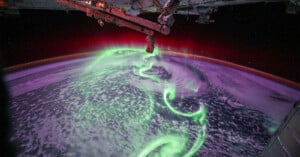
Astronaut Captures Spectacular Aurora Lights Dancing Above the United States
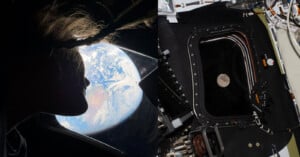
"I've never seen aurora from below, but up here, it's a frequent show," says astronaut Zena Cardman, who currently resides onboard the International Space Station.
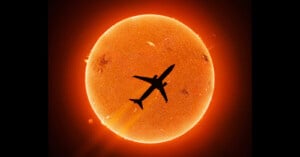
Astrophotographer Andrew McCarthy has captured a stupendous shot of a skydiver falling in front of the Sun. It was incredibly difficult -- requiring precise planning and coordination -- but the pair ultimately pulled it off on the sixth attempt.
The night sky will feature a striking sight this week as a supermoon rises on Wednesday (November 5) -- the largest and closest full moon of 2025.
The NASA/ESA/CSA James Webb Space Telescope got into the spooky season spirit this week by capturing a "cosmic creepy-crawly called NGC 6537," more commonly referred to as the Red Spider Nebula.
Comet C/2025 A6 (Lemmon) made its closest pass to Earth this week and was even visible to the naked eye. Humanity may not see it again for another 1,300 years.
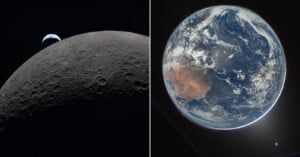
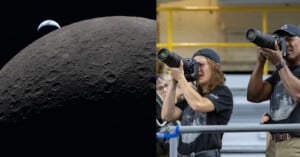
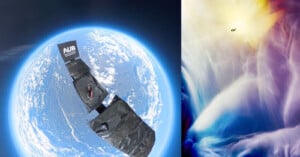
A team of scientists and artists sent a modified Insta360 camera to the edge of space, capturing breathtaking images meant to inspire people to reconnect with Earth.
The International Space Station's social media accounts have been silent since October 1, coinciding with the U.S. government's shutdown and starving fans of awesome space photographs.
While out photographing the dark skies of New Zealand last weekend, the heavens aligned for Dan Zafra as he captured lightning sprites appearing in front of the galactic core of the Milky Way.
Photography is all a matter of perspective: one angle is visually uninteresting and doesn't tell a story, but another viewpoint of the same subject is alive with emotion and meaning.
If there are two things people love, it's adorable cats and awesome space photos. Therefore, it makes complete sense for astrophotographer Andrew McCarthy to combine his stunning work with his adopted cat, Gregory.
Astronaut Don Pettit splashed back down to Earth in April, and he is still "throttling down" from his six-month voyage on board the International Space Station -- and that includes sifting through the troves of videos and photos he captured while in orbit.
NASA's Perseverance rover captured an unusually shaped object flying through the Martian sky on Saturday -- and it's not yet confirmed what it is.
Astronomers have captured the clearest image ever of the vast, powerful jet of matter erupting from the supermassive black hole at the center of the galaxy Messier 87 (M87).
Ever since Amelia Earhart vanished while attempting to become the first woman to circumnavigate the globe in 1937, people have been desperate to find out what happened to her.
The 2025 Astrophotography Prize has revealed its field of winners, a competition dedicated to the "education and the continual improvement of astrophotography."
French smart telescope company Vaonis has announced the Vespera II X_Edition, a new limited edition version of its standard Vespera II smart telescope. The X_Edition promises to embody the mechanical and optical precision for which the Vespera series is known.
Satellite photos reveal how a devastating hailstorm that swept across Canada last month left a 125-mile-long "scar" visible from space.
The NASA/ESA/CSA James Webb Space Telescope's (JWST) latest images reveal a colorful array of stars in the relatively nearby Sagittarius B2 molecular cloud, the most active and massive star-forming region in the Milky Way galaxy.
Alaska’s newest island can now be seen from space in recently released satellite photographs from NASA.
Today marks the autumnal equinox, the astronomical date when fall begins and summer ends. It's a special date for keen skywatchers, including Luca Vanzella and Alister Ling who recently completed an ambitious photographic project charting the swing of the Sun and the Moon over one year.
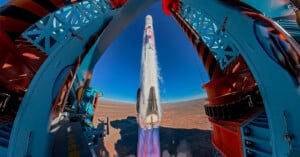
Jeff Bezos showed off a new free-flying camera deployed from Blue Origin's New Shepard launch, which gives a spectacular view of the rocket high above Earth.
Astrophotographer Andrew McCarthy used a specially designed solar telescope attached to an astronomy camera to capture a unique image of a SpaceX rocket blasting off into orbit in front of the Sun.
An unexpectedly strong geomagnetic storm triggered aurora lights in skies across the US last night, seen as far south as Arizona.
A SpaceX Starlink satellite was recently photographed passing over China’s secretive Dingxin Airbase, appearing in an image captured by a commercial Earth-observation satellite.
The Royal Observatory Greenwich's ZWO Astronomy Photographer of the Year 17 contest showcases the best astronomical and night sky images of the year, captured by exceptional photographers worldwide. This year's winning photos include spectacular shots of distant galaxies, unique images of the Sun, magical nightscapes on Earth, and much more.
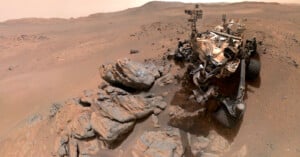
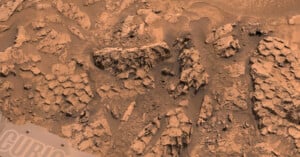
NASA’s Perseverance rover has taken high-resolution images of unusual rocks on Mars that could represent the strongest evidence yet of possible ancient life.
With the upcoming blood moon eclipse this weekend, astrophotographer Andrew McCarthy has revealed a unique image he took during the last total lunar eclipse earlier this year.
The latest James Webb Space Telescope (JWST) image delivers a "glittering glimpse of starbirth," the European Space Agency explains.
NASA's Mars Perseverance Rover has been exploring Jezero Crater on Mars since it landed on the planet on February 18, 2021. Since then, it has made many remarkable discoveries and captured hundreds of thousands of incredible photos. A recent photo shows a close-up of a Martian rock, it looks a lot like a turtle.
A few weeks after the Hubble Space Telescope captured an incredible photo of comet 3I/ATLAS as it screamed through the solar system at a blistering 130,000 miles per hour (209,000 kilometers per hour), the Gemini Multi-Object Spectrograph (GMOS) on Gemini South in Chile set its sights on the comet, capturing a gorgeous, colorful photo unlike anything seen before.
The NASA/ESA/CSA James Webb Space Telescope (JWST) peered at the Butterfly Nebula using its Mid-InfraRed Instrument (MIRI) camera, uncovering never-before-seen details of the nebula's heart. This is the first time scientists have seen the super-hot star powering the beautiful, bug-like nebula.
Studying the Sun is crucial for monitoring space weather, as events like coronal mass ejections (CMEs) can disrupt satellites, power grids, and GPS navigation. And yet this scientific research can create beautiful art.
A fake video showing the "night sky on Mars" allegedly filmed by NASA's Curiosity Rover has fooled thousands on TikTok and even a couple of news websites.
NASA's Solar Dynamics Observatory (SDO) recorded an incredible solar prominence eruption yesterday, and experts are calling the event one of the best, most spectacular events of the current solar cycle.
A camera attached to the International Space Station (ISS) has captured a frightening view of Hurricane Erin, which meteorologists fear will bring life-threatening storm surges to the United States this week.
An extremely bright meteor lit up the night sky over Japan on Tuesday night. It could be seen from hundreds of miles away.
A team of scientists led by the Southwest Research Institute (SwRI) discovered a new moon orbiting the ice giant planet, Uranus, using the James Webb Space Telescope.
DarkSky International announced the winners of its fifth annual Capture the Dark photography contest. Winners across eight main categories showcase the best in astrophotography and demonstrate why it is vital to protect dark skies worldwide.
Clear days on Mars don’t come around often. Most of the time a steady haze of dust hangs in the air, giving the Red Planet its signature rusty glow.
A meteorite that was captured on video in broad daylight and that punctured a homeowner's roof is thought to be 4.56 billion years old -- older than Earth itself.
Astronomers used NASA's Hubble Space Telescope to capture the sharpest-ever photo of the comet 3I/ATLAS as it flew through the solar system at 130,000 miles per hour (209,000 kilometers per hour).
NASA’s Curiosity rover has captured photographs of a rock on Mars that closely resembles coral found on Earth.
Insta360 announced the X5 Satin White Limited Edition 360-degree camera, a sleek new design for its flagship camera. To mark the occasion and test new accompanying neutral density (ND) filters, Insta360 promptly launched its white X5 camera into the upper stratosphere, nearly 25 miles above Earth's surface.
The Hubble Ultra Deep Field is one of the most iconic space photos of all time, showing nearly 10,000 galaxies of diverse ages, sizes, shapes, and colors in a single frame. The James Webb Space Telescope (JWST) revisited the same region of the sky, capturing its longest exposure of an extragalactic field with a single filter yet and revealing one of the deepest views ever of the ancient Universe.
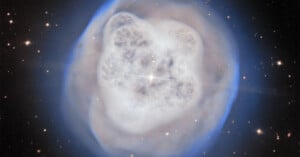
The James Webb Space Telescope's (JWST) newest images offer a dazzling preview of the Sun's eventual fate.
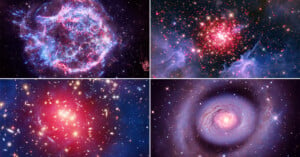
NASA just released a jaw-dropping collection of nine new images captured by its flagship X-ray telescope, the Chandra X-ray Observatory. The Universe looks wild in X-ray light, and scientists can study many fascinating cosmic phenomena in X-rays that are impossible to see across other wavelengths, including visible and ultraviolet light.
Floating 258 miles above, NASA astronauts on board the International Space Station have a view like no other and can therefore photograph Earth in unique ways.
NASA's Hubble Space Telescope and Chandra X-Ray Observatory may be relatively old space observatories, but that doesn't stop them from making groundbreaking cosmological discoveries. The two telescopes just spotted an extremely rare type of black hole currently eating a star in space.
An amateur astrophotographer captured a remarkable shot showing the International Space Station (ISS) and Saturn in the same frame.
The Juno probe has been capturing spectacular images of Jupiter since 2016. However, it recently encountered problems that required NASA to perform a camera repair on JunoCam from 370 million miles away.