This Is the Most Detailed Photo of the Milky Way’s Center Ever Taken
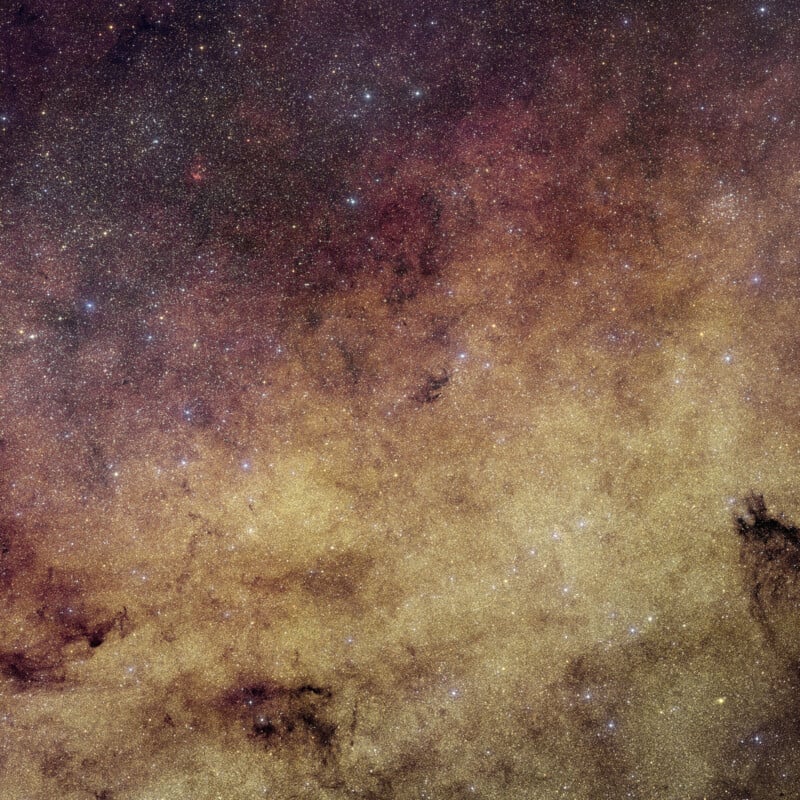
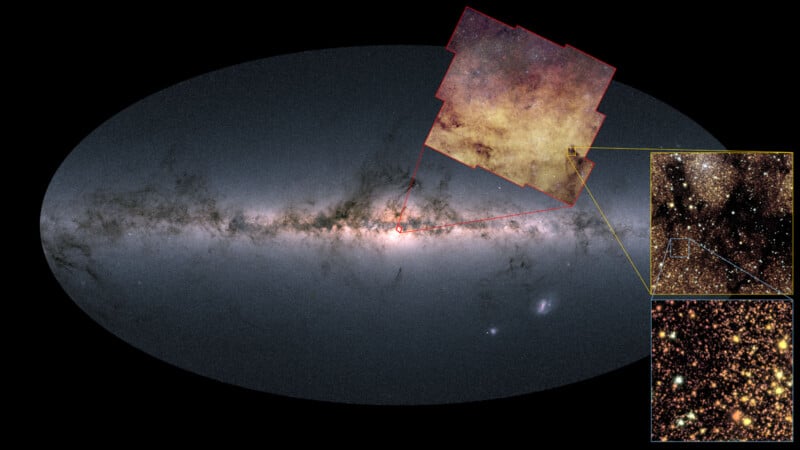
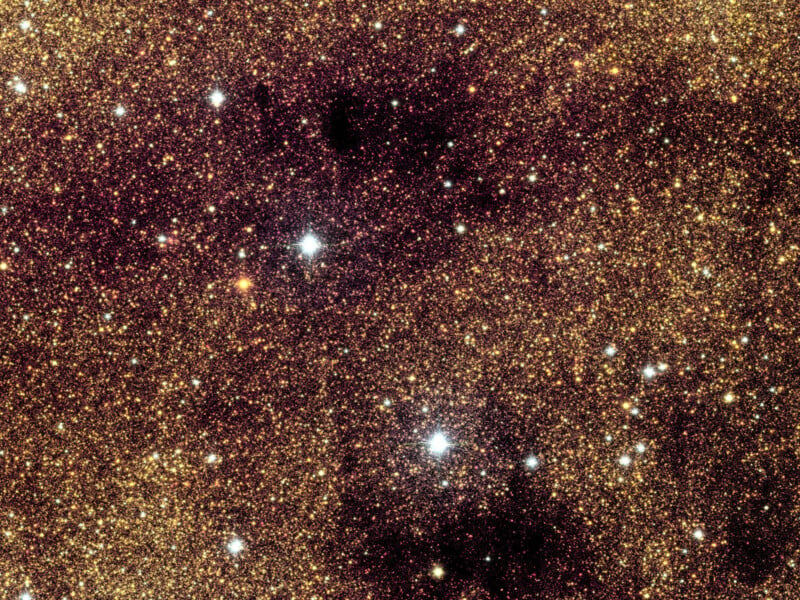
For just over a single day, the European Space Agency’s (ESA) cutting-edge Euclid Space Telescope pointed its lens toward the relatively close and extremely bright inner region of the Milky Way galaxy, known as the galactic bulge. The space telescope made good use of its time, capturing the largest and most detailed photo ever of the Milky Way’s galactic center.
Packed with more than 60 million stars, the Milky Way’s “crowded heart,” as ESA puts it, has never looked so good. It is just a blanket of color and light, with almost no blank space whatsoever.
The full-resolution is 18,000 by 18,000 pixels, which makes it a staggering 324 megapixels.
Although Euclid is designed to photograph extremely distant objects rather than its home galaxy, its visible-light camera is extremely high-resolution and very sensitive, making it well-suited to just about any cosmic exploratory task. What’s especially important about Euclid’s imaging system is that it can look directly at stars, even nearby ones, without being blinded. This enables scientists to use techniques like microlensing to find exoplanets, which are often challenging to spot due to their darkness and proximity to relatively bright host stars.
This is a very important scientific part of Euclid’s new Milky Way photo. The image mission let scientists study microlensing on a much smaller scale, where this distinct form of gravitational lensing is caused by individual stars and exoplanets in “our own galaxy.”
“To catch microlensing, you need to observe parts of the sky that are crowded with stars, such as close to the center of our galaxy,” explains Jean-Philippe Beaulieu of the Institut d’Astrophysique de Paris in France and the University of Tasmania in Australia. Beaulieu was the impetus behind Euclid’s new galactic bulge survey and co-led the exoplanet group in the Euclid Consortium.
“During the last twenty years, almost 300 exoplanets have been discovered using this technique, all with ground-based telescopes and all towards the center of our galaxy. This image from Euclid includes 51 known planetary systems — and it will assist in studying many more that will be found,” Beaulieu concludes.
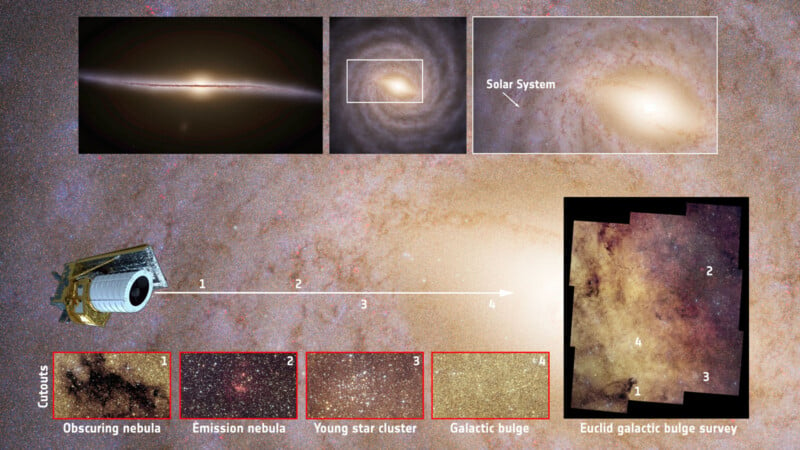
ESA says that Euclid captured its enormous new Milky Way photo during a 26-hour observation on March 23, 2026. It is a mosaic of nine individual “pointings,” or images, and each photo captured a patch of the sky larger than the full Moon.
From a pure sharpness and sensitivity perspective, Euclid’s visible-light camera is similar to the Hubble Space Telescope’s Wide Field Camera (WFC), but what sets Euclid apart is how much larger an area it captures. Each Euclid image (pointing), captured in a few hours, covers an area 270 times larger than Hubble’s field of view.
“Euclid is faster, and able to capture details from fainter stars that would be otherwise missed when observing from the ground,” ESA says. “This single mosaic also encompasses the entire region that the upcoming NASA Nancy Grace Roman Space Telescope will monitor for planet hunting.”
During its 26-hour mosaic, Euclid captured all the stars that will be included in all of Roman’s future microlensing events. Euclid’s data will prove instrumental during that and all future exoplanet missions in the region.
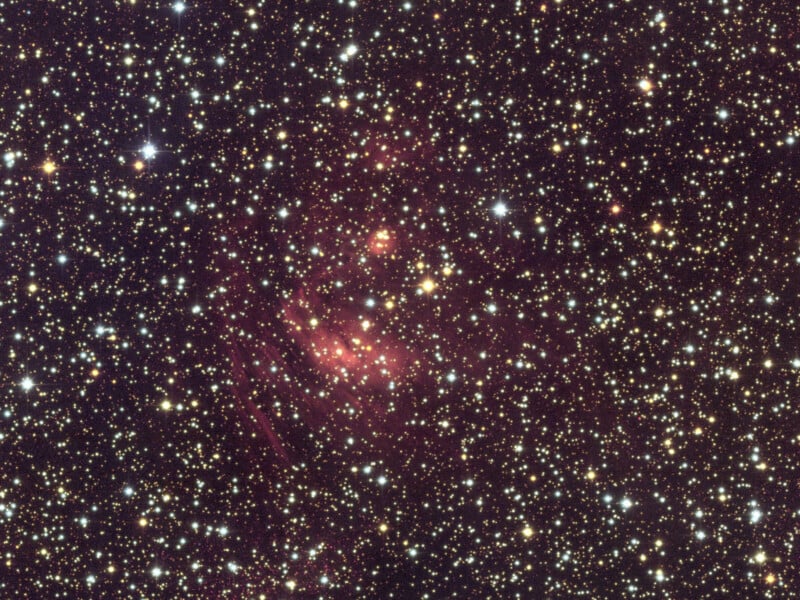
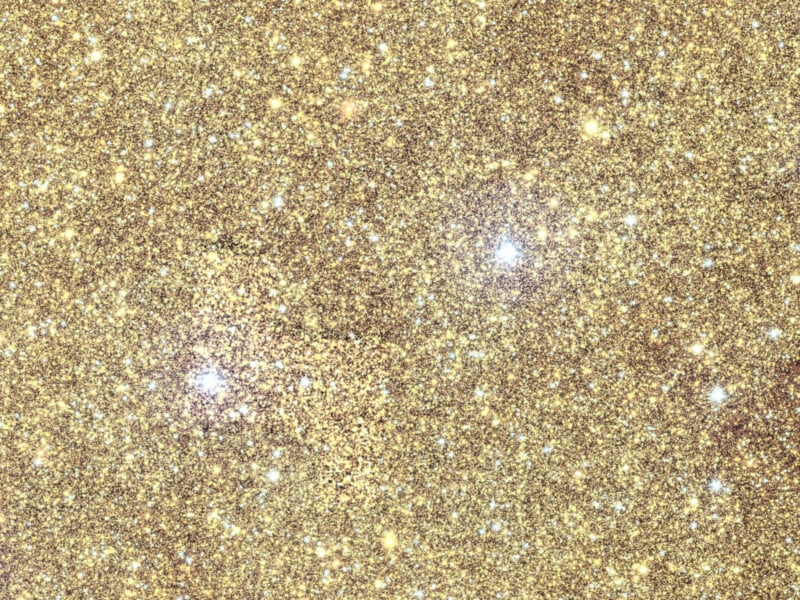
As the European Space Agency explained on Threads, there are so many interesting things to see in Euclid’s record-breaking mosaic, including deceptive and dense clouds of dust and gas, baby nebulae, and a huge cluster of suns.
View on Threads
“This means that anyone who detects a microlensing event in the same region, for example with Roman, will be able from now on to use Euclid data as a time reference in the past and see how the stars looked before they overlapped,” explains Natalia Rektsini of the Institut d’Astrophysique de Paris in France. Rektsini led the release of Euclid’s galactic bulge survey data for the broader scientific community.
“Since Euclid can clearly separate individual stars, one can then measure how fast they move over time and use that information to confirm the existence of a planet and determine its mass. This would not be possible with data from one point in time,” she continues.
Image creditsESA/Euclid/Euclid Consortium/NASA, CFHT, image processing by J.-C. Cuillandre and E. Bertin (CEA Paris-Saclay). The high-resolution image can be explored in ESA Sky.
Affiliate Disclosure PetaPixel articles may include affiliate links; we may earn a commission if you buy through one.