
NASA’s Exoplanet Hunter Reveals its Most Complete Look at the Night Sky
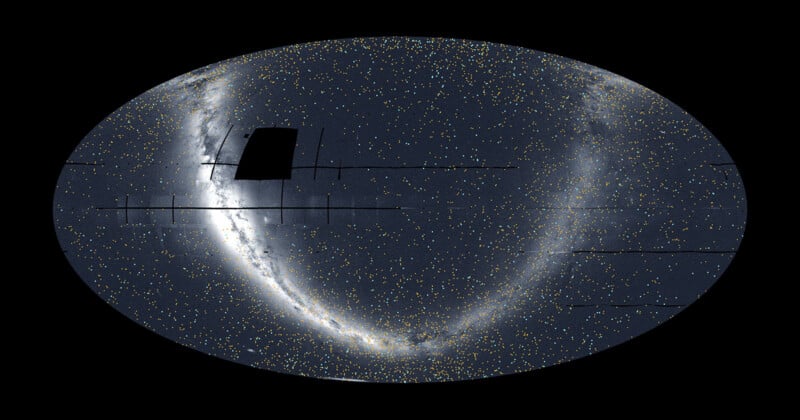
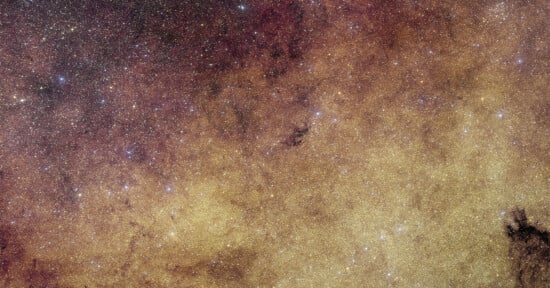
NASA’s Transiting Exoplanet Survey Satellite (TESS) has released a new mosaic that offers its most complete view of the night sky yet. Captured over eight years, the all-sky mosaic includes 679 confirmed, newly discovered exoplanets and nearly 5,200 candidate exoplanets.
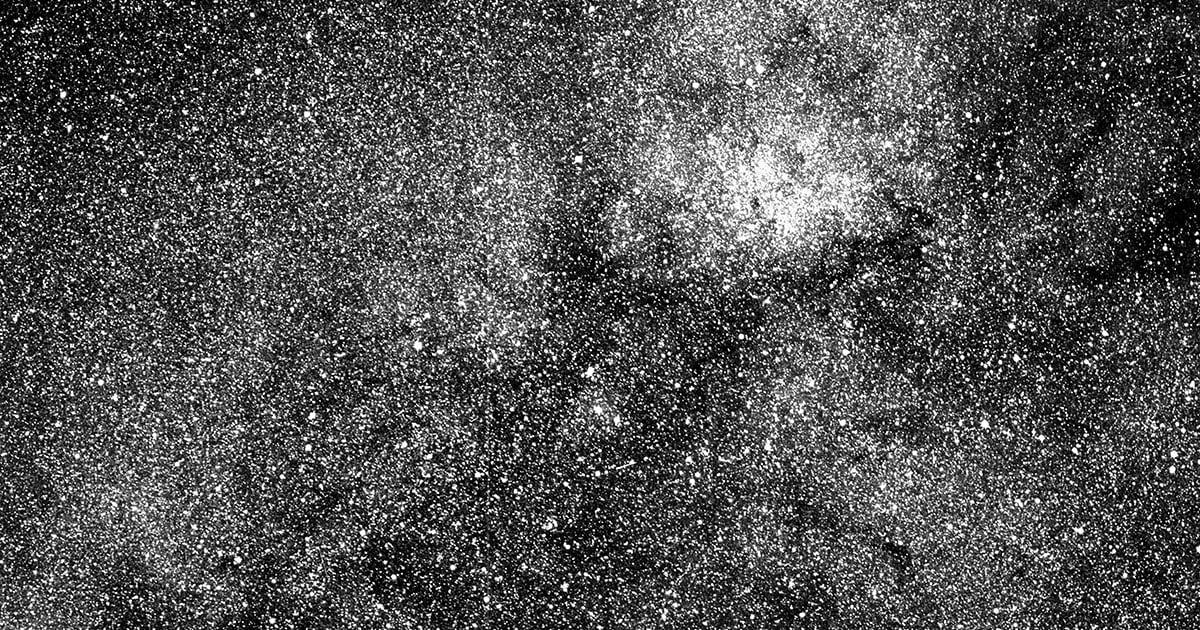
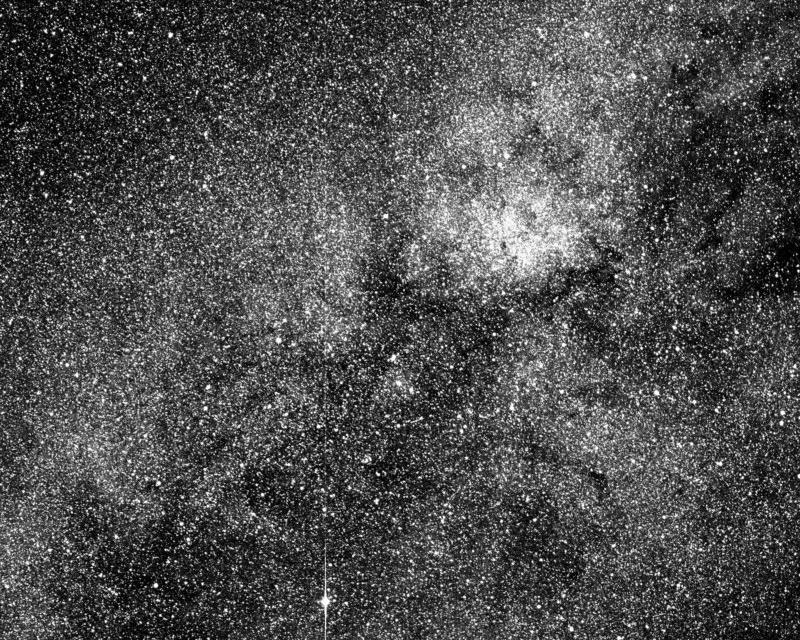
NASA’s planet-hunting satellite shared its first photo back in May 2018, showing off a dazzling starfield with over 200,000 stars. In the next two years, TESS captured 400 times as much of the night sky as seen in its first photo below. It has since captured nearly the entire night sky.
The mosaic above was built using 96 TESS sectors, featuring images captured from April 2018 through September 2025, when the mission’s second extended mission ended.
“Over the last eight years, TESS has become a fire hose of exoplanet science,” says Rebekah Hounsell, TESS associated project scientist at the University of Maryland, Baltimore County, and NASA’s Goddard Space Flight Center. “It’s helped us find planets of all different sizes, from tiny Mercury-like ones to those larger than Jupiter. Some of them are even in the habitable zone, where liquid water might be possible on the surface, an important factor in our search for life beyond Earth.”
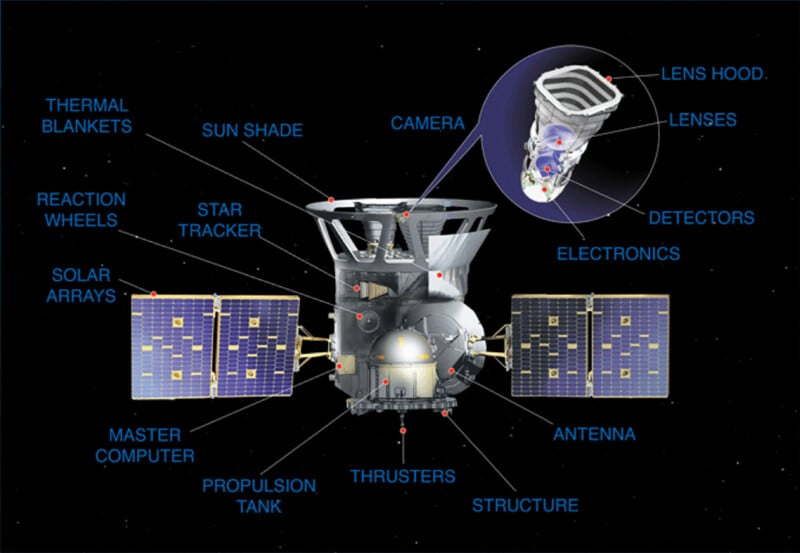
TESS photographs each of its sectors for about a month using its four onboard cameras. Each of the four identical cameras features four CCD sensors and seven different lenses. Each of the CCD sensors captures an area of the sky that could hold 576 full Moons, NASA explains.
MIT describes the four cameras as “highly optimized, red-sensitive, wide-field cameras that together can monitor a 24 degree by 90 degree strip of the sky.” The cameras monitor each strip of the sky for 27 days and nights with a two-second cadence. The cameras feature custom, fast f/1.4 lenses and 4,096 x 4,096-pixel back-illuminated sensors built by MIT/Lincoln Lab.
The blue dots in NASA’s new image mark the locations of 679 confirmed exoplanets, as of September 2025.
“This menagerie includes worlds that may be covered by volcanoes, are being destroyed by their stars, or orbit two stars — experiencing double sunrises and sunsets each day,” NASA explains.
The 5,165 orange dots are candidate exoplanets yet to be confirmed.
Also prominently featured in the mosaic is a bright portion of the Milky Way, shown as a brilliant arc. There are also two bright white ovals in the image, both on the left-hand side of the frame. These are the Large and Small Magellanic Clouds, located approximately 160,000 and 200,000 light-years away from Earth.
“The more we dig into the large TESS dataset, especially using automated algorithms, the more surprises we find,” adds Allison Youngblood, the TESS project scientist at NASA Goddard. “In addition to planets, TESS has helped us study rivers of young stars, observe dynamic galactic behavior, and monitor asteroids near Earth. As TESS fills in more of the night sky, there’s no knowing what it might see next.”
Image creditsNASA/MIT/TESS and Veselin Kostov (University of Maryland College Park)
Affiliate Disclosure PetaPixel articles may include affiliate links; we may earn a commission if you buy through one.