
A NASA Photo Processing Technique to Study Mars Has Discovered Ancient Art on Earth
A rock art enthusiast used an image processing technique that scientists at NASA’s Jet Propulsion Laboratory developed to improve the detail of satellite photos of Mars’ rocky surface to reveal ancient, faded artwork here on Earth.
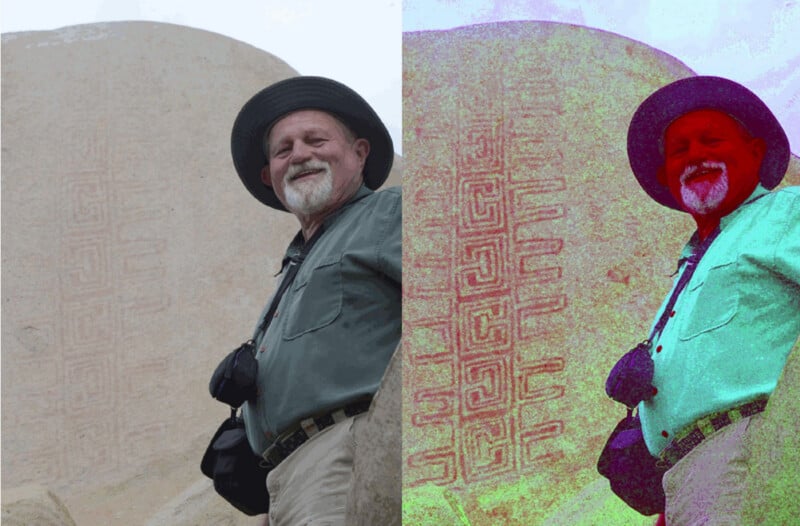
Jon Harman loves history, including rock art. This started back in the 1980s, when one of Harman’s friends took him on a few field trips with local rock art groups. The mysteries of ancient rock art, like cave paintings, for example, immediately enthralled Harman. He carried this love through the decades.
Fast forward to a rock art conference in 2005, just over 20 years ago, and someone showed Harman photos from NASA’s Mars Exploration Rover webpage that showed the dramatic effect of an image-processing technique called a “decorrelation stretch.”
As a 2005 NASA JPL webpage explains, a decorrelation stretch is a “visualization tool to enhance the color variations among objects within a scene.”
“The effect of the process is to obtain an output image whose pixels are well distributed among all possible colors, while preserving the relative sense of the hue, saturation, and intensity of the input image,” JPL continues.
When studying surface variations on Mars, every bit of extra detail helps reveal the Red Planet’s geology and history. This same idea can apply to other faded, hard-to-untangle details in images, like rock art, as Harman immediately thought.
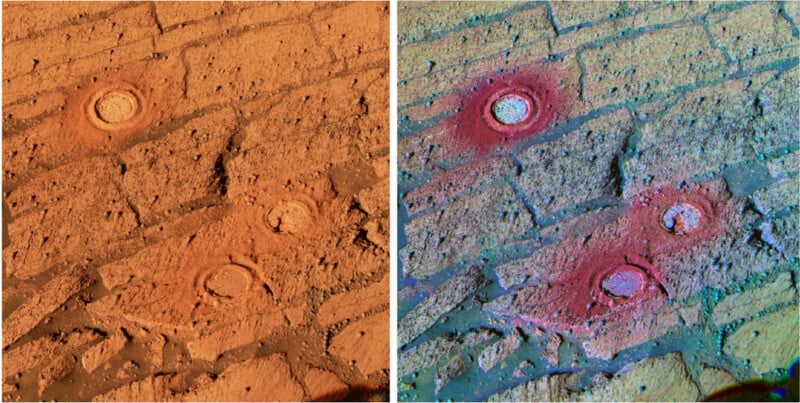
“Seeing how much detail the technique revealed, [Harman] understood the implication for studying ancient, faded images,” NASA writes.
Thanks to his background in medical imaging and a PhD in mathematics, Harman knew he could use NASA’s decorrelation technique as soon as he started poring over a NASA research paper.
“I Googled it and found a NASA paper that explained how to do the algorithm,” Harman says. “I knew from my medical imaging experience that I could do it, so I did.”
Harman got to work developing the Dstretch plug-in, which eventually became Dstretch apps on Android and iOS.
“Rather than simply raising the contrast between colors, decorrelation stretch maps the original colors to a different, expanded range of colors. It’s a complicated process that includes steps like diagonalizing color matrices,” NASA says.
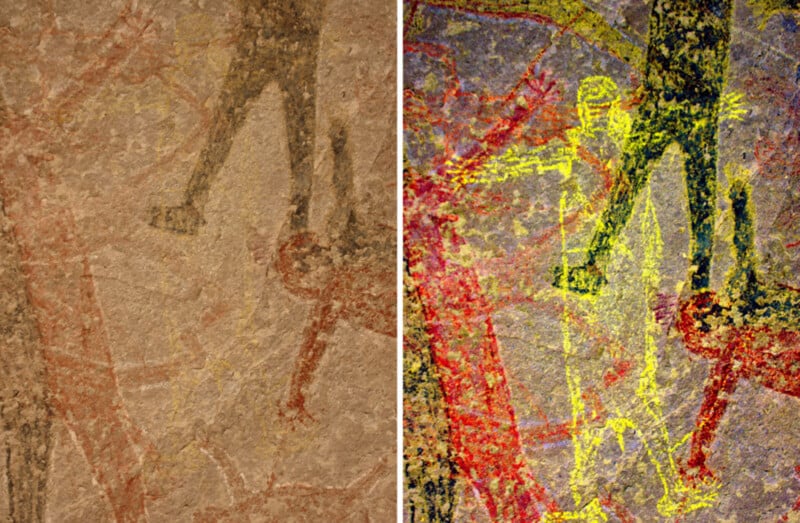
Harman first used Dstretch on photos he had taken of rock art in Baja California, Mexico. The algorithm effectively rescued a yellow figure from nowhere.
“That convinced me of the usefulness,” Harman says. “Then I started playing around and found that by changing the color space I was working in, I could get good results in different images.”
Others quickly learned they could get great results with Dstretch, too, including archeologists worldwide. Harman’s image processing app, built on NASA’s work with Mars photos, has been used to discover undocumented figures and artwork in places like Egypt, Canada, Greece, and more. Dstretch has even been used to enhance images of tattoos on mummified remains.
“I’ve been surprised by a lot of the different applications people have found. So that’s been cool,” Harman says.
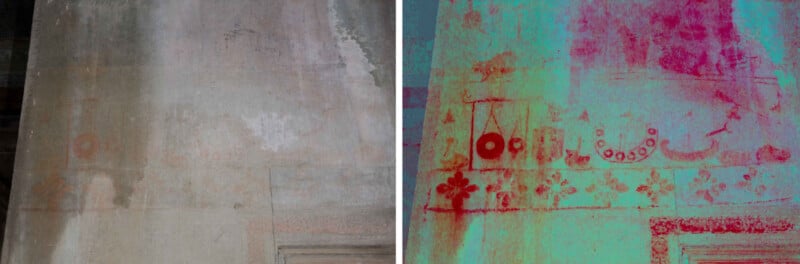
One of Dstretch’s biggest accomplishments came in 2010-2012, when Singaporean archaeologist Noel Hidalgo Tan used Dstretch to discover more than 200 faded paintings around the Angkor Wat temple complex in Cambodia.
Image creditsNASA, Jon Harman, Noel Hidalgo Tan
Affiliate Disclosure PetaPixel articles may include affiliate links; we may earn a commission if you buy through one.