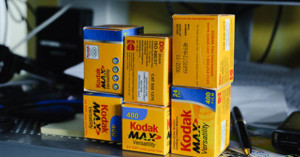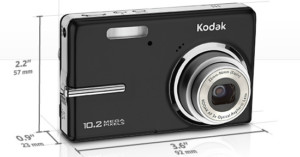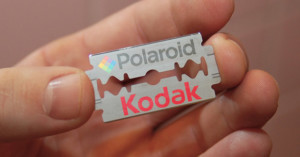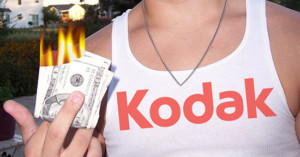
Shocking news: Kodak, the company that invented the first digital camera back in 1975, announced today that it is pulling out of the camera market entirely. The phasing out of digital cameras, pocket video cameras, and digital picture frames will likely happen by the end of June. Instead, the company will be focusing on licensing out its patents and brand name (much like Polaroid does), and on inkjet photo printing. Although Kodak wasn’t a big player in the digital camera space, it was once a dominant camera maker in the days of film. The original Kodak Brownie helped popularize consumer photography and introduced the concept of the snapshot.

Kodak Theatre, the famous theater on Hollywood Boulevard that hosts the Academy Awards, may soon have a different name. As part of its recent bankruptcy filing, Kodak is now trying to get out of the 20-year, $75-million-dollar naming rights contract it signed back in 2000. The theatre’s about page states,
The naming of Kodak Theatre, in a 20-year marketing partnership with Eastman Kodak Co., was one of the most significant non-sports corporate sponsorships in history. Kodak’s prominence and long-standing connection to the film industry in Hollywood made the relationship a natural. In fact, for the 78th consecutive year, ever since the inception of the Academy Awards, Best Picture was produced on Kodak film.


The next annual payment owed by Kodak is reportedly $4 million.
Perhaps inspired by the vintage camera nightlights we shared last year, photographer Laura Merz decided to upcycle her old Kodak digital camera by turning it into a nightlight for her house. She writes,
I took out all the tiny screws and gutted the camera very carefully as to not crack the exterior case. Be careful — some of the parts are pretty sharp. Removing the lens is the last step, and allows you to insert a small round night light through the opening. I had to crack off the exterior casing on the night light, but with a little force, it snapped right off.
It’s a creative way to breathe new life into an outdated or broken digital camera.
Bloomberg writes that Kodak’s bankruptcy announcement yesterday was simply another step in CEO Antonio Perez’s grand plan to sell off the company’s photography divisions and patents in order to focus on selling digital printers and ink. At the same time, the company has been quick to reaffirm its dedication to producing film. Kodak marketing director Audrey Jonckheer was quoted by BJP today as saying,
Film (still and cinema) remains a profitable business for Kodak, and we have the broadest and most respected portfolio of films in both segments. We have taken steps to sustain the business as it has declined, and we know that there are hundreds of passionate fans of film for the artistic and quality reasons they cite. We remain committed to make film as long as there is profitable demand for it. And as I noted, it is still profitable.
That’s definitely good news for film photography lovers. Want film to survive? Just keep buying it, and hope other shooters do the same!
Here’s a video that’s fascinating in light of Kodak’s bankruptcy announcement today. It was created back in 2006 for the company by partners+napier, and was shown at the All Things Digital Conference in California before Kodak CEO Antonio Perez took the stage to talk about the company’s digital transformation. The predictions made in the video are seemingly prophetic, accurately describing the current landscape of digital and mobile photography. It’s too bad that Kodak couldn’t right its ship, even though it had a good idea of where things were headed.
Well, the rumors were true: today the iconic photography company Kodak announced that it has filed for Chapter 11 bankruptcy protection. What this means is that the company is given permission to continue its normal operations as it struggles to restructure and transform into a sustainable business. While we probably won’t see the death of the Kodak brand, the company has stated that it intends to transform into “a lean, world-class, digital imaging and materials science company”, and that they’re planning to sell off “significant assets” during this process. It remains to be seen whether Kodak continues to play a significant role in film photography once it emerges out the other end of bankruptcy protection (if it ever does).
The Economist has a fascinating piece looking at the similarities and differences between Kodak and Fujifilm, two juggernauts of film photography that took different paths when digital photography came around:
While Kodak suffers, its long-time rival Fujifilm is doing rather well. The two firms have much in common. Both enjoyed lucrative near-monopolies of their home markets: Kodak selling film in America, Fujifilm in Japan. A good deal of the trade friction during the 1990s between America and Japan sprang from Kodak’s desire to keep cheap Japanese film off its patch.
Both firms saw their traditional business rendered obsolete. But whereas Kodak has so far failed to adapt adequately, Fujifilm has transformed itself into a solidly profitable business, with a market capitalisation, even after a rough year, of some $12.6 billion to Kodak’s $220m. Why did these two firms fare so differently?
Many potential buyers are also weighing the value of Kodak’s brand-name since there’s been a lot of talk that it may consider filing for bankruptcy. For now the company plans to restructure out of court.
Kodak’s brand name (not its patents) could easily generate more than double Polaroid’s sales price, said Jamie Salter, the CEO of Authentic Brands. “There are a lot of categories that Kodak could attach its name to. People would feel very comfortable using Kodak paper,” said Salter.
Like Polaroid, Kodak has brand cache all over the world offering potential buyers the opportunity to tap global markets.
The Polaroid brand name sold for $88 million in 2009 after Polaroid the company declared bankruptcy in 2008.
Kodak might be on its deathbed, but that’s not stopping the company from launching a new volley of lawsuits over patent infringements. Already trying to milk $1 billion from Apple, the company has filed new lawsuits against smartphone makers Apple and HTC, alleging that Apple violated four of its patents and HTC five. The lawsuits center around technology for transferring photos on and off devices. While today’s lawsuits might simply be a creative marketing effort in Kodak’s attempt to sell off its patent portfolio, the market seems pleased with it: the stock price jumped nearly 40% today.
Kodak was warned by the New York Stock Exchange yesterday that its stock will be delisted if its price remains under $1 for the next six months. The stock has had an average closing price of below $1 for over 30 consecutive days now, and is no longer compliant with the NYSE’s requirement for minimum share price. Sadly, the company might not last another six months: the Wall Street Journal reported today that the company is now preparing to file for bankruptcy, which will likely happen in the coming weeks unless the company succeeds in its efforts to sell its 1,100 digital imaging patents. The revelation added insult to injury as the stock price plummeted another 28% today.