A bride and groom walk down the aisle outdoors while guests cheer. They're surrounded by palm trees, with an arch adorned with flowers in the background. Guests are seated on white folding chairs, and the setting is grassy and tropical.

Tips for Photographing a Wedding Ceremony

The wedding ceremony is arguably the most important part of a wedding day. Seeing as it’s the part of the day you don’t get a do-over on, for a photographer it can be stressful to nail great shots of the key moments. That’s why today I’m sharing some wedding photography ceremony tips from over a decade of experience shooting ceremonies.

Screenshot of a webpage from Moment featuring camera lenses and accessories. A banner shows a photographer using a camera. Below, there are lens categories like Sony E Mount and Fuji X Series, with images of specific lens products displayed for sale.

New Membership Perk: $15 Off at the Moment Shop

We recently launched Memberships for those of you who would like to directly support our publication while receiving a banner-ad-free experience at the same time. We also promised that additional perks would be added over time, and today we're announcing the first one.

A Leica M6 camera with a classic black design is shown from the front. The camera has textured grips, a lens attached, and a red Leica logo above the lens, with a bright glare effect over the lens.

A New Light Meter for the Old Leica M6

The Leica M6 is one of the company's most popular cameras. Built from 1984 to 1998, it proved to be so desirable that two years ago, Leica reintroduced a modestly revised version at a time that no other marque is building new, professional 35mm film cameras.

Two Sony Alpha mirrorless cameras side by side on a yellow-orange gradient background. The cameras have prominent lenses with silver edges and dials on top.

The Biggest Differences Between the Sony a1 and the New Sony a1 II

Sony has a new flagship camera, the Alpha 1 Mark II. However, while the a1 II brings a lot of improvements, it is not a wholesale revolution compared to its predecessor, which was admittedly way ahead of its time when it launched in early 2021. So, what's new with the a1 II? How is it better?

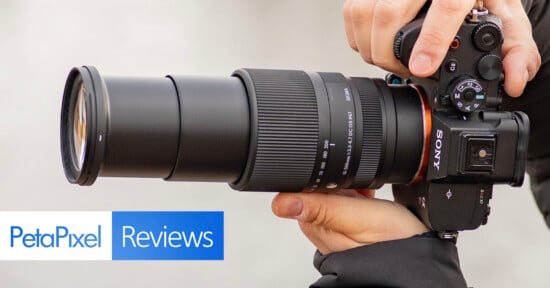
Sony 28-70mm f/2 GM Review: One of the Best Lenses Ever Made

A person holding a Sony camera with a large lens in a dimly lit street, smiling slightly. The background features illuminated signs and blurred lights. Overlay text reads "PetaPixel Reviews.

I’m an outlier in the photo world, especially regarding glass. I dislike the 35mm focal length, and as much as I love a good 24mm lens, a 28mm lens is even better. Maybe this is why I immediately gravitated to the quirky Canon RF 28-70mm f/2 zoom when it first came out. Despite its massive form factor, this bulbous gem of a lens quickly became a favorite of mine.

A Sony Alpha mirrorless camera is displayed against a dark background. The camera's body, with its lens mount visible, is highlighted, showcasing its sleek design and textured grip.

Sony’s New a1 II Pairs Updated Design With Largely Familiar Performance

The Sony a1 series has been in a slightly awkward position since the a7R V and a9 III landed, each sporting a new dedicated artificial intelligence processor and improved autofocus features. The a9 III especially brought a lot to the table, including an excellent new design and user experience. Finally, Sony's flagship camera has these new features, bringing much-needed modernization.

Sony a1 II Hands-On First Impressions: Expensive Excellence

A photographer with a large telephoto lens takes a picture at a crowded outdoor sports event. The stadium is filled with spectators, and a large screen is visible in the background. The image has a "PetaPixel Hands-On" text overlay.

The original Sony a1 is one of the most capable, advanced, and expensive flagship cameras ever. When it first came out, it wowed potential buyers with a fast-scanning 50-megapixel sensor without major rolling shutter issues while offering fast burst rates. It has been almost four years since then, and now we have a version II from Sony in our hands. Does the apple fall far enough from the tree to make it worth the $6,500 cost?

Left image: A person wearing a beanie and brown pants stands on a wooden bridge, placing a camera into a black shoulder bag. Right image: A person in a blue jacket with a black backpack stands in a snowy landscape, photographing mountains.

Deal Alert: Save 15% on Select ProMaster Camera Bags and Gloves

ProMaster products are designed and developed in the US by a small team of enthusiastic photographers for fellow creatives, storytellers, artists, and adventurers. Each product is thoughtfully designed to be practical, dependable, and enjoyable to use.

Image of two black camera mode dials. Each dial includes settings like "P," "A," "S," "M," and "AUTO," along with icons for portrait, landscape, macro, and sports modes. The dials are against a light gray background.


How the Defunct APEX System Inspired Aperture and Shutter Priority Modes

Photography is an art and science deeply rooted in the manipulation of light. From the earliest days of the camera obscura to the digital age, photographers have sought to control exposure—the amount of light that reaches the camera sensor or film—to create compelling images. Central to this control are the variables of aperture, shutter speed, and ISO (no, ISO does not actually change the sensitivity but nevertheless plays an integral role in exposure choices).

Light Lens Lab 28/2.8 9 Element Lens Review: Impressive and Character Rich

A photography lens on a table, accompanied by its packaging box and a storage case. The box features "LIGHT" branding and a small text, "Petapixel Reviews," is overlaid on the bottom right. The background is an out-of-focus room.

Light Lens Lab (LLL) has released a re-creation of Leica’s first generation 28mm f2.8 Elmarit lens introduced in 1965. The Leica lens has become a collector's item known as the 28mm 9 Element. It contains nine spherical surfaced lenses in six groups and the fast f2.8 aperture was a significant improvement from the Summaron f5.6 lens that preceded it. If you can find an original Leica 28mm 9 Element (V1) lens on eBay, prices range from $8,000 to more than $15,000.

Remembering My Father Part III: Bringing His Camera Home

A Nikon camera sits on a white table outdoors with a modern building and greenery in the background. The building has large glass windows and a visible Nikon logo.

"I really want to get the light meter fixed," my dad told me once, years ago. "It's been hard, I don't think they make the parts anymore." By the late 2010s, my dad had given up on ever getting his Nikon Photomic FTn ever working again. This past summer, though, his beloved camera was brought back from the brink.

This New Device Establishes Content Authenticity Using Any Digital Camera

A black device labeled "ATOM" with a red atom symbol and "H1" text on a blue background. The device has a textured surface and a glowing green button.

As a research physicist from MIT, Stuart Sevier learned a lot about reality, technology, and perhaps most importantly, the perception of reality. He veered off his hardcore academic track to pursue the concept of reality from a more engineering-based perspective, ultimately founding Atom Images and working with a talented team to build the Atom H1, a tool built for photographers to capture trusted, authentic images in a world where the line between real and fake is becoming blurrier by the day.