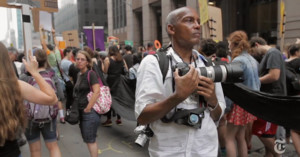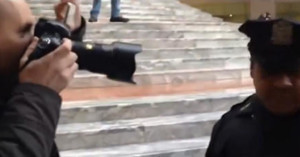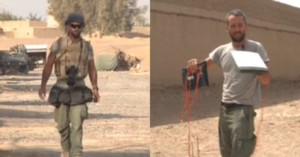
It’s like “déjà vu all over again”: New York Times freelance photographer Robert Stolarik was arrested this past Saturday while on assignment in the Bronx. As he was taking photographs of a developing street fight, Stolarik was confronted by officers, ordered to stop, and then allegedly assaulted.

Read more…

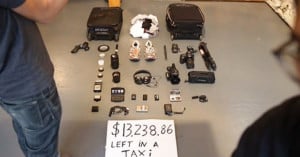
A photographer’s worst nightmare happened to YouTube filmmaker Casey Neistat recently. After taking a taxi after a long 18-hour work day and flight, Neistat accidentally forgot all of his luggage — and $13,238.86 worth of camera gear — in the back of a New York City taxi cab. Among the equipment lost was a Canon 5D Mark III kit ($4300), a 24-70mm lens ($1600), and about $550 worth of memory cards — equipment necessary for Neistat to make a living.
Read more…

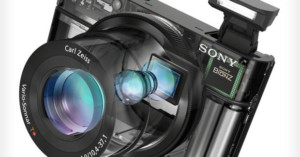
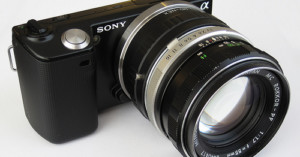
Remember the mysterious camera NYTimes columnist David Pogue was gushing over earlier this month? Turns out it’s the Sony RX100. In his review of the camera published yesterday, Pogue calls it “best pocket camera ever made” and writes,
It will be sold out everywhere. I’ll skip to the punch line: No photos this good have ever come from a camera this small.
[...] the RX100 has single-handedly smashed the rule that said, “You need a big camera for pro-quality photos.”
And if you care at all about your photography, you’ll thank Sony for giving the camera industry a good hard shove into the future.
Tiny Camera to Rival the Pros [New York Times]

New York Times gadget columnist David Pogue knows something we don’t. In this year’s list of personal electronic recommendations, he has some glowing words for a soon-to-be-announced digital camera:
I bought the amazing Canon S100, a tiny pocket camera with the biggest sensor on the market. I wrote about my reasons here. But in two weeks, I’ll be switching my allegiance. You cannot believe what’s about to come down the photographic pike. Trust me: If you’re in the market for a small camera with astonishing photographic results, hold off for a few weeks.
Could he be talking about the Canon mirrorless camera that will reportedly be announced later this month?
What Pogue Actually Bought [NYT]
Image credit: David Pogue by eschipul
Back in February the New York Times launched a new site called “The Lively Morgue” for regularly sharing photos from its historical archive of the same name. The video above gives an interesting behind-the-scenes glimpse at this amazing underground archive that stores millions of historical photographs and 300,000 sacks filled with negatives.
(via DEVELOP Tube)

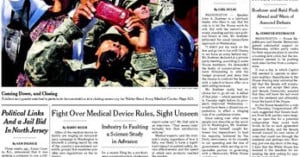
Afghan photographer Massoud Hossaini won the Putlizer Prize yesterday for his Breaking News photo showing a 12-year-old girl screaming after a suicide bombing in Kabul. His images of the mosque attack were so powerful that the New York Times, Washington Post, and Wall Street Journal all published them on their front pages on December 7, 2011. However, each one ran a different image captured at the scene, and only the New York Times ran the Pulitzer Prize-winning shot that showed the full extent of the carnage. Shortly afterward, The Washington Post interviewed the photo editors at each paper to discuss why they chose the images (and the crops) they did.
The Post, NYT and WSJ show same scene of Kabul carnage via different photos (via Poynter)

After reading about the Wakhan Corridor in the New York Times, French photographers Fabrice Nadjari and Cedric Houin decided to visit the remote region in Afghanistan in the summer of 2011, walking for 24 days through a 140 mile stretch. Their project, titled “Traces of Time”, involved capturing instant photos of the villagers they met:
When [Nadjari and Houin] arrived in the first village, they found that even photographs, which freeze time, worked differently. The portraits they took with Polaroid cameras developed oddly, and degraded rapidly, because of the high altitude and harsh conditions. But this made them no less valuable to their subjects, many of whom had never seen a photograph. Some had never seen an outsider.
The local Afghans marveled at the fragile images and lined up to have their photos taken.
“There was something extremely precious in the way they were holding the image, in the way they wanted to get it as soon as it got out of the camera,” Mr. Nadjari said. “It was both the gift and the interaction.” [#]
The photographers soon decided that they would shoot portraits of the villagers holding their own portraits, with the instant photos seen in color while the rest of the portrait is converted to monochrome, saying that it “stops time, and mixes the past and present. The present looks like the past, and the past like the present.”
A Hard Trek to Humility (via Photojojo)
Image credits: Photographs by Fabrice Nadjari and Cedric Houin

Lytro‘s groundbreaking light field camera is finally landing in the hands of customers, and to give people a better idea of how the camera works, the New York Times has published an interesting diagram that shows what makes the camera tick. Here’s what DPreview has to say about the camera:
The Lytro LFC is so unlike any conventional camera that it doesn’t make sense to score it in comparison to them. Ultimately, though, we’re not convinced that the Lytro either solves any existing problem or presents any compelling raison d’etre of its own. If it were higher resolution or allowed greater separation or could produce single lens 3D video it might generate a lot more excitement. As it is, it feels like a product arriving before the underlying technology is really ready.
All of which is a great shame, because Lytro has done a great job of making a credible consumer product out of a piece of fairly abstract scientific research. It’s quite possible that in the hands of the right people it will result in some interesting creations but we just don’t yet see it as a mass-market device.
The New York Times came to the same conclusion — that the technology is revolutionary, but the product isn’t game-changing… yet.
A Review of the Lytro Camera (via Photojojo)

The New York Times has launched a new Tumblr site called “The Lively Morgue” to breathe new life into items in the newspaper’s photo archive (nicknamed “The Morgue”). Each week they’ll be sharing several historical photographs found in massive collection. Just how massive?
We don’t know. Our best guess is five million to six million prints and contact sheets (each sheet, of course, representing many discrete images) and 300,000 sacks of negatives, ranging in format size from 35 millimeter to 5 by 7 inches — at least 10 million frames in all. The picture archive also includes 13,500 DVDs, each storing about 4.7 gigabytes worth of imagery. When the Museum of Modern Art set out to exhibit the highlights of the Times archive in 1996, it dispatched four curators. They spent nine months poring over 3,000 subjects, working with two Times editors, one of whom spent a year on the project. In the end, they estimated that they’d seen only one-quarter of the total. [#]
To make the project even more interesting, they’re also publishing an image of the reverse side of each print. This often reveals information such as how often the image was used, notes by the photographer, and the original caption that was chosen.
The Lively Morgue (via NYT)

The New York Times has sent an angry letter to the New York Police Department after video emerged showing photojournalist Robert Stolarik being pushed around and then blocked while trying to photograph officers arresting Occupy Wall Street protestors. The memo itself hasn’t be published, but NYT VP and assistant general counsel George Freeman is quoted as saying,
It seemed pretty clear from the video that the Times freelance photographer was being intentionally blocked by the police officer who was kind of bobbing and weaving to keep him from taking photographs
The department has acknowledged receiving the note from the NYT, but has not issued a formal response yet. This incident comes just weeks after Police Commissioner Raymond Kelly ordered officers to avoid unreasonably interfering with media access during news coverage.
Read more…