Life As a Bike Race Photographer in Asia
Life as a race photographer can be a tough and risky one. Add in a little eastern spice and it has a whole different taste. Steve Thomas takes us on a back seat ride through the pelotons of Asia.
Life as a race photographer can be a tough and risky one. Add in a little eastern spice and it has a whole different taste. Steve Thomas takes us on a back seat ride through the pelotons of Asia.
There's a good chance you're sick of reading about Fujifilm this week. But with the fever-pitch buzz surrounding the release of the X-T1, it's not often that we consider the business behind these popular cameras.
Well, well. Fuji's done it again. They've simultaneously wowed fans and foes with the newly announced X-T1. There's a lot to learn here and a lot to discuss. Let's take a look at some of the details and perhaps more subtle or overlooked points.
Dear Photography Thieves, …
I have learned many lessons in my years as a professional photographer, but if there is one that really sticks out it is that every time I have gone for the cheaper option is has cost far more than I have saved in the long run.
I recently got asked to shoot photos for a show called “The Haves and HaveNots” for the Oprah Winfrey Network. I’ve shot many shows in my career and I always enjoy these shoots because there are so many challenges involved.
For those close to me, you know how much Michael Schumacher’s skiing accident and subsequent critical condition has affected me. He is one of my heroes, and my family are of the many Ferrari tifosi (fans) that have cheered him on through the years. Like so many around the world we continue pray for his recovery in dark times.
In my last post, I said that Adventure Photography doesn't get much attention; however, based on all of your feedback and reactions it seems I may have been mistaken. Perhaps it's just quiet attention? Regardless, I wanted to go ahead and compile a second list because, as I said in the first post (and as many of you pointed out) there were clearly some people missing.
I didn’t want to like this show. Cross my heart, I didn’t.
A big thank you to Mosaic for sending us this article! We hope you enjoy this amazing story! …
Hello photographer, the report of my death was an exaggeration.
From a design concept to a crowd-funding campaign to a product backed by a major brand, the Polaroid Socialmatic represents an alternative to traditional product development methods. Is crowd-sourced innovation the shakeup that the photography industry needs?
Editor's Note: After the piece was published, we were made aware of a deal WeSellLikes is running that gives away 1,000 likes to anybody who writes about their website. We wanted to make it clear that we did not know about this deal nor do we have any intention of taking them up on their offer... although the irony did make us chuckle.
A few months back I got to see the mighty, ever-reigning dinosaur kings of rock, the Rolling Stones. I had a general admission ticket and a small pocket camera, and arrived many hours early so as to worm my way clear up to the front.
As a website, we're trying to move away from sharing rumors and the like, or at the very least be much more selective. This is happening for a few reasons, but one of them is that, unless you are very selective, you're bound to share something blatantly wrong. And worse yet, in your rush to be one of the first to report on it, you might do serious damage to your credibility.
A Little Background...
Photography companies love catchword marketing. They like catchwords because photographers make assumptions about what those words mean, even though the words really don’t mean anything. So basically, they say nothing, but it makes you believe something.
New Year's resolutions can be very bittersweet. Everybody loves the sweet sensation of starting off a new year fresh, cleaned of your bad habits and motivated to charge in with high hopes and grand goals. But unfortunately there's that slight bitter taste as well. It's that knowledge that we often shoot too high and end up falling flat on our faces and that this year likely won't be any different.
First things first: Happy New Year! Whether you're in Berkeley, CA, Bucharest, Romania or Shanghai, China, it's now 2014 for everyone, and we want to start off the new year by thanking you all for a phenomenal 2013. You guys and gals are the reason we get up in the morning and stay up nights wracking our brains to figure out how we can make this site the best photo blog in the world.
The holidays are a great time for gift giving, which also normally means they're a time for cleaning out closets and camera bags. Every year, I find myself needing to get rid of old stuff that has been replaced; or dealing with the thoughtful but odd and/or useless gifts given to me by well-meaning family and friends.
Everybody is coming out with their editor's choices and best of's and holiday gift guides, but The Camera Store added another facet to their "best of 2013"... the "worst of 2013." From lenses, to still cameras to video cameras, take a gander at what was really good and, inevitably more entertaining, what was really bad.
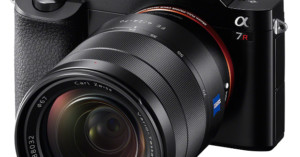
A while back I wrote a post I humbly called Roger’s Law of New Product Introduction, complete with the graph shown below. The release of the Sony A7R has demonstrated the accuracy of that post as few other releases have.
There are all sorts of statistics we can look up to tell us how the photography industry is doing and whether or not smartphones really are going to steamroll the market (spoiler alert: it's not as bad as some make it out to be). One source of information that probably doesn't cross your mind, however, is Amazon's Most Wished For lists.
With every passing year, the digital camera sales dataset offered by the Camera and Imaging Products Association (CIPA) grows more comprehensive. These records are made available to the public by this coalition of camera manufacturers which includes Nikon, Canon, Fujifilm, Sony, Sigma, Ricoh, Olympus, and dozens of other recognizable brands. Since 2002, they've been improving and increasing the scale of their database, which now separates digital cameras into fixed-lens, mirrorless and DSLR …
As a self-appointed pundit, I spend a fair amount of time criticizing the photography industry, but I have a little secret ... I love photography! And 2013 brought yet another year full of strange, interesting and inspiring moments in photography. Let’s go on a little journey ... in no particular order.
It’s been over two years since I cut the academic anchor and sailed away as an independent nature photographer. How am I faring? My little business is chugging along fine, thanks! I’m busy. I have an infant daughter, and I love that my new life allows the flexibility to work from home. Yet I still interact regularly with the university. I’ve just published a couple of research papers. Things are good.
It’s that time of the year when we all take a moment to reflect back on the major events that will forever be remembered, the trends that changed our zeitgeist, and the pop culture phenomena that will soon be forgotten.
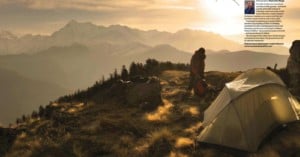
Here is a good example why it is so important to work the scene to get the best results from a shoot. We were camped on a 3000m ridge while photographing the majestic peaks of Trishul (7120m) and Nanda Ghunti (6309m) from Brahm Tal in the Garhwal Himalaya. I had just finished a sunrise shoot of the sweeping panorama before us. We spent two night on this ridge. I wrote more about this experience here.
On Sunday I covered what was easily the hardest football game I’ve ever been asked to shoot. In turn it was the most fun I’ve ever had on an assignment.
Take a deep breath. Picture it in your mind. The world’s largest gathering of camels. Taking place at a tiny Rajasthani town filled with temples, narrow streets and a picturesque lake. Men in brightly coloured turbans as far as the eye can see. Enough dust and sand to make your nostril hairs work overtime. And hundreds of photographers in every nook and cranny, taking thousands of photographs of this annual event.
I’m not going to say that we flew down to Florida to get a picture, because we didn’t. We flew down to Florida to see my grandfather, who is 94-years-old and my son’s only living great-grandparent. All my own great-grandparents passed away long before I was born, as did my husband’s great-grandparents.
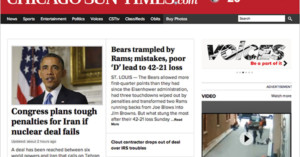
When the Chicago Sun-Times laid off its entire photo staff last year, I commented that one of the problems was the utter failure of website design to appropriately showcase photography. Above is an example of the current design and the way photography is displayed.
News broke yesterday that four of the photographers fired in last May's mass-layoff instituted at the Chicago Sun-Times may soon be rehired, while others will see restitution payments, thanks to a new agreement reached by the Chicago Newspaper Guild. Under the agreement, four photographers would get their jobs back and some of the rest will see one-time payments of $2,000.
First, I'd like to start this article off with a little bit of a warning. This post is primarily aimed at people just starting to get into photography or people just beginning to make the jump from hobbyist to professional. That said, hopefully there's something below that can be appreciated by photographers of all levels.
A few weeks ago, I found myself wandering around a local career fair -- the type of event I normally find pretty loathsome, or at least overcrowded an unhelpful. This time though, a fun surprise: representatives from Snapchat and Shutterfly stood at booths right next to each other.
I’ve been shooting photos for 20 years. I’ve made my living in the profession for the last 15. I can count on one hand the number of times that everything lined up perfectly and a truly rare image was created.
I’m going to open a can of worms today. I’ve been getting more and more emails from people telling me the same story that goes like this: …
It’s 2004, and a group of young entrepreneurs is working on a wearable camera geared towards action sports. Their experimentation results in a multi-million dollar company that launches a series of versatile waterproof cameras that can be attached to a person or vehicle in any number of ways. Their products have been used to film everything from spear fishing to paintball battles. Oh, by the way, I’m not talking about GoPro.
No matter how much energy you have going into a project, it's likely that at some point you'll run out of steam. When you're hours in to editing your photos and are beginning to have an existential crisis about the real meaning of the words "tone curve," you'll suddenly stop and wonder why you're doing this in the first place.
This post is prompted by, but not exactly about, the Humans of New York project/phenomenon (Side Note: This is not an anti-HONY rant. If anything, HONY is merely the straw which broke the camel’s back).
In an insightful essay about the "graying" of photography, Kirk Tuck opines about seeing 50-year old men proudly displaying their huge DSLRs while hanging out at the counters at the Photo Plus Expo in New York last month. The generation that obsessed over pristine primes, low noise and 16×20 prints has been supplanted by a gaggle of Snapchatting millennials for whom photography is no different than a text conversation.
Rumors, leaks, and sneak peaks dominate headlines in photo gear news. More often than not, the appearance, specs and even price of a new piece of gear (this applies particularly to cameras) is known well before its manufacturer announces it themselves -- a fact that should come as no surprise to frequent PetaPixel readers.
Dear clever person who stole my camera from the Barcelona train station -- yes, you are oh so clever. I must say, I read about your ilk in all the guidebooks and could not even imagine how you might be able to get my beloved camera from my ever-watchful grasp, but you and your band of accomplices managed to play me and my group of friends like a fine tuned instrument. I am still only guessing at what you did to me.
I'm a very accomplished photographer. My photos have been in magazines, newspapers, textbooks, blogs, online videos, television and any other medium that you can think of. My work has been seen by millions and will be one of the most important resources for the history of video games. The only catch is that I'm almost never credited and don't get paid for it.
I grew up without the Internet.
Recently there’s been a fair bit of hullaballoo about these new cameras Fuji has been bringing out – the X-series. X100, X-Pro 1, XE-1 and most recently the X-M1 or something like that. All touted as great cameras – the perfect blend of retro styling and cutting edge sensor technology, paring away anything extraneous to the act of shooting.
A Bohemian-looking man stands in a picturesque Scottish glen. Wild grasses sway in the wind, green hills loom to either side and moody, dark clouds drift along above. The man takes in the scene and fiddles with a camera around his neck. We hear satisfying mechanical clicks as he sets the aperture and shutter speed.
"Look at me," he said. Complying, I turned in the man's direction. "Look me in the eyes!"... I tried to raise my eyes and look into his, but I couldn't. Actually, I couldn't look anyone in the eyes at that point, it felt weird and uncomfortable. That man... was my own older brother.
One commonly asked (and commonly mis-answered) question on the Internet these days is around the definition of what constitutes a ‘professional photographer.’ The usual definition is that it is somebody who is shooting for pay, and deriving the majority of his or her income entirely from photography or photography related activities. I suppose in the strictest sense of the definition, that is true. However, it says nothing about professional conduct or skill.
It’s not uncommon to hear someone say that they were haunted by an image, often an old photograph. It is a figurative and evocative expression. To say that an image is haunting is to say that the image has lodged itself in the mind like a ghost might stubbornly take up residence in a house, or that it has somehow gotten a hold of the imagination and in the imagination lives on as a spectral after-image.