National Geographic Reveals its Pictures of the Year for 2026
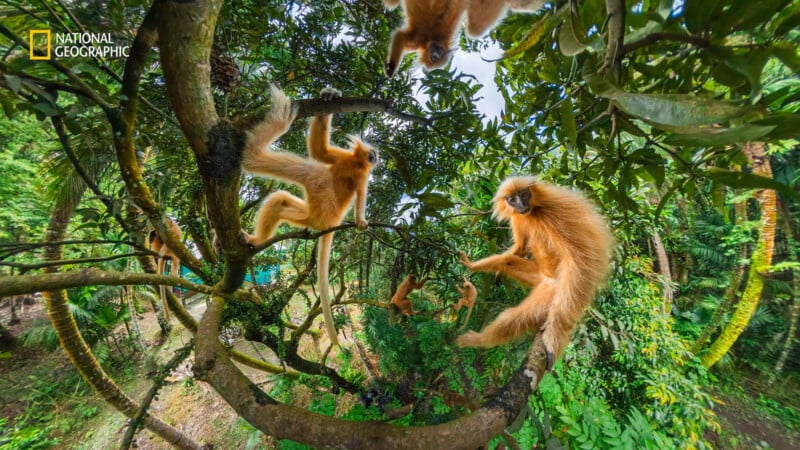
Several golden-furred langurs with long tails climb and sit among the branches of a lush, green tree.
A curious troop of Gee’s golden langurs—named for a naturalist who documented them in the 1950s—peer into a fisheye lens that Prakash Matada affixed to a tele scoping pole. The endangered canopy dwellers here have formed a rare bond with humans and proved anything but camera-shy, gazing at their own reflections. (Photo by Prakash Matada)

National Geographic has unveiled its Pictures of the Year 2026, a collection of 25 extraordinary photographs revealing the moments, discoveries, and untold stories that defined the past year.

Selected from more than one million images captured by Nat Geo photographers around the globe, this year’s collection offers a striking look at the natural world, human ingenuity, and the remarkable ways people and wildlife navigate a changing planet.
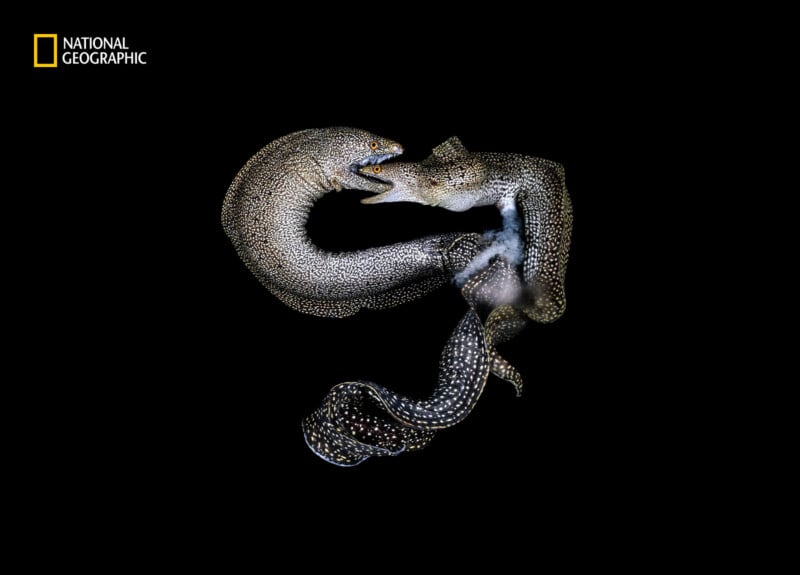
Two spotted moray eels are intertwined against a black background, with their mouths open toward each other, while the National Geographic logo appears in the top left corner.
A pair of Abbott’s moray eels (Gymnothorax eurostus) reaching the pinnacle of their spawning run, three tenths of a second after leaving the cover of coral. The male on the left is just releasing the jaw of female, with both eels sending gametes into the water. Kagoshima Prefecture, Japan. (Photo by Tony Wu)
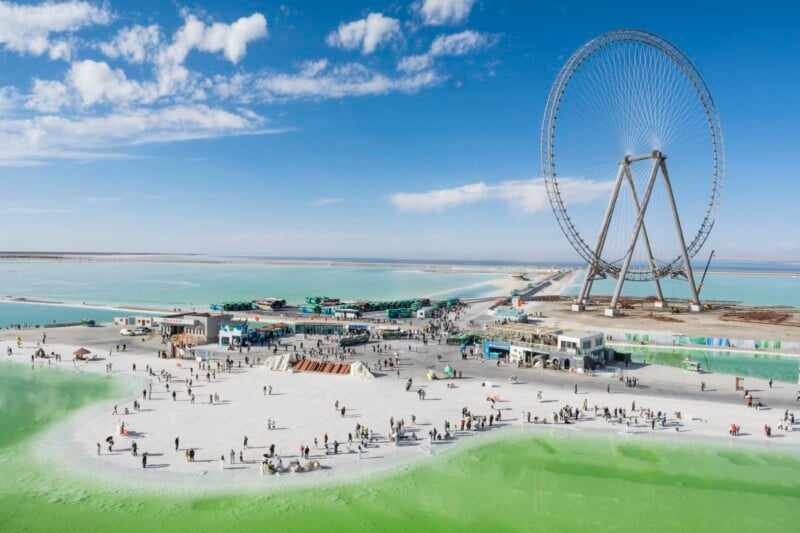
A large Ferris wheel stands on a salt flat beside a turquoise lake, with a parking area for buses and many visitors walking on the white ground.
Once an industrial settlement built around salt and lithium mining, China’s largest salt lake has recently become an unlikely tourist hot spot. A grand Ferris wheel is being constructed to provide views of some 2,300 square miles of crystal-clear water—and the surrounding mine. (Photo by George Steinmetz)

The images transport audiences from the depths of Greenland’s icy waters to the mountains of Peru, capturing moments of wonder, resilience and discovery that might otherwise go unseen.

Made possible by the unmatched access and expertise of National Geographic photographers, the collection embodies the curiosity, discovery, and spirit of exploration that are distinctly National Geographic.
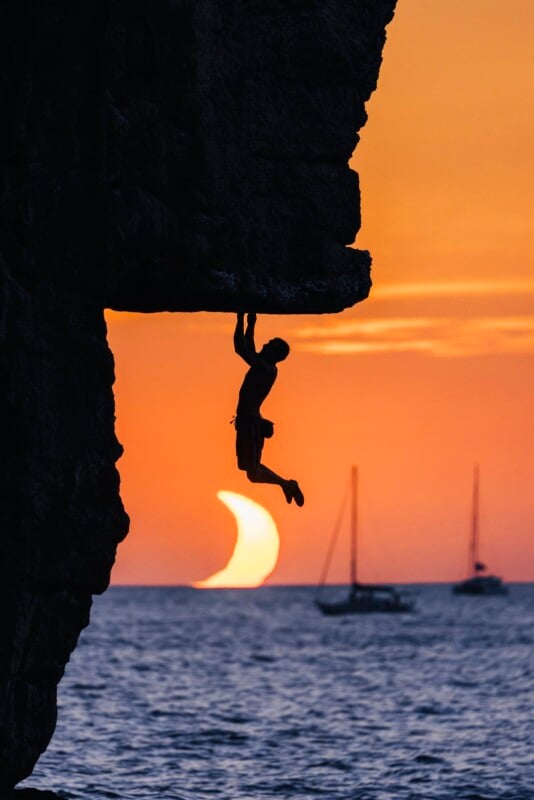
A silhouette of a person hanging from a rocky cliff edge above the ocean during a partial solar eclipse at sunset.
Climber Chris Sharma dangles from a completely horizontal limestone face in the moments after August’s total solar eclipse in Spain. (Photo by Chris Burkard, assistant Joel Barger)
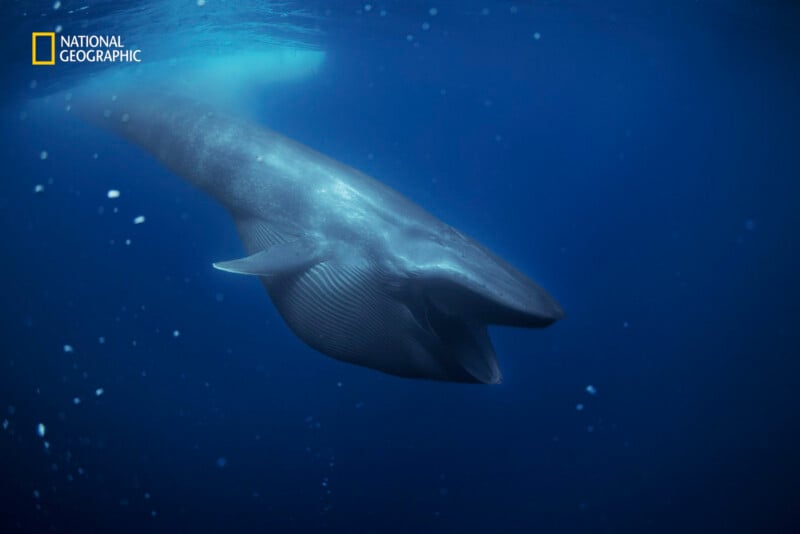
A blue whale swims through deep blue water with its mouth slightly open, showing the pleated skin of its throat.
In New Zealand’s warming waters, a pygmy whale lunges, mouth agape, to feed on abundant krill. Although the giant species is ordinarily migratory, some 700 of them have settled here. Photographer Ralph Pace dived with researchers studying how climate change affects the krill and, in turn, the whales’ feeding and breeding. (Photo by Ralph Pace)

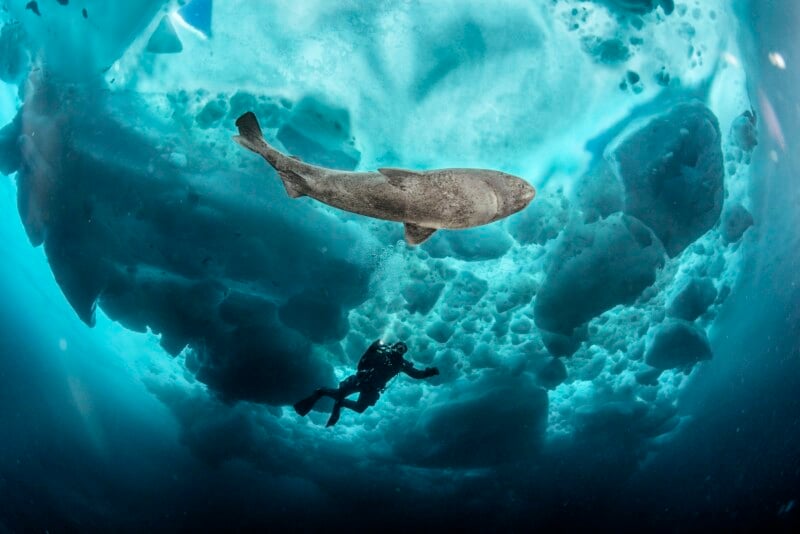
Among the standout photographs are the first-ever images of moray eels spawning in the wild, captured by photographer Tony Wu after nine months in the field in Japan; a climber suspended from a sea cliff in Spain just after a total solar eclipse; and a spine-tingling encounter with a Greenland shark, one of the planet’s longest-lived vertebrates, photographed by Kiliii Yüyan in the 28.4°F waters of Ammassalik Fjord, among the coldest conditions endured by a Nat Geo photographer this year.
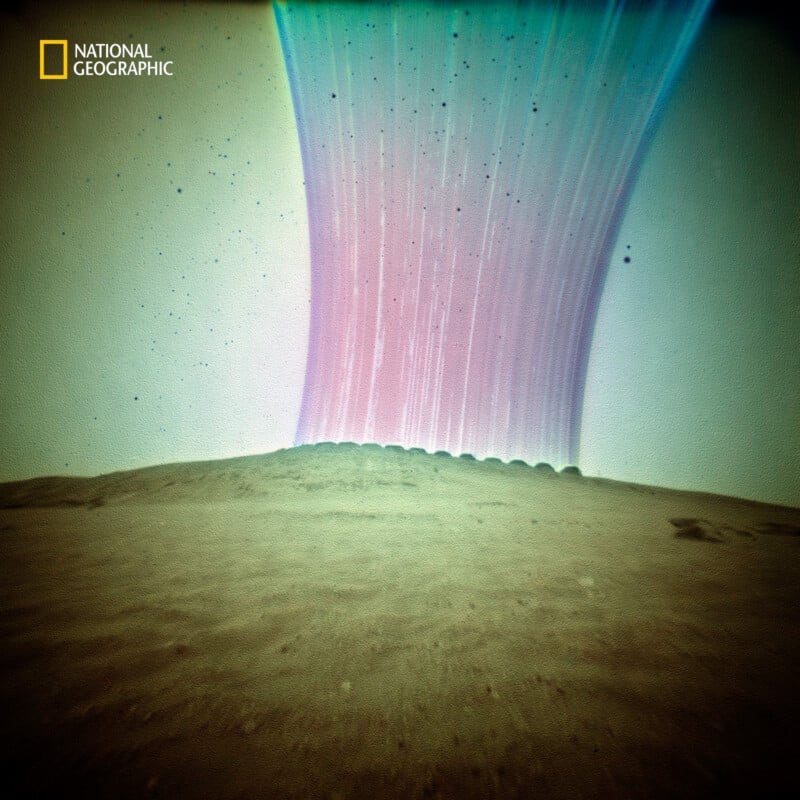
A National Geographic logo appears in the upper left corner above a barren, sandy landscape with a glowing, vertical column of light rising into the sky.
Apparent path of the sun as seen from the western observation point at the Chankillo Solar Observatory in Casma (Ankash), Peru. The six-month-long continuous exposure (solarigraphy) taken between June 21 and December 21, 2025, accurately shows the sun’s path, with the winter and summer solstices located at the ends of the structure outlined by the silhouette of the towers. (Photo by Diego López Calvín)
A scuba diver swims beneath a large Greenland shark in icy, blue water filled with floating ice chunks.
A Greenland shark, the oldest vertebrate on Earth, swims underneath the meter-thick sea ice near the village of Kulusuk in East Greenland, as diver Philipp Oppermann watches. This shark came up from the depths into the shallows at night to follow the scent of a Greenlander’s bait, frozen ringed seal. This photograph was made March 17, 2026, in early spring, when the sea ice remains strong and the visibility of the water is spectacular, over 50 meters. (Photo by Kiliii Yüyan)

For more on this story, visit Nat Geo Photos.

Affiliate Disclosure PetaPixel articles may include affiliate links; we may earn a commission if you buy through one.
Discussion