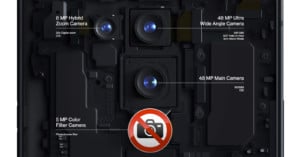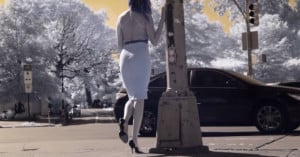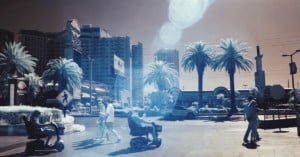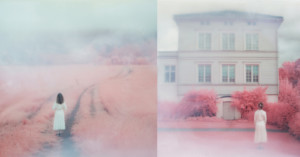
Apple recently filed a patent having to do with baking infrared communication capabilities into the iPhone. Although there are certainly useful applications for the technology (e.g. a museum beaming information to the phone at different exhibitions), what’s troubling is that the feature may also allow the camera to be remotely disabled by those who wish to prevent photography.
[...] the transmitter could be located in an area where photography is prohibited and the infrared signal could include encoded data that represents a command to disable recording functions.
This example could easily apply to movie theatres trying to stop customers from filming a movie for illegal distribution or any kind of music concert to protect an artist’s image from being photographed or videoed illegally, as shown below. [#]
I don’t know about you, but I don’t want a camera that could be disabled remotely by a third party…
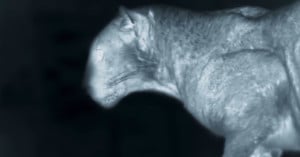
The Midnight Shot NV-1 Night Vision camera by ThinkGeek is a compact camera specially designed for infrared photography. Instead of permanently removing the IR filter from a traditional digital camera, the Midnight Shot allows the filter to be retracted when you want to use it as an IR camera. It shoots 5 megapixel stills, VGA video, and has built-in IR illumination that lets you shoot and film in complete darkness. Read more…
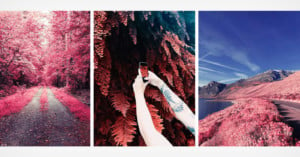
There’s plenty of tutorials online that teach you how to convert digital cameras into infrared cameras, and plenty of services that will do the conversion for you if you send in a camera, but what if you want to cut out the hassle of having a camera converted? Mike Keesling sells pre-converted Canon Powershot cameras through his website Opticsgeek that capture infrared images straight out of the box. A PowerShot A480 will cost you $200, and a SX200 IS will set you back $350.
This neat DIY video shows how you can convert an ordinary digital camera into a night vision camera. The video uses a digital video camera, but the same concept can be applied to still cameras as well.
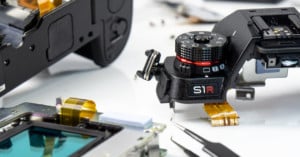
Digital camera sensors are sensitive to both visible and infrared (IR) light. However, there’s a special IR filter used to block IR light from the sensor, keeping images from being washed out. If this special filter is removed, the camera can be made sensitive to IR light. The hack in this video involves replacing the filter with the black end of a film negative, and then using red and blue lighting gels on a flashlight to have it give off mostly IR light. The result is a camera/flashlight setup that can be used to take stills and videos in the dark where ordinary cameras can’t.
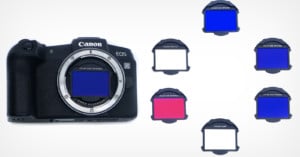
This is similar to the pricey modifications you can have done to your DSLR to use it as an infrared camera.
Future generations of photographers may one day look back and wonder why we often blinded each other with painfully bright flashes of light for the sake of proper exposure.
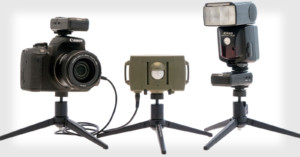
NYU researchers Dilip Krishnan and Rob Fergus are working on a dark flash that eliminates the “dazzle” effect of regular flashes in a low-light room. They’ve created this camera rig that combines common infrared photography techniques with an ultraviolet flash that produces a dim purple glow instead.
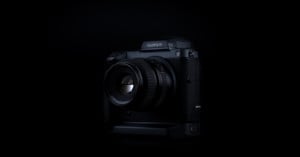
The team placed an infrared filter on the lens of the Fujifilm S5 Pro, which is has a modified CCD sensor that specializes in IR and UV photography. To supplement existing UV light, the team created a modified filter on an external flash to emit only UV and IR wavelengths. Read more…