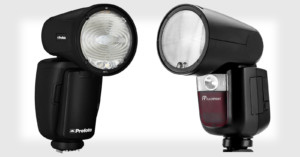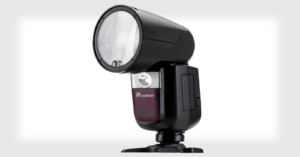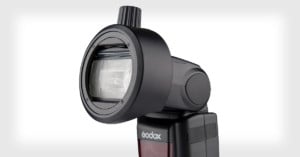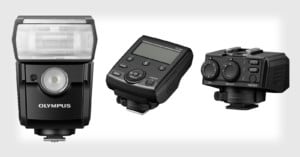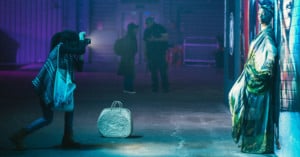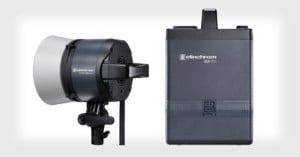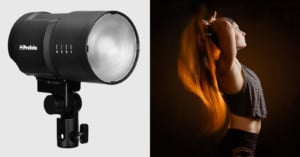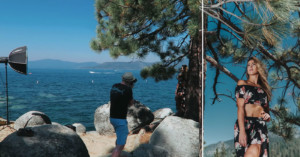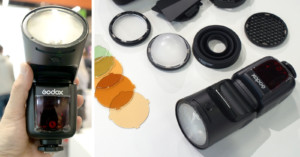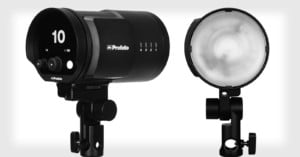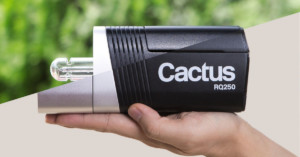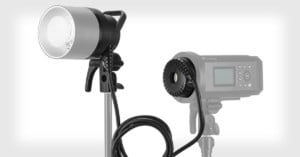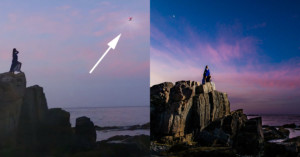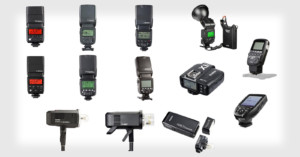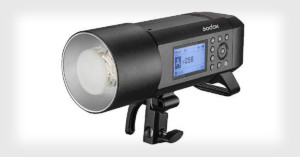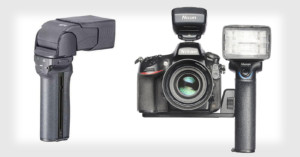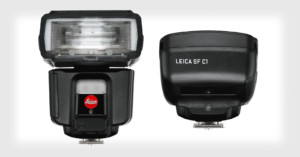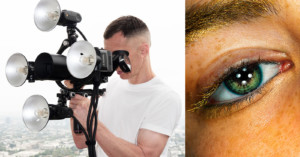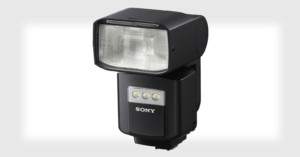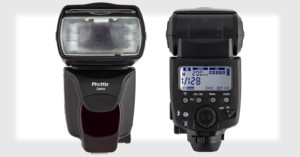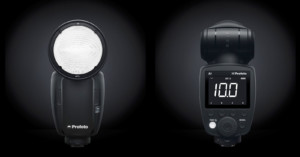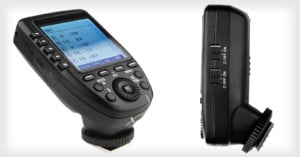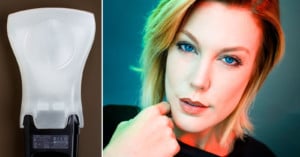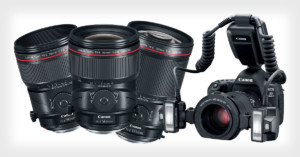
Okay — maybe it’s trying to reinvent the wheel, er, ring flash, but this could be an interesting gadget: Chinese company CononMark has unveiled a flash system that looks like a cross between a ring flash, speedlights, bracket flash and modeling lights. Read more…
Photographer Benjamin “Von Wong” has pulled of a flashy feat with fire: a multiple exposure shoot of a pyrotechnician at work — all photographed and produced in his Nikon D800. That’s right — all in-camera, no stacking in Photoshop. Read more…
Want to shoot photographs of rainbow-colored smoke? Just strap some color gels to your flash(es). Photographer Sean Wyatt used three snooted flashes with two colored gels on each flash to create a rainbow blend of color. He then used the setup to photograph smoke from burning incense sticks. Read more…
After buying a Yongnuo flash and finding its wireless capabilities “hit and miss”, Marcell of fiberstrobe decided to try out something he saw on a forum: using a fiber optic cable as a sync cord. The Yongnuo YN460-II can function as an optical slave, so the basic idea is to channel light from your camera’s flash into the light sensor of the strobe. To solve the problem of light leakage, Marcell also created an accessory using LEGO bricks, cardboard, and duct tape to fox the fiber to the sensor and protect it from direct sunlight.
You may remember photographer Benjamin Von Wong from last week’s behind-the-scenes video of his photo shoot with the band The Agonist. In that video he showed you how he put together a very creative, cinematic composite shot that really stood out from other band photos. In this video, Benjamin runs you through the lighting challenges unique to black and white photography, and how he chose to overcome them.
Flash diffusers come in all shapes and sizes, from DIY Home Depot versions to more expensive professional grade equipment. None of these solutions seemed adequate for 30 year photography veteran Les Tirmenstein, however, and that’s why he designed the FlashPipe. Read more…
“Darkroom Escape” is a simple flash game in which you’re stuck in the darkroom of a photo studio and must escape using only the items in the room. The idea is pretty simple, but the difficulty is pretty ridiculous. If you can figure everything out without looking up the answers, you’re either a savant or someone with way to much free time. You can play full screen here or watch a walkthrough video with the solution here.
Flickr user boingr came up with a great idea for those of us who don’t want to spend money on a flash diffuser from a camera shop — head over to Home Depot instead. All he did was buy an Amerimax Home #85208 downspout funnel, shimmy it onto his Canon Speedlite 580EX II, and presto: Open-Top Flash Diffuser.
The diffuser apparently fits snuggly on several of the flashes he has around the house, and for the ones on which it doesn’t, “one of those fat rubber bands that come around broccoli bunches” helped to solve the problem.
This past Sunday, a group of amateur astronomers in San Antonio, Texas successfully “flashed” the International Space Station with a blue laser and spotlight as it whizzed by overhead. While this might sound like an easy thing to do, it’s much more complicated than you think. Astronaut Don Pettit shot the photo of the experiment seen above, and writes,
This took a number of engineering calculations. Projected beam diameters (assuming the propagation of a Gaussian wave for the laser) and intensity at the target had to be calculated. Tracking space station’s path as it streaked across the sky was another challenge. I used email to communicate with Robert Reeves, one of the association’s members. Considering that it takes a day, maybe more, for a simple exchange of messages (on space station we receive email drops two to three times a day), the whole event took weeks to plan.
The International Space Station maintains an orbital altitude of between 205 and 255 miles, so the fact that Pettit was able to see the flash of light from that distance is quite impressive.