Educational

PetaPixel's editorials are in-depth stories, thought-pieces, and opinions on the photography industry led by the minds of our editorial team.

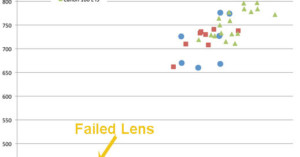
Quantifying the Variation in Sharpness Between Copies of the Same Lens

As you might know, different copies of the same lens can vary in quality, and some people go as far as to purchase multiple copies to pick the sharpest one before returning the others. Roger Cicala over at LensRentals wanted to quantify exactly how much variation actually exists between copies of the same lens, so he subjected some to Imatest quality tests: …
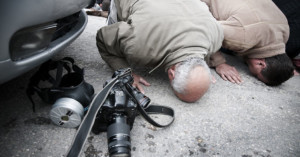
An Eye-Opening Look at How Many Conflict Photos Are Staged

Here's a fascinating video in which Italian photographer Ruben Salvadori demonstrates how dishonest many conflict photographs are. Salvadori spent a significant amount of time in East Jerusalem, studying the role photojournalists play in what the world sees. By turning his camera on the photographers themselves, he shows how photojournalists often influence the events they're supposed to document objectively, and how photographers are often pushed to seek and create drama even in situations …

Can You Tell the Difference Between Phone Photos and DSLR Photos?

CNN recently published a pop-quiz with 10 photos and a simple question: was the photo taken with a phone or DSLR? The test is meant to open the public's eyes to the fact that phone cameras are getting to be just as good as expensive DSLRs. It's misleading though, and Neal Krawetz over at Hacker Factor has a great explanation as to why: …
How to Recreate the Look of Instagram Filters with Vintage Cameras and Films

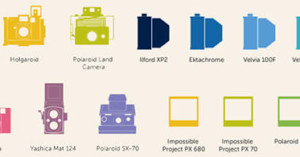
Instagram's filters are meant to mimic the look of vintage and toy cameras, but have you ever wondered which cameras and films you'd need to make analog photos with the same look? The folks over at 1000memories decided to tackle this question and, after a good amount of research, came up with a neat infographic showing the different camera and film combinations you can use to recreate popular Instagram filters.

The First “Camera Phone” Photograph Was Sent in 1997

Cell phone photography is a huge trend these days with Instagram skyrocketing past 10 million users this past weekend, but have you ever wondered how it all started? An entrepreneur named Philippe Kahn is credited with creating the camera phone back in 1997. On June 11th of that year, Kahn took the first "camera phone" photo of his newborn daughter in a maternity ward, and then wirelessly transmitted the photo to more than 2,000 people around the world. Since "camera phones" didn't exist at …
Quickly Track Packages by Googling the Tracking Number

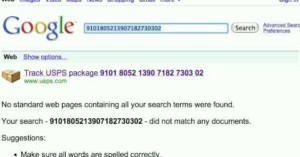
Here's a neat productivity tip for those of you who regularly buy stuff online (e.g. obsessive photo gear buyers): you can track most packages by simply searching for the tracking number with Google! The search engine automatically figures out which service the number belongs to, and provides you with a direct link to the droids page you're looking for. Since some shipping companies don't have bookmarkable tracking pages, this tip can help you avoid having to go through those companies' …
More People Have Walked on the Moon Than Have Captured the Analemma

Want a challenging photography project? Try capturing an analemma in a single shot. "Analemma" is the name given to the figure-eight shape traced by the sun if photographed at the same time of day over the course of a year. To capture it, you'll need to leave your camera in a fixed position and shoot photos at exactly the same time of day for all of the shots.

Did You Know: Nikon Shooters Can Buy “White” Lenses Too!

Canon has long offered its telephoto L lenses in white in order to keep the lens cooler under sunlight, but did you know that certain Nikon lenses can be found in "white" as well? The lenses were officially called "light gray", and can be purchased for pretty reasonable prices on eBay -- the AF-S ED 70-200 f/2.8G VR seen above was sold a couple days ago by eBay seller shrewd25 for $1,999.

Your Rights as a Photographer in the US

In response to the "widespread, continuing pattern of law enforcement officers ordering people to stop taking photographs or video in public places", the American Civil Liberties Union has published a helpful article that clearly details what your rights are as a photographer in the United States.

Camera Work: The “Most Beautiful of All Photographic Magazines”

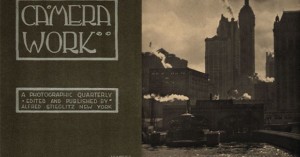
Between 1903 and 1917, photographer Alfred Stieglitz published a quarterly photographic journal called Camera Work featuring the work of important photographers around the world and promoting photography as an art form. Called "the most beautiful of all photographic magazines", 50 issues containing 473 photographs were published before Stieglitz could no longer afford to continue the publication. Individual issues now sell for thousands of dollars each, but you can view the entire collection of …

Keep Your Eye Out for DSLR Cameras in Hollywood Movies

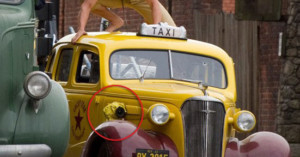
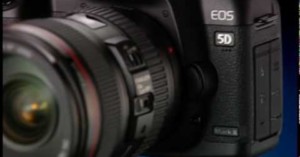
It's no secret that Hollywood directors are using DSLRs more and more these days to film scenes that traditional bulky cameras can't, but what's interesting is that the cameras are often used from within the scenes filmed by the main cameras. A Canon 5D Mark II was mounted to the front of Tony Stark's crashing racecar in Iron Man II, and was also attached to moving vehicles in the recent Captain America movie. The cameras are camouflaged to blend into the scene, but keep your eyes peeled (or …

Shooting at f/90 with a 70-Pound Camera on 504-Square-Inch Film

YouTube user destinw -- the guy behind the chicken steadicam (and worth subscribing to) -- recently met up with photographer Darren Samuelson and his massive homemade large format camera. In this video, we're given another look into how this one-of-a-kind camera works, as Samuelson photographs the Saturn V rocket at the US Space and Rocket Center. Check out some of his amazing ultra-large format photos here.

Sony’s Translucent Mirror May Reduce Detail in Photos by up to 5%

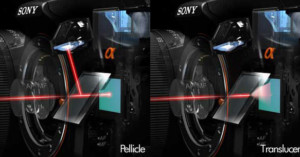
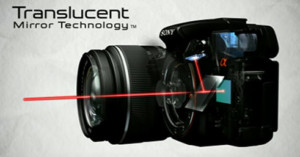
You've probably read plenty of articles touting the benefits of Sony's translucent mirror technology (e.g. high fps, AF for video, quietness, etc...), but what about the cons? One of the main downsides to having a translucent mirror is that the light hitting the sensor passes through an additional layer (the translucent mirror), which reduces the amount of light and the image quality.

Awesome Course on Digital Photography

Marc Levoy, the Stanford professor behind the "Frankencamera" project, teaches a course on digital photography called CS 178. The class website is a treasure trove for anyone looking for some great free education in photography: …

How NASA Captured the First Full Photo of Earth Back in 1966

While we're on the subject of photos of Earth, did you know that the first photo showing the entire planet was captured by an unmanned NASA orbiter from the moon back in 1966? To accomplish this, they had to come up with a camera that could expose, process, scan, and transmit film photographs -- something "akin to a flying television station and photographic mini-lab".

Are Film Canisters Safe for Storing Food?

A neat way to reuse film canisters is to poke holes in the lids and turn them into salt shakers, but some people argue that this may expose you to the harmful chemicals that leak out of film and into the plastic of the canister. It's actually a question that Kodak has received a lot over the years, and they say it shouldn't be a problem as long as you wash it out first: …

The Ancestors of Modern Camera Lenses

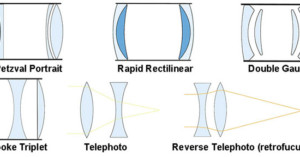
Rather than being built from scratch with new designs, new camera lenses are designed by taking existing lens designs that work well and then improving on them. As a result, virtually every lens design can be traced back to one of six basic lens designs developed in the early 1900s (shown above). Roger Cicala of LensRentals writes, …

World’s Largest Camera Back in 1900

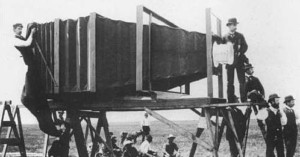
The record for world's largest camera is currently held by an aircraft hangar camera, but back in 1900, a photographer by the name of George R. Lawrence built the massive camera seen above. He was commissioned by the Chicago & Alton Railway to shoot the world's largest photo of one of its trains -- a photo measuring 8 feet by 4.5 feet. The camera weighed 900 pounds, required 15 men to move and operate, and cost a whopping $5,000 -- enough money back then to buy a large house.

Digital Rot: The Sad Truth about Digital Cameras and Depreciation

You probably know that, like computers, digital cameras depreciate pretty rapidly -- especially when a replacement model is announced every 2 or 3 years. A sad truth about digital cameras is that the digital sensor inside DSLRs cause them to be more expensive than comparable film SLRs when purchased new, yet less valuable further down the road when purchased used. Ken Rockwell calls this "digital rot", and writes, …

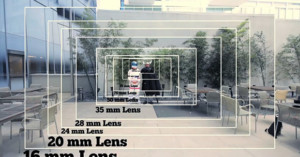
Field of Views of Different Focal Lengths

Here's a neat image showing the different field of views offered by focal lengths ranging from 16mm to 200mm. It's not simply lines overlaid on a single photo -- the different focal lengths were actually used to capture what the scenes looks like through the lenses.

Here’s What Happens When You Try to Edit Photos of Money in Photoshop

Did you know that Photoshop has built-in mechanisms that prevent you from editing photos of banknotes? After getting a payday, Reddit user tarballdotgz tried to Photoshop some of his hundred dollar bills, but ran into the above error in Photoshop. Even if you find a way to edit the images in Photoshop, there's a good chance your printer will give you a similar error if you try to print the image out! …

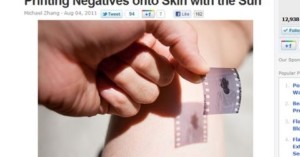
The Results of Printing 35mm Film onto Skin Using the Sun

Last week we published a post asking whether anyone had made a "print" on their skin by placing a negative on their skin under the sun. After seeing the post, videographer Jeremiah Warren decided to conduct the experiment for the benefit of all mankind. Taping four slides onto his forearm (he didn't have any suitable negative film), Warren exposed his skin for four hours in 100-degree heat (consuming a gallon of water in the process).

Interesting Video on “What Is Video?”

With the rise of sites like YouTube, the Internet is teeming with digital videos (two days worth are uploaded to YouTube every minute), but when was the last time you stopped to think about how video works? Here's a fascinating video in which Michael from vsauce explains everything from beta movement to frame rates.

Iconic Photo Exposed: Migrant Mother

For every iconic photograph that's out there, there was likely a number of other photographs taken at the same time that many people probably have never seen. One such photo is Migrant Mother by Dorothea Lange -- an image that became one of the defining photos of the Great Depression. The woman in the photo, Florence Owens Thompson, had been travelling with her family when their car's timing chain snapped. After setting up a temporary camp to wait while her husband and two sons went to town for …

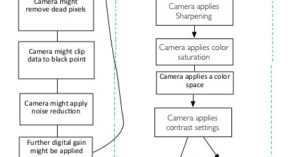
Why You Should Shoot Photos in RAW

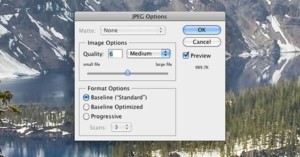
Shooting in JPG mode is convenient because you instantly have a file you can throw onto the Internet, but if you're serious about photography, you might want to think about shooting in RAW if you aren't already. The reason is that only shooting JPG is the equivalent of letting the camera make a print for you and then tossing the negative -- something film photographers would never do. Here's a simple diagram by Haje Jan Kamps and Reddit user jannne to help you understand the differences.

Photo Tampering Throughout History

Image forensics company Fourandsix set up an interesting page called "Photo Tampering throughout History". It's an interesting timeline of famous photo manipulations, going as far back as the 1860s -- the above left image of General Grant was found by the Library of Congress to actually be a composite of three separate photos! Pretty good for not having access to Photoshop, eh?

A Behind the Scenes Glimpse of Diorama Photographer Lori Nix’s Studio

Photographer Lori Nix spends weeks and months creating extremely detailed miniature scenes -- called dioramas -- and then photographs them using an old fashioned 8x10 large format camera. This video offers a look at what goes on behind-the-scenes at Nix's Brooklyn studio, and how she goes about creating her unique images. You see some of her photos in this post we published a year ago featuring her photography.

How (And Why) Photos Are Selected for the Bing Homepage

In the middle of last year, Google finally gave users the option of customizing its homepage with a photograph. Microsoft's Bing search engine, however, has featured photography ever since it launched in 2009. Fast Company has an interesting article about how the photographs are an integral part of the strategy for stealing users from Google: …