Posts Tagged ‘35mmfilm’

Panoramic Pictures of Famous Locations Made From Carefully Shot 35mm Film

Panoramic Pictures of Famous Locations Made From Carefully Shot 35mm Film 35mmfilmpanos 1

German photographer Thomas Kellner creates large-scale panoramas of famous locations using 35mm film. Rather than have the shots printed or digitized, Kellner uses scans of the film strips themselves. The rolls are kept in their long strips, which means Keller meticulously plans out and carefully shoots every shot to have the frames come together when the strips are placed side by side.
Read more…

This is What Happens to 35mm Film in Hydrochloric Acid

This is What Happens to 35mm Film in Hydrochloric Acid

Chemistry and physics teacher MattAttackPro shot the above photo showing what happens when a roll of unused 35mm camera film is dropped into a beaker of hydrochloric acid. What you’re seeing is the emulsion (light sensitive chemicals suspended in gelatin) separating from the clear plastic backing.

(via Boing Boing)


Image credits: Photograph by MattAttackPro

Art Students Become Human Cameras by Eating 35mm Film

Art Students Become Human Cameras by Eating 35mm Film eat1 mini

Kingston University photography students Luke Evans and Josh Lake wanted to do something unusual for their final major project, so they decided to turn themselves into human cameras by eating 35mm film squares and letting their bodies do the rest. After eating and pooping out the film in the dark, they used fixer on the film and then scanned the film using an electron microscope. They are currently exhibiting massive prints of the images that show every detail of what their bodies did.
Read more…

Fujifilm to Increase Its Worldwide Film Prices Starting Next Month

Fujifilm to Increase Its Worldwide Film Prices Starting Next Month fujifilm mini

Bad news if you’re a film shooter and Fujifilm is your brand of choice: the company has announced that it will be increasing the worldwide price of its entire line of photographic films starting in May 2012. In the announcement, the company blames demand and economics for the decision:

The demand for film products is continuously decreasing, yen’s appreciation and the cost of production, such as raw materials, oil and energy, continues to rise or stay at high level. Under such circumstances, despite our effort to maintain the production cost, Fujifilm is unable to absorb these costs during the production process and is forced to pass on price increases. To sustain its photo imaging business, Fujifilm has decided to increase the price of photographic films.

Fujifilm remains committed to photographic products and asserts that even with the new price. Its photographic products remain exceptionally good value compared with other system products.

While the announcement doesn’t mention how much prices will increase by — they state that it will vary depending on market — Fuji Rumors reports that it will be an increase of over 10%.

(via Fujifilm via Fuji Rumors via Mirrorless Rumors)


Image credit: Roll On by Looking Glass

Beware Counterfeit 35mm Film on eBay

Beware Counterfeit 35mm Film on eBay fakefilm mini

If you ever turn to eBay to purchase film, you should purchase from sellers that have both a high feedback rating and a country of origin that you trust. Reader Dallas Houghton recently purchased what he thought was 10 rolls of Fujicolor Superia 200 for $28 from a seller based in ShenZhen, China. After the film arrived, he noticed a tiny bit of yellow on the roll. When he gave it a closer look, he discovered that the “Superia” branding on the outside was actually a sticker. Once the sticker was removed the film turned out to be a roll of Kodak 400. He peeled the sticker off another roll and that one turned out to be an older Kodak Kodacolor 100 roll. Caveat emptor.

Kodak to Increase Price of Films by 15%

Kodak to Increase Price of Films by 15% kodakgold mini

Kodak’s film business just can’t seem to catch a break. One week the company announced the death of its entire slide film lineup, Kodak announced today that it is increasing the price of all the surviving films by 15%, stating,

We have to contend with further increases in energy and raw material costs, and higher costs associated with lower volumes.

Therefore, to remain a sustainable, viable business, the company is implementing a price increase for consumer and professional films.

(via Amateur Photographer via Photo Rumors)


Image credit: film by ka_tate

LomoKino: The First Hand-Cranked Movie Camera that Uses Ordinary 35mm Film

LomoKino: The First Hand Cranked Movie Camera that Uses Ordinary 35mm Film lomo mini

Lomography has launched the LomoKino, the world’s first consumer 35mm movie camera. It’s an old-school hand-cranked camera that uses standard rolls of 35mm film (yeah, the kind you use in film cameras). The camera captures 144 individual frames onto each roll of film, producing a video that lasts 50-60 seconds. Once you have your film developed, you can watch it using a separate LomoKinoScope: a hand-cranked movie viewer!
Read more…

Movie Camera Companies Have Quietly Stopped Making Film Cameras

Movie Camera Companies Have Quietly Stopped Making Film Cameras panavision mini

Over the past year, major movie camera manufacturers ARRI, Panavision and Aaton have all quietly stopped manufacturing film cameras — a tough blow to film, and grim news for film photographers. Debra Kaufman over at Creative COW writes,

Can the continued production of film stock survive the twin disappearance of film acquisition and distribution? Veteran industry executive Rob Hummel [...] recalls when, as head of production operations, he was negotiating the Kodak deal for DreamWorks Studios. “At the time, the Kodak representative told me that motion pictures was 6 percent of their worldwide capacity and 7 percent of their revenues,” he recalls. “The rest was snapshots. In 2008 motion pictures was 92 percent of their business and the actual volume hasn’t grown. The other business has just disappeared.”

Panavision’s Executive VP Phil Radin states that, “Film will be around as long as Kodak and Fuji believe they can make money at it.” With their revenues from the movie industry drying up, Kodak and Fuji are going to have a harder time keeping their film businesses profitable. If you want to see film survive, then you can do your part by buying film and encouraging others to shoot analog as well!

Film Fading to Black (via TechCrunch)


Image credit: PANAFLEX PLATINUM STUDIO by openreel

Unique Earrings Crafted From 35mm Film

Unique Earrings Crafted From 35mm Film 35mmearrings mini

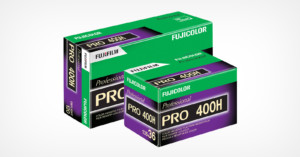
Brussels-based jewelry designer Clement Marquaire creates one-of-a-kind earrings using old 35mm film. A pair will cost you $15 over in Marquaire’s Esty store.
Happy Factory Etsy Store (via Photojojo)

How to Make Your Own Redscale Film

How to Make Your Own Redscale Film redscalefilm

Redscale is a technique where film is exposed on the wrong side — rather than having the light hit the emulsion directly, you expose the film through the non-sensitive side.

The name “redscale” comes because there is a strong color shift to red due to the red-sensitive layer of the film being exposed first, rather than last (the red layer is normally the bottom layer in C-41 (color print) film). All layers are sensitive to blue light, so normally the blue layer is on top, followed by a filter. In this technique, blue light exposes the layers containing red and green dyes, but the layer containing blue dye is left unexposed due to the filter. [#]

The two main ways for doing this are loading the film upside down (if your camera allows it), or by purchasing film that has been “converted” already. A third way is to make DIY redscale film by going into a darkroom, pulling out the film, cutting it, flipping it, taping it back together, and then winding it back into the canister. Messy, but it works!
Read more…