Living Pictures: Photo Collages of Windows Spotted Around the World
Photographer Anne-Laure House photographs illuminated windows at night in cities around the world, and arranges them into beautiful collages. She writes, …
Photographer Anne-Laure House photographs illuminated windows at night in cities around the world, and arranges them into beautiful collages. She writes, …
USBCELL batteries might look like ordinary AA rechargeable batteries upon first glance. That is, until you see how they're charged. Rather than use a battery charger, the batteries are charged using the standard USB ports on your computer or laptop. They could come in handy on trips where you need power for your camera or flash, but want to avoid the hassle of a separate battery charger.
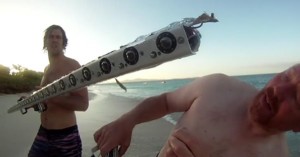
Surf gear company Rip Curl recently teamed up with Time-Slice Films to make a video showing surfers in "bullet time". Rather than use a giant DSLR rig, they decided to make a portable rig composed of 30 GoPro cameras.
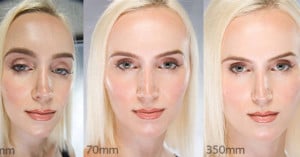
You've probably heard before that focal lengths between 85mm and 135mm produce the best head shots because they provide a desirable perspective in head shots, but how much of a different does the focal length actually make? Photographer Stephen Eastwood decided to find out, shooting 10 portraits of the same subject with focal lengths ranging from 19mm to 350mm.
Sorry if you've had trouble accessing this site so far today. Our hosting provider, Rackspace, is having issues. Hopefully they can get things together soon. If you haven't already, subscribing to our RSS feed and/or daily email is another way to receive our posts! …
After photos of the camera were leaked a week ago, Panasonic has officially announced the Lumix GX1. The camera should satisfy GF1 shooters who loved the camera but were unhappy about the consumer-oriented GF2 and GF3 followup cameras. The 16MP Micro Four Thirds camera features a max ISO of 12,800, a solid build, .09 second autofocus (with iPhone-esque touch to focus), a 3-inch touchscreen, RAW mode, and 1080/60i HD video. The camera ships for $700 (body-only) starting in December 2011.
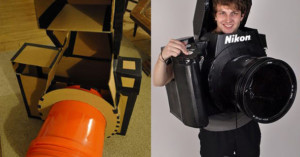
Photographer Tyler Card's uber-creative Nikon DSLR costume was the talk of the photo world this past Halloween. If you've been wondering how he managed to make a fully functional giant DSLR, you're in luck: Card has written up an extensive tutorial explaining how it was done: …
Eric Fossum, the man who invented the CMOS image sensor, recently gave an hour-long lecture at Yale that provides an educational overview of the technology. He covers a wide range of topics, ranging from digital imaging history to the latest state-of-the-art technologies in the sensor field. If you're at all interested in learning how your camera works, this'll be an interesting lecture to take in.
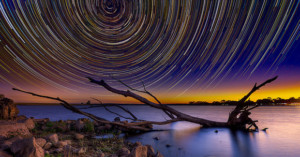
Photographer Lincoln Harrison captures jaw-dropping photographs of star trails. Shooting from the Australian outback, he spends up to 15 hours creating each image of the night sky. Shooting with a Nikon D7000, Nikon D3100, and a wide assortment of lenses, Harrison captures a large number of exposures of the foreground and stars separately. He then combines the images (sometimes hundreds of them) into amazing photographs showing the sky dominated by colorful star trails.
Here's a helpful tutorial on how to adjust the angle of your light sources to avoid the nasty reflections that show up in eyeglasses. It has to do with understanding and harnessing the "angle of incidence" and "angle of reflection" of your light.
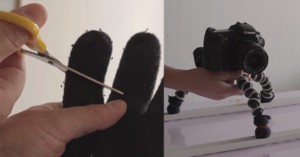
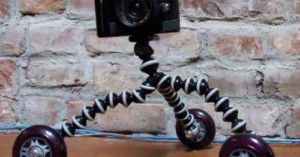
Photographer Peter Wirén came up with a super cheap and easy way to record sliding shots using his DSLR. Instead of buying an expensive slider or dolly system, he simply cut the fingers off an old glove and used them as "socks" on his GorillaPod.
Here's a helpful video that attempts to demystify the concept of DSLR sensor sizes. If you've never been able to understand how sensor size (and its crop factor) affects resulting photographs, this video will help.
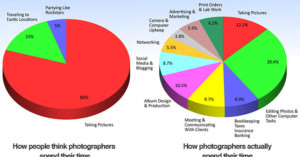
The International Society of Professional Wedding Photographers did a study a couple years ago on how photographers spend their time, and published these two charts showing the difference between what the general public thinks and what is actually the case. Here's a larger version.
Update on 12/18/21: This video has been removed by its creator.
A few weeks ago, Brooklyn resident Katie O'Beirne did a weekend project in which she left a disposable camera on a Prospect Park bench with a note asking passer-bys to snap a photograph. After getting the film developed and finding some cool photos, O'Beirne decided to continue with the project, leaving disposable cameras in a number of other spots around NYC. The resulting photographs can be seen on a Tumblr page she set up called "new york shots".
Update: For some reason the video is now showing as "expired". Not sure why.
Kodak's fall from grace is an interesting case study that modern day companies can learn from. Even though the world's first digital camera was invented by one of its engineers, the company was unwilling to cannibalize its film business that, at the time, was making money hand over fist. By the time digital cameras started catching on, Kodak had missed the boat.
Ever wonder why most DSLR cameras capture images with a 3:2 aspect ratio, while most other cameras use 4:3? It's because they were designed to match different things: …
This photograph by Jimmay Bones, titled "Eye of the City", shows a mirrored cityscape of New York City. It's neat how the Empire State Building is connected to itself, transformed into a giant pillar holding up the "sky". The photo reminds us of Simon Gardiner's vortograph of the Champs-Élysées that we shared recently.
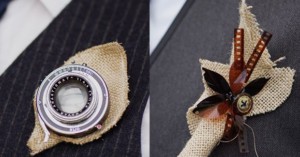
When husband and wife photography duo Jodi and Kurt got married last year, they were determined to do something photography-related for the guys' boutonnières. Luckily for them, Kurt's sister Lynn is a brilliant wedding stylist who helped make these one-of-a-kind designs. Kurt's featured an old camera lens, while the best man's was a flower made from film negatives.
This short film, titled "Mobius", is one of the short films Canon screened at last night's Hollywood announcement for the EOS C300 and concept cinema DSLR. It was made by Vincent Laforet, who was also selected to test the Canon 5D Mark II and Canon 1D Mark IV.
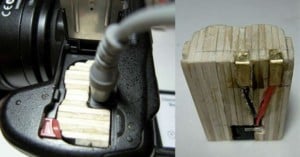
Many digital cameras are battery-only, and can't be directly connected to an outlet for an infinite source of power. That's ordinarily not a problem, but can become an issue if you attempt to do things like time-lapse imagery, for which the camera needs to stay powered and perfectly stationary for extended periods of time. That was the problem faced by Instructables member txoof with his Olympus E520. Handy with electronics and woodworking, he decided to build his own AC/DC interface for the …
The new "EOS Movies" C300 digital video camera wasn't the only thing Canon had up its sleeve today. The company has also announced that it's working on a new EOS DSLR that's geared more towards filmmakers than photographers. Not much was revealed about the camera, but it'll be a 35mm full frame DSLR that can capture 4K video at 24fps. While recent EOS DSLRs have been still cameras that happen to have video capabilities, this new one seems to be much more geared towards having video being its …
Canon's historic announcement is here, and as most people predicted, it's geared towards filmmaking rather than photography. The company just unveiled its new C300 cinema camera in an effort to break into a Hollywood digital filmmaking scene that's dominated by the Arri Alexa and the RED EPIC. While it's not particularly powerful in any specific category, the new camera comes in EOS or PL lens mounts, shoots 1080p video with a 4K sensor, has dual CF card slots, and offers high quality footage …
Dutch artist Purr Anders transforms old photographs into beautiful jewelry. After printing the images onto fabric, Anders crafts them into leaf and flower-shaped brooches. You can visit her Etsy store to order a custom one for $37.
Sophie Windsor Clive was canoeing on the River Shannon in Ireland when she came across one of nature's most beautiful phenomenon: a murmuration of starlings. This is when vast numbers of starlings fly together in giant, cloud-like formations. Luckily for Sophie, she had her camera handy.
Here's something you've probably never seen before: a white "L" version of the cheap Canon 50mm f/1.8 (AKA the "nifty fifty"). No, it's not an uber-rare and expensive special edition. It's a custom paint job by Clubsnap forum member nntenzo.
This amazing photograph by Ricardo Mohr shows the volcano Puyehue-Cordón Caulle in southern Chile erupting this past June. After being submitted to National Geographic's My Shot photo community, the photograph was selected as one of the magazine's "Pictures We Love: Best of October." You can download a high-res version to use as a wallpaper here.
Want to see what pure dedication looks like? This music video for the song "In Your Arms" by Kina Grannis is a stop-motion animation done with a background composed of jelly beans. It's a crazy project that required 22 months, 1,357 hours, 30 people, and 288,000 jelly beans. They could have used CGI, of course, but each frame was carefully created by hand and photographed with a still camera. It's even more mind-blowing given this fact: none of it was done with a green screen.
It's not uncommon to hear stories of wedding photographers getting sued by unsatisfied clients, but one lawsuit currently underway in New York is causing quite a stir. Todd Remis (pictured on right) of Manhattan is suing 65-year-old studio H & H Photographers (on left), claiming that the photographers had missed the final 15 minutes of the wedding that included the last dance and bouquet toss.
Barcelona-based design studio low ink created this unique business card for freelance photojournalist Hugo Fernandez. It's a viewfinder with a see-through focusing screen and the photographer's contact information in the information readout at the bottom!
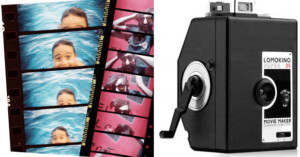
Lomography has launched the LomoKino, the world's first consumer 35mm movie camera. It's an old-school hand-cranked camera that uses standard rolls of 35mm film (yeah, the kind you use in film cameras). The camera captures 144 individual frames onto each roll of film, producing a video that lasts 50-60 seconds. Once you have your film developed, you can watch it using a separate LomoKinoScope: a hand-cranked movie viewer!
Australian college student Nathan Grant created this stop-motion music video for the song 'Minister's Daughter' by the band The Good God Damned. After recording footage of the band playing using a Sony XDCAM, Grant printed out 3,433 photographs from stills in the video. He then spent six months turning the prints into this stop-motion video, capturing the new photographs with a Canon 600D.
There was a minor hoopla yesterday after Boing Boing shared that mugshot photos of arrested Occupy Portland protesters were being uploaded by the Portland Police Department to Facebook.
During the World Series last month, Chevrolet aired a new commercial that might have felt familiar to many of you. Featuring old photographs overlaid on their modern day locations, the concept is identical to the images found on the website Dear Photograph, which we featured back in June.
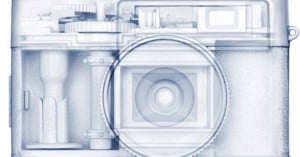
The photographs in artist Max de Esteban's Proposition One project might look like X-Ray images, but they were actually captured with an ordinary camera. They were created by carefully deconstructing old gadgets, photographing them in "layers", then "reassembling" the gadgets digitally. You can see them on display through December 9th at Klompching Gallery in NYC
Jim Harmer of Improve Photography conducted an interesting experiment in which he stacked the Gary Fong Lightsphere up against an ordinary piece of tupperware: …
In the market for memory cards? B&H is currently offering SanDisk Compact Flash cards at crazy prices. They're listing Extreme Pro cards at less than 50% of the price offered at other retailers. For example, a 16GB Extreme Pro card currently costs $60 (with free shipping in the US) from B&H but $130+ at most other places.
'Life In A Day' is a historic crowdsourced documentary film that shows what the world was like on a single day: July 24, 2010. People in 140 countries around the world captured snippets from their lives on that day and submitted 80,000 video clips to YouTube. Oscar-winning director Kevin Macdonald and executive producer Ridley Scott then edited those 4,500 hours of footage into a 95 minute long feature film. After debuting at Sundance and being streamed on YouTube earlier this year, the film is …
Inspired by Noah Kalina's viral everyday video a girl who goes by clickflashwhirr has been doing a similar self-portrait-a-day project. Designer Tiemen Rapati decided to make a composite image showing what the average of the self-portraits looks like. Taking 500 images from clickflashwhirr's Flickr set, Rapati wrote a script that counts the individual RGB values for each pixel, averaging them across the 500 portraits.
If you think you can't compete as a photographer because you're past a certain age, think again. Here's a fantastic quote by National Geographic Editor-in-Chief Chris Johns from an interview he gave back in 2005: …
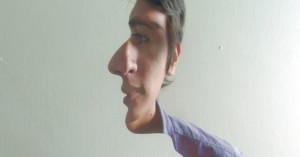
Venezuelan artist Jesús González Rodríguez has a project called 1/2 that features strange Photoshopped portrait illusions. They each show half a face, but is that face looking to the left or towards the camera?
Philip Bloom recently shot this interesting mini-documentary on Anthony Vizzari using a Sony NEX-5N. Vizzari is a guy who collects photographs and cameras, owns a photo shop, and runs a photobooth business. Here's an artist, architect, antiquarian, photographer, and storyteller, and calls himself an "archotographist".
Update: This giveaway is now over. The winner was randomly selected and announced below.
Photographer Sharon Rainis recently collaborated with wedding dress designer Erez Ovadia for an underwater photo shoot in which models wearing wedding dresses were photographed 20-meters under the sea. In an interview with MegaPixel, Rainis shares some of the challenges involved in such a unique shoot: …
The Eatery is a new "photo sharing" app that's focused more on health than photography. Instead of being judged on aesthetics photographs are rated based on whether people think the food is healthy or not. Your "photo habits" are also crunched and turned into useful infographics and statistics about how and when you eat, giving you helpful information that you can use to change your eating habits.
Last week we wrote about an obscure law in Washington DC that can land a person in jail for doing photography for "more than 5 minutes at location". The Washington Post published a clarification stating that the law is targeted at people who make a living taking a portrait for strangers on city sidewalks. However, the National Press Photographers Association isn't satisfied with the explanation, and has written a letter to the city requesting that the "vague" law be repealed: …
Amazon is selling the Photive ML-L3 Wireless Shutter Release Remote for Nikon DSLRs for just $2 with free shipping. The retail price is $30, so it's a crazy 93% discount. No idea if the price will last -- maybe it's a mistake.
Editor's note: Since we featured in back in August, Justin Jensen's Cineskates project has raised nearly half a million dollars. Here's a DIY tutorial by Ed Lewis on how to make your own.
Photographer Joey L had the great idea of setting up a backdrop on a Brooklyn street and photographing the characters that strolled by while on the hunt for Halloween candy. Shooting sidewalk portraits of strangers is a great way to hone your skills, especially on a day when many people are more than willing to have their photo taken.