Sigma in 2025: The Best Performance of Any Photo Company This Year
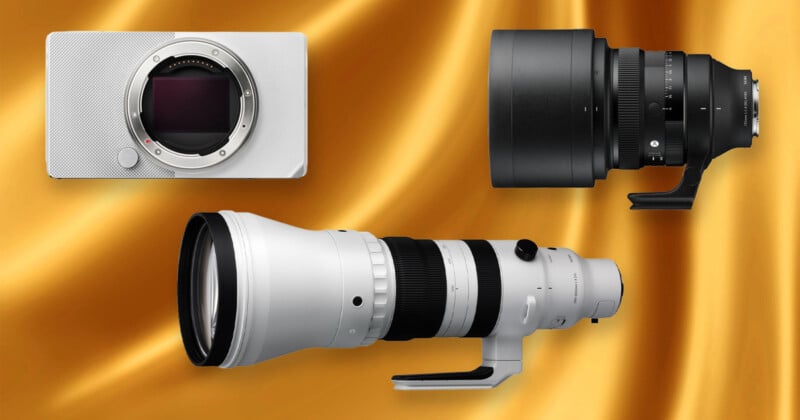
I saved the best for last. Sigma had a truly remarkable year, launching a beautiful new camera and a diverse, large array of incredible lenses. There’s a very good reason Sigma was PetaPixel‘s Photo Company of the Year for a second straight year. The company even rebranded! There’s a lot to cover, so let’s get right to it.
The Sigma BF: A Beautiful, Unusual Camera
Whenever Sigma releases a camera, there’s something strange about it. From compact box cameras like the fp L to butter stick-styled cameras like the dp3 Quattro, Sigma’s camera design always strays from tradition and normalcy. Sometimes that’s not such a great thing, but in the case of 2025’s Sigma BF, I’m grateful that Sigma approaches camera design with boldness few other companies would dare to.
Beautiful, sleek, and very time-intensive to make, the Sigma BF is a 24-megapixel full-frame camera that goes all-in on a relatively simple photographic experience. The camera may not sport the long-awaited and still-in-development full-frame Foveon sensor I so desperately want, but the BF still has competitive features. The Sigma BF embraces the joy of photography, and it delivers a special experience because of this commitment.
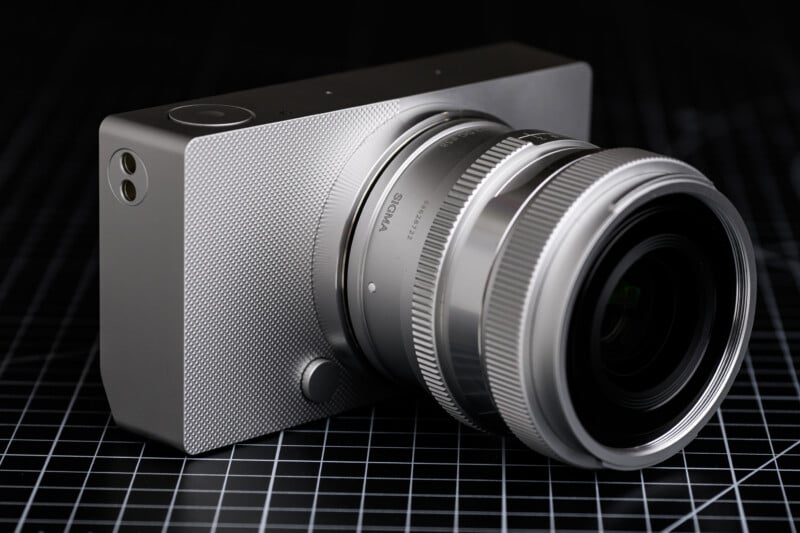
But a camera as radical as the BF is bound to have some detractors. PetaPixel‘s Chris Niccolls believes the camera may have stripped away too much in pursuit of simplicity and elegance.

“As a company, Sigma loves to make unique camera designs that eschew the commonly held rules that so many other manufacturers stick to. You have to respect the boldness it takes to do this but in my opinion, that doesn’t always make for a great camera. I have often criticized Sigma cameras for being incredibly bold at the expense of basic usability and it looks like I’m right back to doing it again with the BF,” Niccolls wrote. “Clicking photos here and there about town is absolutely fun but the moment I wanted to take control and do something more manually, the fun factor waned.”

While not everyone may love the actual experience of using the BF to take photos, many of us here love that in a world of mostly similar cameras offering nearly identical experiences, the Sigma BF provides something different. It may not be for everyone, it certainly isn’t for me, but when everything clicks, the BF offers a feeling no other new camera in 2025 can. Sigma isn’t shaking its “weird camera” reputation anytime soon, and I think photographers are better for it.
Sigma’s Lenses in 2025 Are Superb
While Sigma released a new camera this year, which is actually unusual for the company, it is best known for its lenses, and wow, did Sigma deliver great glass in 2025. From budget-friendly to professional-grade lenses, Sigma offered something for nearly everyone this year. Oh, and Sigma launched a brand-new cinema prime lens series comprising a dozen lenses, in case the company didn’t seem busy enough as it is.
Sigma kicked things off with a pair of zoom lenses announced in February, albeit two very different ones for vastly different photographers. Starting with the admittedly less exciting of the two, the 16-300mm f/3.5-6.7, for APS-C cameras. This lens for Sony E, L-Mount, Fujifilm X, and Canon RF delivers a 24-450mm equivalent (26-480mm on Canon cameras) focal length range, which is very versatile.
The lens is only less exciting than the next one because it’s an APS-C travel zoom, which is not particularly unusual. But make no mistake, this is an excellent APS-C zoom lens.


“Sigma has given us an eminently convenient optic that combines ruggedness, compactness, and versatility into one package. However, like the super-zoom lenses of old, being a jack-of-all-trades comes with some compromises and the Sigma 16-300mm cannot escape some of the issues that commonly plague such lenses,” Chris Niccolls concluded, before stating that although the lens is imperfect, it’s very good, fun, and a slam dunk for those who value versatility in their APS-C kit.
Sigma’s second new zoom announced in February was the incredible, groundbreaking 300-600mm f/4 DG OS Sports. This first-of-its-kind 300-600mm f/4 zoom lens is perfect for sports and wildlife photographers alike, and despite being $6,000, is actually a relative bargain. First-party 600mm f/4 primes are much more expensive than the Sigma 300-600mm f/4 DG OS Sports, and lack the versatility of Sigma’s new lens.
We named the Sigma 300-600mm f/4 DG OS Sports PetaPixel‘s Zoom Lens of the Year, and frankly, it wasn’t that close. The 300-600mm ran away with it.
“What certainly impressed me was the level of detail and sharpness that the Sigma could deliver,” Niccolls wrote. “Regardless of whether you shoot at f/4 or stopped down, and at any given focal length, the 300-600mm has the resolving power it needs. This makes the entire lens useful because there is no point in its range that you would want to avoid using for any reason. I think most professional wildlife and sports shooters would be impressed with the wide-open performance of the Sigma 300-600mm versus any of the available prime alternatives.”

PetaPixel contributing writer Kate Garibaldi also went hands-on with the Sigma 300-600mm f/4 for a follow-up story, focusing on using the lens for wildlife photography.

“As someone who sits at the proverbial table of the target market for this lens, a photographer looking for the reach of 600mm, a bright aperture, and the versatility of a zoom at a price that remains attainable for fortunate photographers, I am pleased to give this lens my seal of approval,” Garibaldi concluded.
I’m going to skip the Sigma Aizu primes for now, which were announced in early June, to focus on Sigma’s second APS-C zoom lens of 2025, the 17-40mm f/1.8.
This lens, much like the 16-300mm near the start of the year, delivered a modern reimagining of a classic Sigma APS-C zoom lens. This time, it was the beloved 18-35mm f/1.8 DC HSM Art lens that got the mirrorless treatment. The Sigma 17-40mm f/1.8 DC Art offers a wider focal length range than before and is a dynamite option for photographers and videographers alike.
The new lens did not deliver quite the performance we expected or hoped for, but it is still a rare breed among APS-C zoom lenses, delivering a versatile focal length range with a fast, constant f/1.8 aperture.
DSC00372 Sigma’s CEO Kazuto Yamaki | Photo by Chris Niccolls
“If you need a decent general zoom with good light-gathering capabilities, the Sigma will take good care of you,” Niccolls wrote.
Sigma didn’t wait long before announcing more new lenses. In August, the company unveiled the Sigma 12mm f/1.4 DC Contemporary, yet another APS-C lens, and the awesome 200mm f/2 DG OS Sports for full-frame cameras.
The Sigma 12mm f/1.4 DC Contemporary offers an 18mm equivalent focal length, fast f/1.4 aperture, and compact form factor. It is not just impressively small, though, it is also optically excellent.

“This is an absolute gem of a lens, and it leaves me with almost nothing to complain about. You really get a complete package with few issues to speak of,” Niccolls concluded.
The Sigma 200mm f/2 DG OS Sports beat the Laowa 200mm f/2 to become the world’s first 200mm f/2 telephoto prime lens for full-frame mirrorless cameras, and it also offers much better performance than Laowa’s lens. The Sigma 200mm f/2 is an excellent lens for sports photography and can also be used for portraiture.
Back in the DSLR days, Canon and Nikon both made fast 200mm primes. For whatever reason, despite these older lenses being beloved, no company had taken a crack at the 200mm f/2 concept in the mirrorless era. At least until this year, when we got two of them. The Sigma 200mm f/2 is a stunning example of what makes this type of lens so special.

“The Sigma 200mm f/2 Sport is just such a pleasure to use. Optically, this lens is unrivalled right now, with excellent sharpness and a unique look to sports compositions thanks to the shallow depth of field and beautiful bokeh. I didn’t find the weight to be overly difficult to carry, and the controls and functions are easy to use,” Niccolls wrote.

“This lens provides a unique look that transcends use meant exclusively for sports and action. Photographers shooting concerts, portraits, weddings, and street will all find something to love.”
PetaPixel named the Sigma 200mm f/2 DG OS Sports an Official Selection in this year’s PetaPixel Awards.
Five lenses later, Sigma was far from done. In September, the prolific Japanese company announced three more lenses, all at once. The Sigma 20-200mm f/3.5-6.3 DG Contemporary, the Sigma 35mm f/1.2 DG II Art, and the Sigma 135mm f/1.4 DG Art all offer something different, and each are excellent. Two of them are also first-of-their-kind lenses, for what it’s worth. Sigma did that a lot this year.
The Sigma 20-200mm f/3.5-6.3 DG Contemporary is the world’s first full-frame 20-200mm zoom lens and promises a ton of versatility for travel and general-purpose photographers. As it turns out, it’s not just unique, it’s also good.

“The large zoom range and especially the opportunities afforded by the 20mm focal length at the wide end makes this lens extremely versatile, and the image quality is high where it counts,” Chris Niccolls said.
As good as the Sigma 20-200mm is, especially given its versatility, Sigma’s two other lenses are even more impressive optically.
The Sigma 35mm f/1.2 DG II Art is smaller, lighter, and sharper than its predecessor. It is fast but not large, sharp but not terribly expensive, and just really darn good.

“If you want a 35mm capable of incredible subject isolation in a relatively small package, the Sigma is the best choice out there. Hitting the streets and looking for unique images is a pleasure, not a burden, thanks to Sigma’s latest technology,” wrote Jordan Drake.
Drake also loved the Sigma 135mm f/1.4 Art, a first-of-its-kind fast telephoto prime lens for full-frame mirrorless cameras. While we have seen plenty of great 135mm f/1.8 primes in the past few years, a 135mm f/1.4 sounds even more enticing.
The fast aperture comes at a cost, as the Sigma 135mm f/1.4 is a beefy lens, but it is magnificent. It is PetaPixel‘s Prime Lens of the Year and arguably an optically perfect lens. Yes, perfect.

“The Sigma 135mm f/1.4 DG Art is, effectively, optically flawless. Sure, it’s not a macro lens, and videographers will be dismayed by the breathing, but for its intended purpose of posed portraiture, candids, and sports photography, this lens has no weaknesses. I absolutely loved the aesthetic it can produce, especially for full-body shots taken from a distance,” Drake concluded. Praise gets no higher than that.
That’s it for Sigma’s photo and hybrid lenses of 2025, which leaves the company’s 12 Aizu cinema primes. I will not be talking about each of them separately, as they were announced all together and are, essentially, a cohesive set that makes the same promises across the board, from the widest 18mm to the longest 125mm optic. All the lenses sport class-leading T1.3 apertures, identical designs and form factors, and promise the same “organic and naturally soft look.”
We’ve used them for different projects this year, including shooting PetaPixel‘s documentary film, “No Guarantees.” PetaPixel YouTube Director Jordan Drake has also used the lenses for numerous reviews, and most recently, our tour of Sigma’s headquarters in Japan.
“Overall, the Aizu Prime lenses have extremely impressive optics considering the ambitious aperture range and sensor coverage. There are drawbacks to be aware of, but I was constantly impressed by the distinct rendering these lenses can achieve,” Drake said of the Aizu Primes. The Sigma Aizu cinema lenses deliver clean, sharp images that still have charm and character. As Drake celebrated, “That’s a rare combination.”
Grading Sigma in 2025
What an incredible year for Sigma. I didn’t think the company could top its performance in 2024, but somehow, it did. Not every new Sigma lens is optically incredible, and the BF is not the perfect camera for everyone. However, Sigma released a ton of products this year without ever sacrificing what makes Sigma special. And make no mistake, Sigma is a special company.
I will kick myself for saying this, but I don’t see how Sigma could top this performance next year. Full-frame Foveon, maybe? A man can dream.
Grade: A+
Image credits: Header photo created using an asset licensed via Depositphotos.