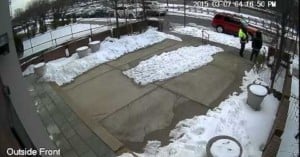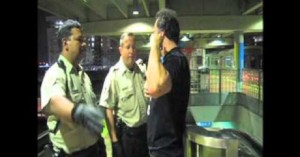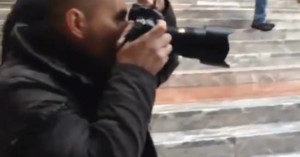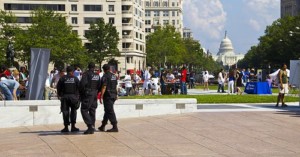
Elizabethtown, Pennsylvania-based photographer Jason Macchioni was recently shooting a time-lapse project from an overpass at night when he was approached by police officers who demanded his ID and threatened to arrest him for wiretapping (Macchioni was recording video of the encounter). Macchioni tells us,
I was shooting a time-lapse which I’m still working on, I arrived at this site around 9 and was there for about 3 hours until these two cops rolled up! At first I was calm and refused to give ID, After the second cop was breathing down my neck and really threatening me. I gave in and tried to get them to leave. Then stuff got heated.
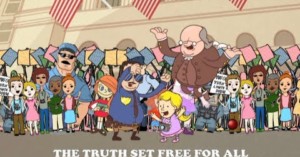
Macchioni has enlisted the help of the ACLU in filing a complaint with the police department. Want to learn more about your rights as a photographer in the US? Check out this short cartoon the ACLU released earlier this month.
Want to inform someone of their right to take pictures in the US? Just share this short cartoon created by the ACLU, Joseph Gordon-Levitt, and The Gregory Brothers. It features Benjamin Franklin’s ghost, who sings about the various things you’re legally allowed to do without being harassed by law enforcement.
Here’s a disturbing video called “If You See Something, Film Something” that shows why it’s important that citizens have the right to turn cameras on the activities of police officers without being stopped or harassed:
The United States has growing problem with police abuse, brutality, and corruption. It is essential for civilians to document their encounters with police officers to ensure transparency, accountability, and safety to all of those involved.
Police departments have, for too long, tried to bully, intimidate, threaten, arrest, or otherwise harass law abiding citizens from recording the activities of law enforcement in public. Enough is enough! It is time for all of us to take a stand and expose police brutality when we witness it.
Be warned: the video contains many graphic scenes of police brutality…
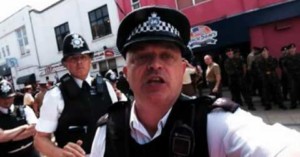
A UK photographer who goes by the moniker Hamstify was documenting his town Scunthorpe late last year when he was confronted by security personel outside a Golden Wonder plant and ordered to stop photographing. He was shooting from a public location, so he decided to stand up for his rights and film the argument that transpired. On VisitScunthorpe.com, he writes,
What also aggrieves me is that someone in a uniform representing a company in an apparent position of authority can try and intimidate members of the public by making up laws that don’t exist. This seemed to be an attempt to subjugate a member of the public into accepting what was being told was to be true. Further more hurling offensive insults and puerile slander, like seen at the end of the video, surely isn’t something that someone in that position should resort to.
In general, for UK residents, photography from public places is perfectly legal. There are some exceptions (e.g. buildings critical to national security), but the general rule of thumb is that if you’re shooting from public property police and security guards don’t have the power to stop you.
16-year-old photographer Jules Mattsson has won a settlement from the London Metropolitan Police after being stopped and detained last year while photographing the Armed Forces Day parade. Here’s Mattsson’s account of what happened:
I was detained by Police in Romford after taking an image of a cadet unit who were about to march in a massive parade in front of thousands of people with cameras. I was told it was an offence to photograph a child, then an offence to photograph the military, then an offence to photograph the police then that I was a threat under the terrorism act. I was frog marched with my arm painfully twisted away from the public eye and any witnesses and pushed down a set of stairs. The police illegally tried to take my details on several occasions also. [#]
In addition to the financial settlement paid to Mattsson early last week, the police department has also apologized for its actions.
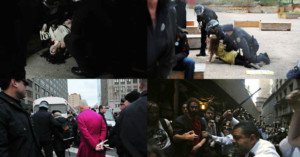
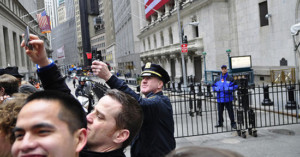
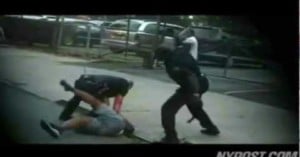
The New York Times has sent an angry letter to the New York Police Department after video emerged showing photojournalist Robert Stolarik being pushed around and then blocked while trying to photograph officers arresting Occupy Wall Street protestors. The memo itself hasn’t be published, but NYT VP and assistant general counsel George Freeman is quoted as saying,
It seemed pretty clear from the video that the Times freelance photographer was being intentionally blocked by the police officer who was kind of bobbing and weaving to keep him from taking photographs
The department has acknowledged receiving the note from the NYT, but has not issued a formal response yet. This incident comes just weeks after Police Commissioner Raymond Kelly ordered officers to avoid unreasonably interfering with media access during news coverage. Read more…
Three years ago, an Illinois man named Michael Allison was arrested for videotaping police in public in accordance with the state’s extremely strict wiretapping laws. He faced up to 75 years in prison for his crime, but a few months ago an Illinois judge ruled that the laws were unconstitutional and threw out the case. However, the State of Illinois is now appealing to the Supreme Court to have the dismissal overturned.
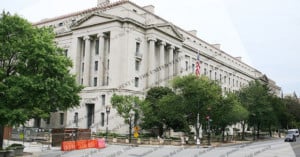
Last week we wrote about an obscure law in Washington DC that can land a person in jail for doing photography for “more than 5 minutes at location”. The Washington Post published a clarification stating that the law is targeted at people who make a living taking a portrait for strangers on city sidewalks. However, the National Press Photographers Association isn’t satisfied with the explanation, and has written a letter to the city requesting that the “vague” law be repealed:
[...] these three vague and incrementally overly broad sections taken together could be interpreted to mean that any photographer taking a photograph of anything, be it a building, person or inanimate object for longer than five (5) minutes would be in violation of the regulations and subject to fine or arrest [...] We contend that this licensing scheme, based upon regulations that are facially inconsistent with the protections provided under the First Amendment, is unconstitutional.
[...] these facially defective regulations will only further contribute to the erroneous belief by law enforcement that public photography may be arbitrarily limited or curtailed.
The NPPA also writes that they’re concerned that the law could be used against photographers covering events such as “Occupy Wall Street”.
The ACLU of Southern California has filed a lawsuit against the Los Angeles County Sheriff’s Department and several of its deputies, claiming that they unlawfully harassed, detained, and searched photographers simply because they were taking pictures. The suit asks the court to instruct the Sheriff’s Department to stop detaining citizens on the basis of photography, and also seeks damages. ACLU attorney Peter Bibring tells the LA Times,
Photography is not a crime. It’s protected 1st Amendment expression. It violates the Constitution’s core protections for sheriff’s deputies to detain and search people who are doing nothing wrong. To single them out for such treatment while they’re pursuing a constitutionally protected activity is doubly wrong.
One of the confrontations cited by the lawsuit was captured on camera, and can be seen here. The Los Angeles Times notes that similar lawsuits have been filed in other states as well. Earlier this year the Long Beach police department came under fire after it came to light that officers were instructed to be on the lookout for photos with “no apparent aesthetic value”.