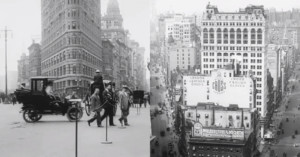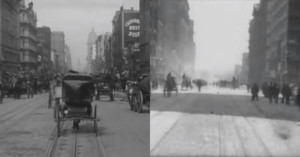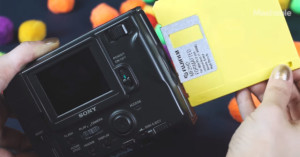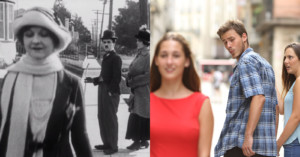
Two years ago, San Francisco-based photographer Shawn Clover began to create an amazing series of images, titled 1906 + 2010: The Earthquake Blend, featuring photographs captured during the devastating 1906 San Francisco earthquake blended into views of what the city currently looks like. Read more…
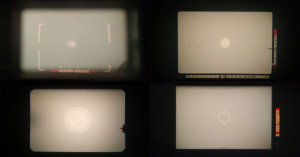
Did you know that Atari was once in the “photo” making business? In 1975 — 3 years after it’s founding — the young video game company launched the Compugraph Foto, a large coin-operated machine that snapped photos and printed them out as ASCII portraits. Subjects stood in front of a monitor showing their face and then pressed a series of buttons, triggering the 950-pound machine to print out the portrait as a 14×11-inch “photo” on computer paper. Read more…
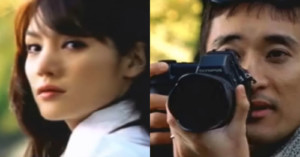
Check out this blast from the past: it’s a 1986 commercial for the Minolta Maxxum 7000.
The Minolta 7000 was the first successful auto focus SLR using a motor integrated in the camera body. It was released in 1985 together with 11 lenses, 2 flashguns and a complete lineup of accessories. The 7000 featured one AF-sensor, shutter speeds of 1/2000 to 30 seconds, flashsync speed of 1/100s, exposure compensation of +-4EV in 0.5 exposure steps, center-weighted lightmetering and two frames per second film advance. [#]
The AF system was marketed as Maxxum in North America and Alpha (α) in Asia. When Sony acquired Konica Minolta in 2006, it kept the Alpha brand name for its new DSLR system, which used the old Minolta lens mount. Hence, Sony Alpha DSLRs.
Back in the late 1800s and early 1900s, while the world was still shooting black and white photographs, Russian photographer Sergey Prokudin-Gorsky was busy inventing techniques for creating color images. Credited with capturing the only known color photo of Leo Tolstoy, Prokudin-Gorsky’s technique involved capturing three separate monochrome photographs of the same scene, each captured through a red, green, or blue filter. He would then project the three slides using colored lights, which reconstructed the original color scene. Since the images were captured at different times, any changes in the scene caused my movement show up as ghosted images (similar to what happens in HDR photography). Read more…
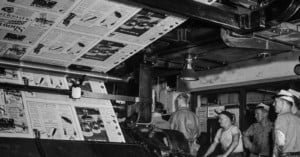
The New York Times has launched a new Tumblr site called “The Lively Morgue” to breathe new life into items in the newspaper’s photo archive (nicknamed “The Morgue”). Each week they’ll be sharing several historical photographs found in massive collection. Just how massive?
We don’t know. Our best guess is five million to six million prints and contact sheets (each sheet, of course, representing many discrete images) and 300,000 sacks of negatives, ranging in format size from 35 millimeter to 5 by 7 inches — at least 10 million frames in all. The picture archive also includes 13,500 DVDs, each storing about 4.7 gigabytes worth of imagery. When the Museum of Modern Art set out to exhibit the highlights of the Times archive in 1996, it dispatched four curators. They spent nine months poring over 3,000 subjects, working with two Times editors, one of whom spent a year on the project. In the end, they estimated that they’d seen only one-quarter of the total. [#]
To make the project even more interesting, they’re also publishing an image of the reverse side of each print. This often reveals information such as how often the image was used, notes by the photographer, and the original caption that was chosen.
This photo shows what 5MB of hard drive storage looked like in 1956. The IBM 305 RAMAC hard disk was state of the art, weighed just shy of a ton, required a forklift to be carried around, and was composed of 50 separate 24-inch discs that occupied 16 square feet. The annual cost of using it was a staggering $35,000 — steep even in today’s money. Nowadays most RAW photos outweigh the storage capabilities of that behemoth of an external hard drive…
Here’s a fun blast from the not-so-distant past: the video above is a short clip from the TV show “Call For Help” that originally aired back in September 2003. In it, tech broadcaster Leo Laporte chats with digital photography pioneer Mikkel Aaland — who, by the way, was introduced to digital cameras by Ansel Adams — about the evolution of digital cameras up to that point. It’s an interesting glimpse into a time when the Nikon D100 was the state of the art.
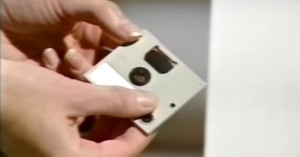
Here’s a neat blast from the past — a Kodak Instamatic commercial from the 1960s, when the latest technology was the ability to take four flash photographs without changing bulbs. “Four full power flashes in one tiny cube!”. The camera set was priced at $18, which is about $131 when adjusted for inflation.