Posts Tagged ‘safety’

Case With Built-In Cameras Reveals the Journey of Checked Baggage

Earlier this month we shared some advice from an anonymous airline baggage handler, who revealed that hard-sided “spinners” suitcases are safest if you must transport valuables (e.g. camera gear) in checked baggage. To see why, check out the video above by Delta Airlines. They drilled holes into a hardcase and installed six outward-facing cameras to document what a bag goes through after it disappears behind those black rubber flaps and before it emerges onto the conveyor belt in the baggage claim area. The video doesn’t show any abuse, but there’s a number of points along the journey where careless handlers have the opportunity to mishandle bags.

(via Laughing Squid)

Why Camera Gear May be Safest in a Four-Wheeled Suitcase When Flying

Why Camera Gear May be Safest in a Four Wheeled Suitcase When Flying airplane mini

You probably already know that it’s not a good idea to include your expensive camera gear with check in luggage, but what if you have no choice? If you must, then putting your gear inside a hard-sided “spinner” suitcase with four wheels is your best bet. The Huffington Post has published an interesting interview with an anonymous baggage handler, who gives the following advice:

Hard-sided suitcases will get less damage, but also look for well-designed handles that are attached with rivets and some sort of protection around the wheels. Speaking of wheels, the best bags to get are the “spinners” with four wheels on the bottom. We like these because we don’t have to throw them when loading. We just roll them down the belly of the plane so your bag and its contents will suffer much less damage.

The handler reveals that bags are commonly subjected to all kinds of abuse due to the strict schedules the handlers must abide by.

Confessions of An Airline Baggage ‘Thrower’ (via Lifehacker)


Image credit: airplane by shyb

Are Film Canisters Safe for Storing Food?

Are Film Canisters Safe for Storing Food? saltshaker

A neat way to reuse film canisters is to poke holes in the lids and turn them into salt shakers, but some people argue that this may expose you to the harmful chemicals that leak out of film and into the plastic of the canister. It’s actually a question that Kodak has received a lot over the years, and they say it shouldn’t be a problem as long as you wash it out first:

To protect the film from contamination, Kodak quality standards require that the insides of the containers must be exceptionally clean. No “toxic” materials leach out or offgas from the containers themselves.

[...] Newspaper and magazine articles have mentioned “toxic residues” in the containers which might come from the film. There are none. The chemicals in a roll of film are embedded in the gelatin emulsion layers (about as thick as a human hair) and do not rub off the plastic film base.

[...] In summary: There are no “toxic residues” in Kodak film containers [...] if a customer chooses to use a Kodak film container for other than film storage, the container first should be thoroughly washed with soap and water.

They also state that if you (or your pet) accidentally eat some film itself, the main concern would be the film cutting your innards rather than chemical poisoning.

35mm Film Containers [Kodak]

How to Secure a DSLR When Shooting from Great Heights

How to Secure a DSLR When Shooting from Great Heights securecamera

When we shared the practice of “rooftopping” (climbing to the tops of skyscrapers and taking pictures from the edge) a couple days ago, some commenters pointed out that accidentally dropping your camera could kill someone on the ground. Well, Reuters photographer Mark Blinch had a “rooftopping” adventure of his own recently at the CN Tower in Toronto, which just launched an attraction called “EdgeWalk” that lets you walk hands free 356m (1,168ft) off the ground. Blinch describes how the crew secured his gear:

The morning started when the tower’s safety personnel attached all manner of clips and cables to my cameras so they could fasten them securely to the bright red jumpsuit they gave us to wear. I brought up a Canon 5d Mark II with a 16-35 wide zoom, and a Nikon D3s with a 24-70. The memory card slots, eyepiece, and battery doors of both cameras were all taped down to make sure nothing fell off. I have dropped a camera maybe once or twice in my life, and I knew this wouldn’t be the time to have an accident.

If you’re planning on doing any kind of photography where butterfingers could kill more than your camera, you might want to try this method of tape, clips, and cables.

Teetering on the edge [Reuters]


Image credits: Photographs by Mark Blinch/Reuters and used with permission

Real vs. Counterfeit Nikon Accessories

Real vs. Counterfeit Nikon Accessories counterfeit

One sad truth about the photo industry is that there’s a ton of counterfeit products floating around, and unless you buy directly from a reputable source, it can be difficult to know for sure whether you’re getting the real thing. Last month we posted on how up to 1/3 of memory cards labeled “SanDisk” are actually counterfeit. Over on Nikon’s website, there’s a support page that shows photographs of counterfeit Nikon accessories next to genuine ones, with many of them almost indistinguishable from each other. Some of the counterfeit products are so real-looking that the only difference is a slightly different screw, or a slightly brighter logo.
Read more…

Be Careful When Storing Your Camera Gear Behind Zippers

Think your camera gear is safe in your zippered bag just because you have have sliders locked up? Think again. This video shows how easy it is to break into a zippered bag without leaving a trace.

Yet another reason you should try and keep your gear in sight at all times.

Protect Your Gear by Flying with a Gun

Protect Your Gear by Flying with a Gun flyingwithguns

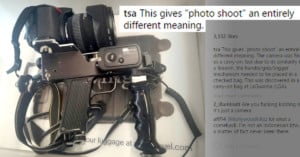
A few days ago we came across this brilliant trick for protecting your valuable camera gear while flying. Most airlines don’t allow you to fly with your luggage locked, but there’s a clever way around the rule — bring a gun.

No, we’re not advocating violence, and no, you don’t need a real gun at all:

A “weapons” is defined as a rifle, shotgun, pistol, airgun, and STARTER PISTOL. Yes, starter pistols – those little guns that fire blanks at track and swim meets – are considered weapons…and do NOT have to be registered in any state in the United States.

I have a starter pistol for all my cases. All I have to do upon check-in is tell the airline ticket agent that I have a weapon to declare…I’m given a little card to sign, the card is put in the case, the case is given to a TSA official who takes my key and locks the case, and gives my key back to me.

That’s the procedure. The case is extra-tracked…TSA does not want to lose a weapons case. This reduces the chance of the case being lost to virtually zero.

It’s a great way to travel with camera gear…I’ve been doing this since Dec 2001 and have had no problems whatsoever.

If you’ve ever lost anything valuable while flying, or have had anything mishandled and broken (I have), this might be a good way to ensure your gear’s safety.

Expensive Cameras in Checked Luggage (via Boing Boing)


Image credits: B A N G ! by mr.beaver and Lufthansa by caribb