One of the big stories in the tech world this weekend was a policy brief published by the Republican Study Committee titled “Three Myths About Copyright Law and Where to Start to Fix It,” which people called “shockingly sensible” and a “watershed” paper. However, just one day after it went up, the paper suddenly vanished. Read more…
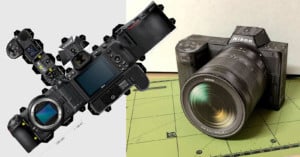
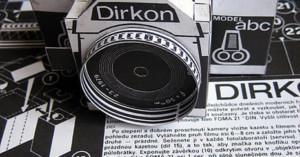
The Dirkon pinhole 35mm camera is made entirely from paper cut from a template by designers Martin Pilný, Mirek Kolář and Richard Vyškovský. The three published the template in a 1979 issue of Czechoslovakian magazine ABC mladých techniků a přírodovědců (translated as An ABC of Young Technicians and Natural Scientists). While original prints of the magazine are rare, the Dirkon gained cult popularity in Chzechoslovakia. Read more…
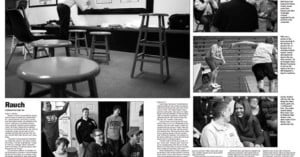
Shirking expectations of both its size and location, the paper has produced some of the country’s best documentary photography and most thoughtful presentations since the late ’70s.
[...] The paper, a tabloid instead of a broadsheet, has created a following mostly because of its now-famous Saturday photo stories, which combine thoughtful reporting and powerful photography. They’re run ad-free and take up the entire front page plus five additional pages inside, sometimes more.
[...] Because the new Saturday cover features were driven by photography, it was often the photographers who were out finding the stories instead of the other way around. This earned them a newfound respect that has since trickled down.
Today, photographers not only have a real voice in the Saturday features but also in the entire news cycle, bucking a trend of second-class citizenship that still plagues other photojournalists across the country.
Despite the financial downturn in the journalism industry, the paper has had no layoffs and has given its staff a raise every year.
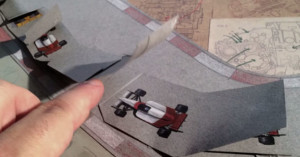
Here’s a neat idea for photographic experimentation: create a pinhole camera out of photographic paper by folding it into an origami box with the light-sensitive side on the inside. The hole that is used to blow the box into its shape is also used to expose the inside to the outside world. After exposing it, simply unfold it and process it using standard developer and fix.

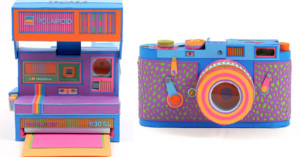
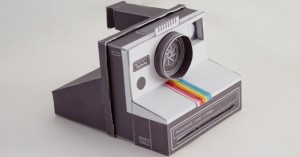
Photographer Matthew Nicholson, the guy behind the amazing Lie-ca paper pinhole camera, is at it again. This time he’s building a working paper camera that looks just like a Polaroid One Step Rainbow camera! Branded as the Fauxlaroid Land Camera, it will apparently use actual instant film that the user “processes” manually.
Samsung made this creative paper camera ad a couple years ago to promote its WB500 compact camera. The magical pencil in the ad would be one heck of a camera accessory.
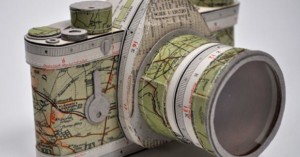
Artist Jennifer Collier uses found and recycled paper as if it were fabric to recreate common household objects, including cameras! Here are a few that were made using maps, postcards, and letters. Read more…
Artificial lens flare is an important part of making certain computer generated scenes look realistic, but up to this point creating realistic lens flare has been a task that requires a good deal of processing power. Now, researchers have come up with a way to simulating lens flare quickly and accurately, taking into account a large number of physical factors that cause the phenomenon:
The underlying model covers many components that are important for realism, such as imperfections, chromatic and geometric lens aberrations, and antireflective lens coatings.
The video above discusses how the technology works, and also touches on the science behind lens flares. The method is patent-pending, and will be presented later this year at SIGGRAPH 2011.
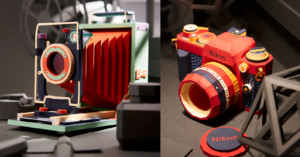
French design duo Zim & Zou (Thibault Zimmerman and Lucie Thomas) these papercraft versions of Polaroid and Leica cameras — they’re super realistic, except the colors are quite trippy! Read more…