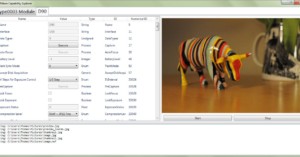
Nikon released software development kits (SDKs) for its SLRs some time ago, allowing for developers to create software that play nice with Nikon cameras. Using the company’s DSLR SDKs, savvy programmers can develop software that controls camera functions such as aperture, shutter speed and even shutter release.
Unfortunately, Nikon’s SDKs are notoriously difficult to work with. But if you’re just dying to control your SLR from your computer, SourceForge user Thomas Dideriksen has kindly done the heavy lifting for you by putting together an open source C# wrapper library that allows you to do just that.
Read more…

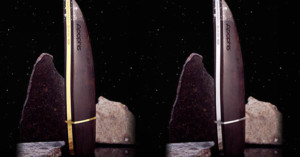
If you’re planning to pick up a $6,500 Hasselblad Lunar mirrorless camera and need a matching USB flash drive to store your photos, you should definitely take a look at the Apophis. It’s a high-end flash drive by Polish firm Zana Design that, like the Lunar, is crafted out of rare materials. How rare? Well, one of the ingredients is meteorite.
Read more…

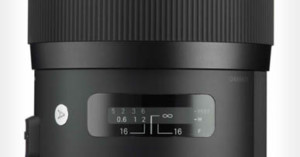
Sigma has officially launched its new 35mm f/1.4 DG HSM lens for Canon-, Nikon-, Sony-, Pentax-, and Sigma-mount cameras. The Japanese-made lens features a sleek matte finish, low dispersion elements, multi-layer flare-reducing coating, a hyper-sonic motor for speedy and quiet AF, and a 9-blade diaphragm for smooth bokeh.
Read more…

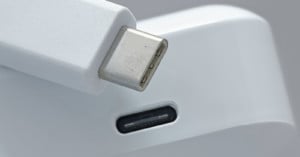
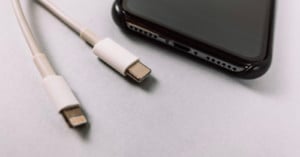
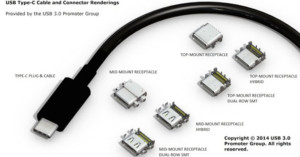
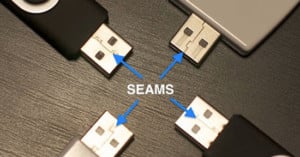
Here’s a simple trick for those of you who find yourself always plugging in USB cables the wrong way on your first attempt: pay attention to the seam on the metal tip. Apartment Therapy writes,
Look closely on the metal tip and you’ll notice that there is a seam on one side of the connector. This seam denotes the contact side of the USB. In horizontal oriented USB ports the seam should face down. In vertical oriented USB ports the seam should face left. If you follow those rules, you’ll get your USB plugged in the right way, the first time, most of the time.
(via Apartment Therapy via Lifehacker)

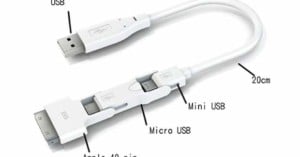
Tired of packing a huge mess of cables every time you go on a trip? The Magic Cable Trio is a 3-in-1 cable designed to cut down on your clutter. It lets you power and sync a wide range of devices ranging from phones, iOS systems (e.g. the iPad), music players, and compact cameras. Just make sure your device uses miniUSB, microUSB, or an iPhone dock connector. The three connections are daisy-chained, making it uber-compact and easy to manage. They cost $20 over at Innergie.
Magic Cable Trio (via Wired)

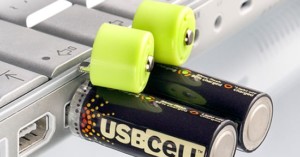
USBCELL batteries might look like ordinary AA rechargeable batteries upon first glance. That is, until you see how they’re charged. Rather than use a battery charger, the batteries are charged using the standard USB ports on your computer or laptop. They could come in handy on trips where you need power for your camera or flash, but want to avoid the hassle of a separate battery charger.
USBCELL AA Rechargable Battery [Amazon]

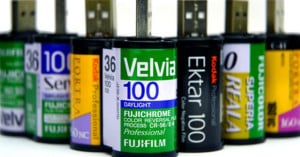
Here’s a funky fusion of analog and digital: Etsy seller newfocus repurposes 35mm film cassettes by using them to house USB flash drives. You can buy a 2GB one for $19 or a 4GB one for $24 from their Etsy store. They would make pretty fun gift for a photography-lover you know, and if you don’t want to buy one you can try your hand at building your own!

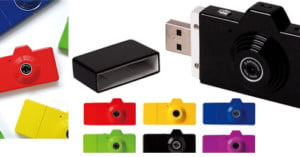
Flash drives are a dime a dozen, but the Fuuvi Pick is a bit different — it functions as a flash drive but doubles as a camera for both still photo and video! There a USB connector on one end, and microSD slot on the other. It shoots 1280 × 1024 (1.3 megapixel) photographs and 720 x 480 video at 30fps. To transfer photographs, simply plug the camera into your computer — like you would with a flash drive or with a Flip camcorder — and it will be recognized as a drive. You can pick one up over at AudioCubes for $60.
Fuuvi Pick (via Trendhunter)

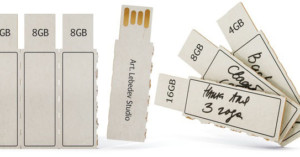
The Flashkus by Art Lebedev is a cheap, disposable, and environmentally friendly cardboard USB stick that might one day make sharing event photos with friends much easier and cheaper. While many websites are geared towards photo sharing, transferring gigabytes of data to friends is still difficult to do via the Interwebs, so people often choose to burn DVDs or use pricey USB drives. The Flashkus would make the process easier by allowing people to simply tear off a USB drive, dump photos onto it, scribble a note onto the front, and hand it off to their friends. Once the photos are downloaded, the drive can be reused or thrown away.
It’ll be available in 4GB, 8GB, and 16GB but currently seems to be in the concept/design stage. Hopefully Art Lebedev adds it to their online store soon.
Flashkus (via Wired)

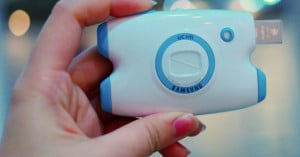
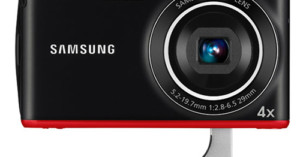
In the current world we live in, it’s often the case that one person taking photographs for a group might promise to share the images as soon as they can but end up forgetting the images in some corner of their hard drive, never to be enjoyed by the other people in the photo. Enter the Samsung UCIM concept camera, designed by Jung Eun Park. Rather than store images onto a memory card owned by one person, it records images onto USB flash drives through three USB ports, allowing two other people to instantly receive the captured images.
It’s an interesting concept that turns the way we think about shooting and sharing upside-down.
UCIM Concept Camera (via Engadget)