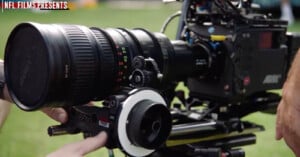
The folks over at NHK’s (the Japan Broadcasting Corporation’s) Science & Technology Research Laboratory have developed a groundbreaking multi-viewpoint, motion-controlled camera rig that could very soon be changing the way we view sports, among many other potential applications.
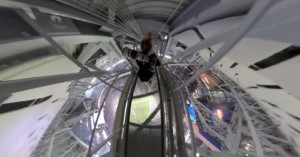
The rig is a robotically controlled system that links one camera to eight sub-cameras, all of which are pointing at the same thing. Basically, it’s a bullet time rig that moves, enabling the people behind the lenses to take the technique of timeslicing to new heights. Read more…
Earlier this year, photographer James Quantz Jr. got the opportunity to shoot the official photos for the 2013 South Carolina Gamecocks football team. So, at 6 o’clock one morning, he and his assistant found themselves at Williams Brice Stadium preparing to take the photos that will grace the teams posters, programs and tickets for the next calendar year.
As an added bonus, Dust of the Ground production company from Columbia, SC tagged along and put together this behind the scenes video that shows Quantz at work with the players and staff. Read more…
Photographer Ray Demski recently teamed up with climber Alex Luger to shoot a project he’s dubbed “Ice Nights.” Shot entirely at night using several powerful flash units and a medium format camera, the shoot looked to take ice climbing photography to a whole new level. Read more…
Action sports photographer Alexandre Socci along with kayakers Pedro Oliva, Ben Stookesberry and Chris Korbulic recently took a trip to Hawaii. But where most of us would spend our time on the beach or in a national park, they decided to brave the waters surrounding Kilauea, an active volcano on the southeast slope of Mauna Loa. Read more…
Tim Kemple is a well-respected action-sports photographer who we had the pleasure of interviewing in November of last year. In that interview, he told us about his passion for extreme photography while we did the easy part and shared his photos/asked the obvious questions.
Now, almost half a year later, Kemple is getting some well-deserved attention for the above video he did with Phase One documenting one of his trips to Mexico where he photographed some of the most talented kayakers in the world. Read more…
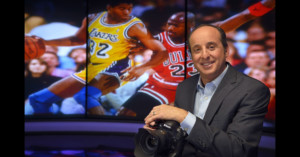
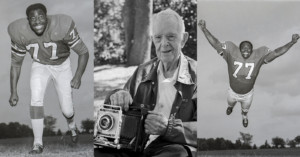
This fascinating behind-the-scenes video shows what it’s like to work as a sports photographer for the New York Times. It follows around Barton Silverman, a photographer who has been working at the Times since March of 1962. Over the past 50 years, he has covered many a championship game and has photographed many a legendary athlete. The New York Times writes,
When he started at The New York Times 50 years ago, [Silverman] worked as a lab assistant, a title he would hold for four years. But he wanted to be a photographer. So he volunteered to carry Larry Morris‘s camera bag to Madison Square Garden.
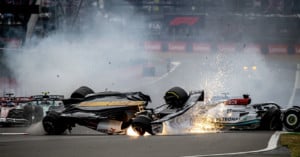
“As I was taking notes,” he said, “I basically figured out how to shoot a hockey game.”
In the meantime, he volunteered to shoot for the team, earning the program credit “Photos by Barton.”
Here’s a short interview he gave after photographing his 39th Super Bowl back in 2010. Also, be sure to check out this New York Times Lens piece that sheds some more like on the epic photograph of a leaping Joe Namath mentioned in the video.
Here’s a video that offers a peek into the life of a Reuters photographer covering the Olympics. It features photographers and editors on the Reuters team talking about the joys and challenges of shooting the biggest sporting event in the world. Read more…
We’ve seen some very heavy-duty gear lugged out to cover the Olympic games in London this year: some robotic rigs, an 800mm lens that could easily weigh more than the average lady gymnast, and of course, the usual suspects in a packed camera bag. But Guardian photojournalist Dan Chung is traveling light: he’s covering the games with a simple iPhone setup.
Using different combinations of an iPhone 4s, a clip-on Schneider lens and a pair of Canon binoculars, Chung has been live-blogging all aspects of the games. His photos yield surprisingly crisp results, indoors, outdoors and even underwater through a viewing window — which again reinforces the old photographer’s adage that the best camera is the one that’s with you.
Chung uses the Snapseed app to do in-camera/phone edits. You can check out more of Chung’s work on his Guardian blog.
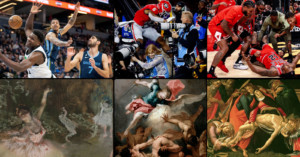
Sports photographers sitting close to the action occasionally take a beating when athletes leave their field of play. This happened yesterday to Reuters photographer Mike Segar while he was shooting the Olympic basketball game between Spain and Australia. While trying to dive for a loose ball, Spain’s Rudy Fernandez slammed into Segar and injured his head. Segar has written up an interesting post on what it was like to suddenly find the cameras pointed at him:
As the smoke cleared and I looked up, Fernandez was basically lying in my lap head down eyes closed. He rolled forward slightly, moved his hands to his head, moaned loudly and stopped moving. He was in my lap, clearly injured on his head. I could see blood on his fingers on top of his head and apparently he was now unconscious for a few seconds, or nearly so. At this point I was not a photographer. I suppose I just kind of instinctively rubbed his arm and shoulder, kept my hands on his back and held him a bit and said “stay still, stay still man… You’re all right.” I didn’t actually know if he WAS all right at all, but all I could do was to try to comfort him for the 20 or 30 seconds it took the Spain trainers, players and staff to rush to his aid. Anyone would do the same for anyone else injured in their lap, right?
I looked up and realized that fellow photographers and TV crews were shooting the incident from all possible angles. I was in the center of this wreckage but I was not really hurt. A camera with a wide angle lens was somewhere in the strewn mess of my equipment at my side and for a moment I thought to try to find it and take pictures, but with Fernandez lying bleeding on my feet and me the only one trying to help a bit, that wasn’t going to happen.
Image credits: Photographs by Christian Petersen/Getty Images, Richard Mackson/USA TODAY, Richard Mackson/USA TODAY, and Eric Gay/Associated Press (clockwise from top left)