Goodbye old young friend. Let me give you all a piece of wisdom that I recently learned the hard way. If you go on a fishing trip called ‘Hit em’ Hard’ and the captain tells you that you should take your bag off and put it in the ‘dry container’, what he really means by ‘dry container’ is a place that will fill up with seawater after he accidently clogs the drainage pipe, soaking you and your friends cameras, bags, wallets and cellphones for over an hour in salty seawater.
Better yet, just never go on a fishing charter with a name like ‘Hit em’ Hard.’ Read more…
Here’s a dissection video for those of you who like photography better than biology. It’s a Khan Academy lesson that offers a glimpse into how digital cameras work on the inside. The camera being dissected is a Vivitar V25, a 2.1 megapixel camera that you can pick up for around $18 from places like Walmart. Although it’s basically the digital equivalent of a disposable camera, the camera still shares some things in common with higher-end digital cameras. You might be able to learn an interesting thing or two about how your own camera works. Read more…


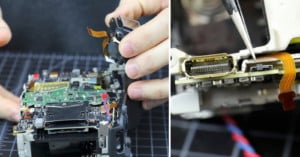
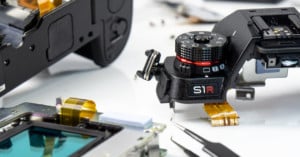
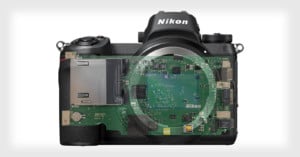
Yesterday we featured a photographer’s DIY teardown of the Nikon D700, offering a peek at the camera’s guts. It was interesting, but a bit outdated since the camera was released back in July 2008. iFixit and Chipworks have just finish their own teardowns of a camera that’s much more recent: the Nikon D600 “entry-level” full-frame DSLR. Read more…
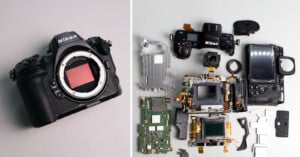
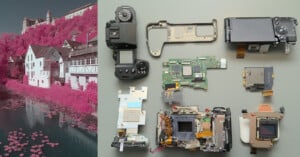
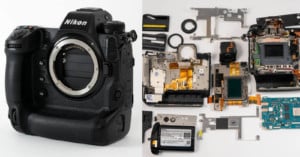
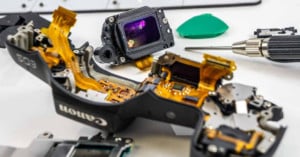
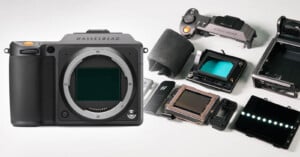
If you’ve ever wondered what a Nikon D700 looks like when completely disassembled, today’s your lucky day. Czech photographer Martin Kozák recently did a complete teardown with a ruined D700, and then snapped the still life photo seen above. Read more…
Phil Wright got his hands on the Sony RX100 — the camera David Pogue was raving about — shortly after it was released back in June. It didn’t survive very long.
Earlier this month, Wright was rushing to work in the darkness of the early morning when he placed his coffee and his black camera bag on top of his car. When he arrived at work 22 miles and 25 minutes later with coffee in hand, he suddenly realized that his camera was nowhere to be found. After panicked call to his wife back home, she made the discovery: camera roadkill 300 yards from their house. Read more…
If you think 14fps on a high end DSLR is fast, check out this video by Mike’s Electric Stuff. In it, he does an extreme teardown of a cheap Panasonic Lumix compact camera and spends 30 minutes exploring and explaining the various components. At about 18 minutes in, he hooks up a signal generator to the shutter mechanism to see how fast the shutter can flap. He’s able to take it up to around 70 flaps per second before the shutter begins to stutter. The limiting factor in FPS isn’t the mechanical components of a camera, but how fast the sensor and memory card can capture and store data.
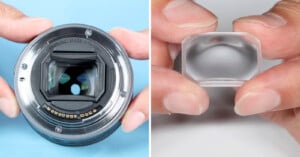
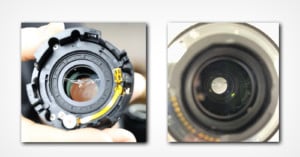
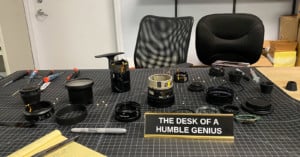
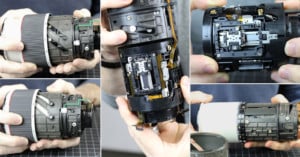
I’ve always been fascinated by pancake lenses. It just amazes me that something that small can actually function. As I mentioned in an earlier post, we’ve been taking things apart to determine where and how (and sometimes if) the lenses can be adjusted optically. So, I decided to do two pancake lenses for mirrorless cameras side-by-side to see how they differed (the Sony 16mm f/2.8 E mount and the Olympus 17mm f/2.8 micro 4/3 mount). I wasn’t sure there would be much we could do with pancakes (and there wasn’t), but I still found the look inside rather interesting. Read more…
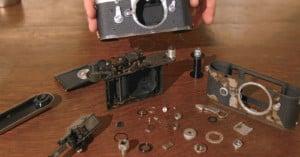
I have to say I have one of the better jobs on the planet, at least for a photography gear-head. The part I like best — well, really there’s a lot of parts I like best — but one fun part is that my job description includes: Take things apart. See how they work. Learn how to fix them. Read more…
Devin Coldewey of TechCrunch created this helpful diagram showing the relative sizes of various sensors, including the one found inside the Lytro light field camera (a camera that lets you focus after shots are taken). The FCC published photos of the Lytro camera’s guts last week, revealing that the sensor inside is roughly 6.5×4.5mm (smaller than our previous estimate). This means that it’s slightly larger than the iPhone sensor and slightly smaller than the one in most point-and-shoot cameras.
Another interesting finding is that the chip inside supports Bluetooth and Wi-Fi. The company says that they’re working on wireless connectivity, but doesn’t have it enabled in the initial Lytro camera.