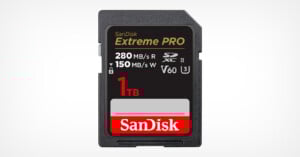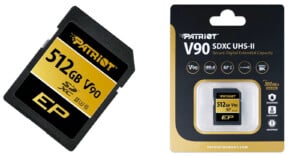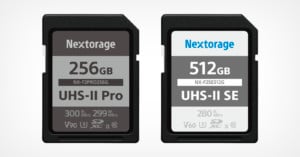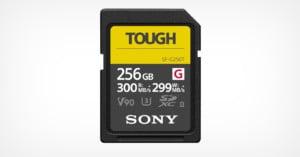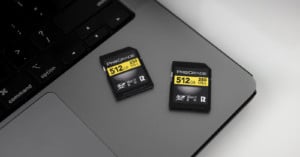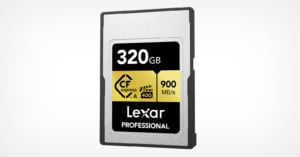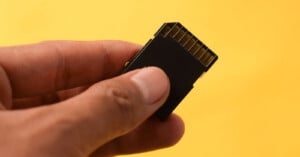
Last week we featured some Sears catalog ads for camera kits from back in 1900, and shared how complete camera kits were selling for just $15.35. Now fast forward a century to the 2000s, when this advertisement appeared 9 years ago. You could buy a “massive” 256 metabyte SD card or a 512MB CF card for your camera for just $100 and $150 (respectively)! For about $100 these days, you can buy a 128 gigabyte SD card.
256GB SD cards cost a hefty $700 these days, but in another 9 years, we’ll almost certainly be poking fun at that price tag as well.
Image credit: Photograph by gfraser and used with permission

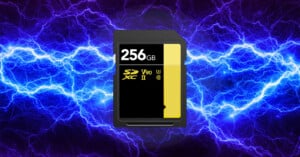
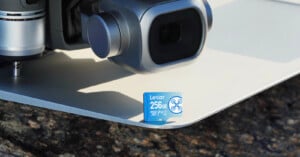
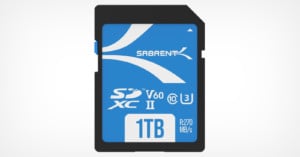
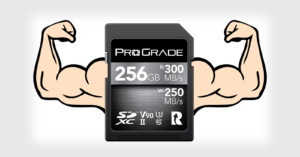
Lexar has set a new bar in SD memory card capacity with its new 256GB card — the largest size offered in the SDXC (Secure Digital eXtended Capacity) format. SDXC has an upper limit of 2TB, compared to the 32GB cap that restricts the SDHC (Secure Digital High Capacity) format.
The official name of the card is the Lexar Professional 400x SDXC UHS-I. It’s geared towards photographers who need to “capture, store, and transfer a large number of high-quality photos” and videographers who need to record massive amounts of HD video.
Read more…

Photographer Jeff Cable purchased a couple Canon 5D Mark IIIs recently and discovered that although the camera offers both SD and CF card slots, you should avoid the SD slot if you want maximum shooting speed. He writes,
[...] for some reason unbeknownst to me, Canon decided to build the 5D Mark III with one very fast CF slot which supports the newer UDMA7 protocol and a standard SD card slot which does NOT support the high speed standard [...] Without UHS [Ultra High Speed] support, the top speed that can be achieved by the SD card is 133x. This is true even if you purchase a 600x SD card and insert it in the camera. The best you will get is 133x
It turns out that the camera will default to the slowest card inserted. So, if you have a 1000x CF card in slot one and any SD card in the second slot, the very best buffer clear that will achieve is 133x.
It might not be a big deal for most photographers, but if your line of work requires clearing the camera’s buffer as quickly as possible, it something you might want to be aware of.
Why you should not put an SD card in your Canon 5D Mark III (via Photography Bay)
Image credit: Photograph by Jeff Cable

Eye-Fi cards have seen their fair share of competition, but a new product from memory manufacturer PQI could pose a bigger threat than they’re used to. The Air Card, as PQI are calling it, made its debut at Computex 2012 and, for the most part, offers exactly what we’d expect from a WiFi memory card: it creates its own WiFi hotspot when the camera is turned on, at which point photos appear automatically on whatever tablet, phone or PC you happen to have connected. The card can even connect to three sources at once, although this will slow down the transfer rate quite a bit. One specific feature, however, makes the Air Card stand out. Read more…

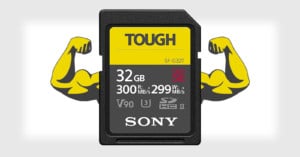
Samsung has released a new line of SD and microSD memory cards that focus not only on speed and durability but appearance as well. They come with a brushed metal look in silver or black, and are able pretty dang tough as well:
In order to ensure their reliability, Samsung has designed both lines of memory products to be waterproof, shockproof, and magnet proof, allowing them to withstand some of the harshest conditions. All models are guaranteed to survive up to 24 hours in water, withstand the force of a 1.6 ton vehicle (3,200 lbs), and resist up to 10,000 gauss (slightly less than the power of a medical imaging magnet).
Prices range from $10 to $90 for 2GB to 32GB cards.
(via Engadget)

Back in August, it came to light that some of Leica’s $7,000 M9 cameras had a problem in which they would corrupt the SD card being used — a problem that caused one photographer to permanently lose work after a day of shooting. The company quickly acknowledged the problem, and today announced that they had finally discovered the cause:
Thanks to the close collaboration with SD card manufacturers, Leica has now managed to rectify the fault by making adjustments to the firmware. To ensure compatibility with as many cards as possible and to ensure that all the related processes remain fault-free and are not compromised, comprehensive testing must be carried out in the development phase.
In the coming weeks we will test a beta version of the firmware in practice in cooperation with affected and selected customers.

The firmware fix will be released to the general public after they’ve thoroughly tested it.
Leica M9 / SDHC Card compatibility (via PopPhoto)

Some Leica M9 owners are discovering that their camera will suddenly stop functioning and render their SD card unreadable on any device. Photographer Gil Lavi writes on his blog,
A couple of weeks ago I got a new Leica M9. All excited, I put in the best SD card on the market, the SanDisk Extreme Pro 8GB. It took only a few hours of taking pictures before the card crashed and the camera become unresponsive until I removed the card. I wasn’t worried at the beginning. I was in love.
A few days after, I had a high profile portrait photo shoot for an important client. Of course I took the M9 and my beloved Leica 90mm with me, together with a new SanDisk SD card, not before installing the newest firmware update. It was a very long photo shoot with heavy production, a tight schedule and sweaty assistants. It was just before that end of the photo shoot that the other new SanDisk SD card Extreme crashed inside the M9, making the camera dead and the card unreadable in any device. With all the embarrassment, I had to reshoot everything all over again with my backup equipment.
Leica and SanDisk are currently investigating this issue after a number of customers have reported it, and currently recommend that SD cards be FAT formatted.
(via Pop Photo via 1001 Noisy Cameras)

We’ve heard of digital photos being recovered after lost cameras drift for 1,000 miles (in underwater casing) or spend a year at the bottom of the ocean floor, but is there any hope for a camera that experiences four years of abuse at sea? Turns out there is. A man named Peter Govaars was walking along a beach in California when he stumbled upon a battered camera “skeleton” with a memory card still attached. He took the SD card home, took it apart, spent 30 minutes cleaning it, and was surprised to discover 104 photographs taken within a 2 week period in June 2007.
Read more…

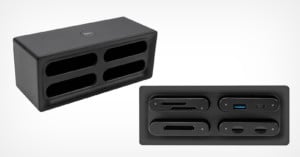
Have numerous SD cards you need to access at once? The Elecom MR-C27 SD card reader is a four-slot card reader that allows you to do just that. It allows you to access up to 64GB of data, and looks like a cute little toaster connected to your computer via USB. It’ll be available for ¥3,980 (~$48) starting mid-December in Japan.
Elecom MR-C27 SD Card Reader (via Wired)

Viral marketing agency The Viral Factory is helping Samsung with an experiment in which they’re planning to drop 100 SD cards attached to paper airplanes from 21 miles above the Earth in the stratosphere. Instructions will be printed on the paper airplane informing anyone who finds one of the experiment and what they can do to participate. Finders are encouraged to shoot with the cards and then upload anything taken to the Project Space Planes website.
The claim that the planes will “carry the messages across the world” is a bit farfetched, but supposedly the planes could potentially travel hundreds of miles depending on the wind conditions. The experiment is planned for mid-October.
Read more…