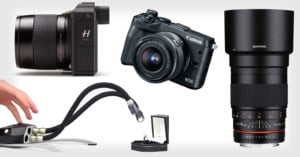
The rumor mill is churning regarding Canon’s tilt-shift lens lineup. The company will reportedly be announcing replacements to its two oldest TS-E lenses by the end of this year, and the lenses are likely already floating around in the wild for real world field tests. Read more…
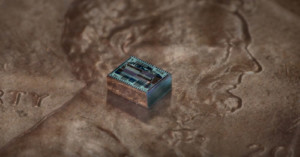
Lenses and sensors weren’t the only camera components miniaturized and dumbed down when digital photography jumped over into the world of smartphones: flashes did too. In order to fit everything into a tiny package, smartphone makers have largely opted for LED flashes in their phones rather than the bigger and bulkier xenon flashtubes found in proper digital cameras (a notable exception is the Nokia PureView 808). That may soon change.
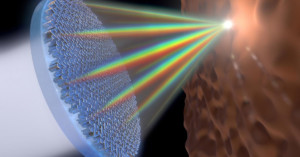
Scientists in Singapore have developed a new capacitor that may lead to more powerful xenon flash units replacing the LED flashes found in consumer smartphones. Read more…
Talking to computers is one of the exciting new trends that’s emerging in the tech world, and in the future we may find ourselves casually talking to our gadgets as we go about our lives. One application of this that you may never have considered is photo editing: what if you could post-process your photographs simply by telling an image editor what you would like done to the images?
That’s exactly what scientists are currently working on, and the research is further along than you might think. They’re already playing around with a prototype version of an app — one called PixelTone. Read more…
At the CP+ show in Japan, Ricoh is showing off a new camera prototype its developing that can capture full 360-degree immersive photographs with a singel push of the shutter. The omnidirectional camera looks like a cross between an electric toothbrush and a hammerhead shark. Lift it up into the air, press a button, and it will capture an image that shows every direction around you. Read more…
Could memory cards and hard drives one day store massive numbers of digital photographs on DNA rather than chips and platters? Possibly, and scientists are trying to make that happen.
Last year, we reported that a group of researchers had successfully stored 700 terabytes of data on a single gram of DNA. The data being stored that time was a book written by one of the geneticists. Now, a new research effort has succeeded in storing something that’s a bit more relevant to this blog: a photograph. Read more…
Google has been working some time now on a camera-equipped device that’s worn over (or above) the eye. Olympus has something similar going on, but instead of a full-fledged camera, their device only serves as an external viewfinder for a separate digital camera. Read more…
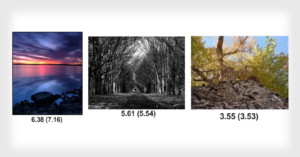
In the latest issue of Japanese magazine Impress, there’s a two-page section that predicts the new DSLRs that Canon and Nikon will be unleashing in this upcoming year. Alongside each model name, design illustration, and spec list is a percentage that indicates the likelihood of the rumor coming true. Read more…
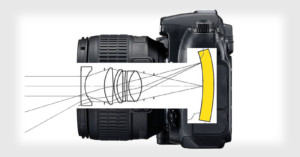
Electronic viewfinders have become all the rage as of late through the rise of the mirrorless camera, but many photographers still prefer optical viewfinders due to certain weaknesses of EVFs. One major drawback is the fact that the scene is often laggy, especially in low-light situations, making it difficult to track a moving subject.
Nikon is apparently trying to combine the best of the OVF and EVF worlds by developing a new giant viewfinder that’s see-through. Read more…
Here’s a slightly-oldie but a very-goodie: New York University photography professor Fred Ritchin gave this keynote address last year at the “What’s Next?” event put on by Foam. He shares his thoughts on the past, present, and future of digital photography and how it impacts the world around us. Read more…
We live in a world that’s teeming with digital photographs. More photos are now uploaded every two minutes than were created during the entire 1800s. Facebook is seeing thousands of photographs uploaded to its servers every second of the day, and Instagram was flooded with 10 storm-related photos per second during Hurricane Sandy.



With such a large quantity of photographs flooding the web, it’s clear that visual data mining will be an in-demand market in the coming years as more and more people look to glean valuable images from the torrent of useless pixels. One of the companies trying to occupy this space is CrowdOptic, a San Francisco-based startup that’s building some pretty interesting location-based photo curation technologies. Read more…