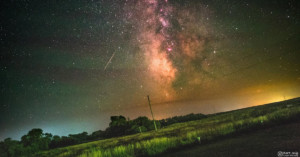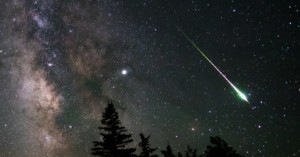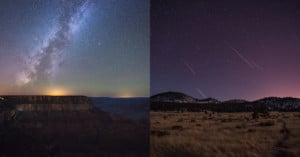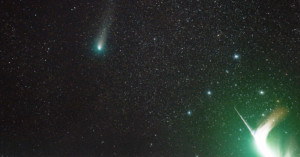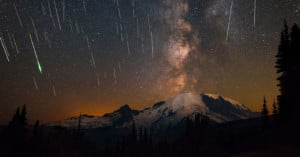
Capturing a single shooting star can make for a brilliant photograph, but what does it look like if you composite multiple meteors into a single image? Fort Collins, Colorado-based nature photographer David Kingham decided to find out recently during the ongoing Perseid meteor shower. The amazing photo seen above is what resulted. Read more…
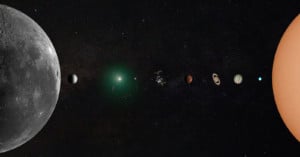
What would photographs of the night sky look like if other planets in our solar system replaced the Moon? This beautiful video by 3kingAmazing (remixed using a video by Brad Goodspeed) shows the answer.
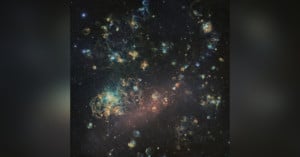
NASA astronomers announced today that they are certain that our galaxy is on an unavoidable collision course with the Andromeda Galaxy, the closest spiral galaxy to us. Don’t worry though, it won’t be happening for another 3.5 billion years or so. What’s interesting is that the collision will drastically change what our night sky looks like, and the astronomers released a series of photo illustrations showing what future astrophotographers will be shooting when they point their cameras at the heavens. Read more…
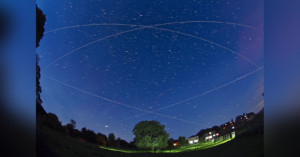
First things first, the most important thing to do is to plan well. Forward planning is vital to any night sky shot, along with a steady tripod and a warm coat. There are quite a few websites and twitter feeds that can help you with your planning. Even though it only takes about an hour and a half for the ISS to complete an orbit of the planet, you could be waiting quite some time under the night skies before the station appears above. The station only appears for a short time (about 1-2 weeks) and then re-appears again many weeks later. This is due to the orbit of the station above earth.
You can check out a collection of ISS photographs he has taken here.
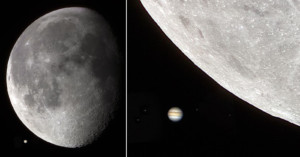
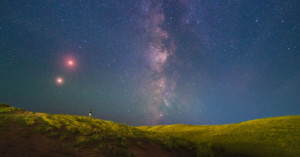
This past Sunday, Jupiter and Venus put on a show by lining up with our moon (a conjunction). Rick Ellis of Toronto, Canada managed to create the awesome photo of the event seen above by capturing 31 separate frames. Each photo was taken 5 minute apart and had an exposure time of 5 seconds.
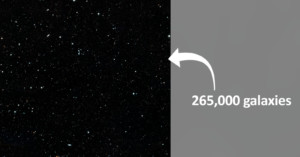
This photo is what you get when you point a massive 4.1 meter telescope (VISTA in Chile) at an unremarkable patch of night sky and capture six thousand separate exposures that provide an effective “shutter speed” of 55 hours. It’s an image that contains more than 200,000 individual galaxies, each containing countless stars and planets (to put the image into perspective, the famous Hubble Ultra-Deep Field contains “only” around 10,000 galaxies). And get this: this view only shows a tiny 0.004% of the entire sky! Read more…
NASA has released a gigantic catalog of the night sky that contains more than 563 million stars, galaxies, asteroids, planets, and objects. The images were captured by the infrared cameras of the Wide-field Infrared Survey Explorer (WISE) mission, which has been collecting data for the past two years. After capturing more than 2.7 million images of the sky, NASA created an epic panorama showing the entire sky by stitching together 18,000 of those images. You can view the panorama in a zoomable browser here or download the 180MP/73.5MB photograph here.
“Global Rainbow” is an outdoor art installation by Yvette Mattern that consists of seven high powered lasers projecting a bright rainbow across the night sky. The rainbow was originally displayed in New York in 2009, but has since appeared in cities across the UK. If you’re lucky enough to see the project in real life, be sure to take some photographs — it’s not every day you get to enjoy rainbows at night. Read more…
Time-lapse photographer Randy Halverson (whose time-lapse of lightning storms we featured last year) is back again with another epic time-lapse film. This one is packed with shots of some of the most beautiful things you can point your camera at in the night sky: the Milky Way, auroras, and shooting stars. It’s composed of thousands of 15-30 second exposures captured with a Canon 5D Mark II and Canon 60D at ISO 1600-6400, f/2.8, and 3 second intervals. Keep your eyes peeled at 53 seconds: you get to see a shooting star with a Persistent Train, which is the ionized gas left behind as the meteor burns up in our atmosphere!
Swedish photographer Göran Strand created this amazing “little planet” photo (AKA a stereographic projection) that shows the Aurora Borealis overhead. He titled it “Planet Aurora”.