Fujifilm in 2025: High Highs and Low Lows
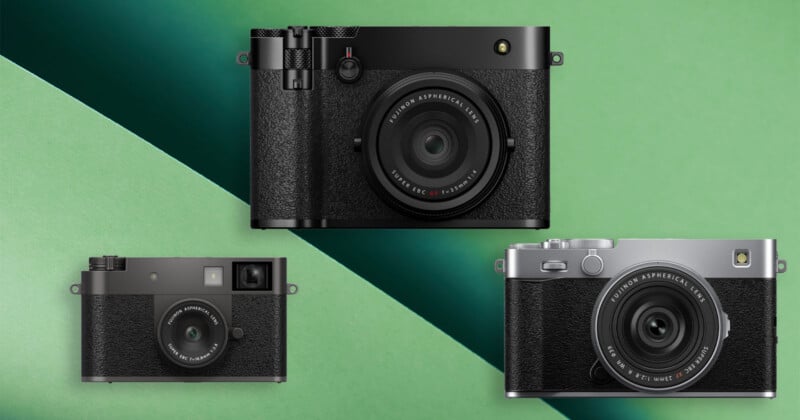
Fujifilm is going to be very difficult to grade this year, not because the company didn’t do anything, but because it delivered such an eclectic mix of products, ranging from fun but bad to good but boring. Fujifilm always does things a bit differently, but this year was especially odd.
I think a big part of why Fujifilm’s 2025 was so strange is that we are reaching the end of multiple imaging sensor lines. The current generation of X-Trans image sensors is getting long in the tooth and surely on the cusp of being replaced, and you can argue much the same point concerning the medium-format GFX system, too.
While that explains the odd smattering of Fujifilm cameras launched this year, it doesn’t say much about the company’s lack of interesting glass this year. By far the most noteworthy lens is also the most niche, a video-oriented GF-mount lens released alongside the GFX Eterna 55. Otherwise, the two X-mount lenses are, frankly, boring. That doesn’t mean they’re bad, by the way.
Without further ado, let’s kick this into gear and start pulling on some threads.
From X half to GFX100RF: Fujifilm’s Unusual Year of Cameras
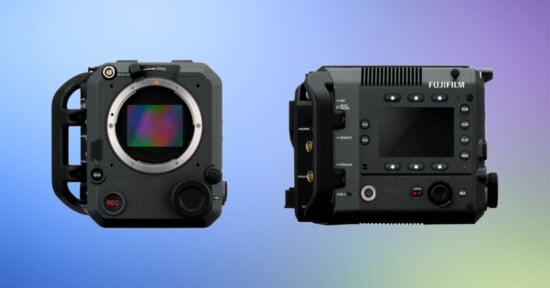
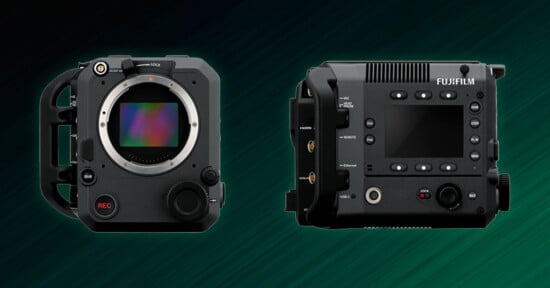
I’m going to go out of order a bit here because technically, one of the five Fujifilm cameras released this year was announced in November 2024. Fujifilm unveiled the GFX Eterna as a prototype with minimal details, only stating that it would feature the same 102-megapixel sensor as the GFX100 II and GFX100S II. The company released more info throughout this year, finally fully revealing the camera as the GFX Eterna 55 in September. The camera launched for $16,500 in October.
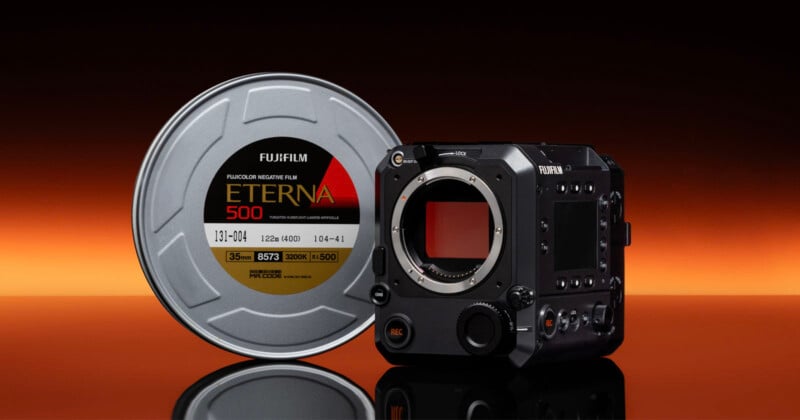
PetaPixel even used the GFX Eterna 55 to film its documentary, “No Guarantees.”
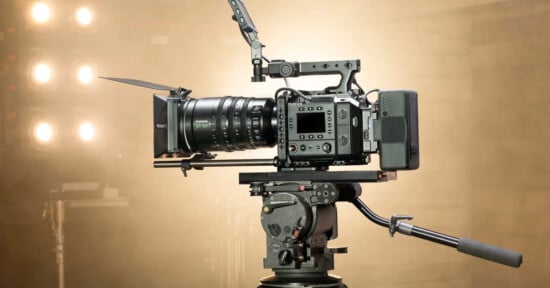
While the GFX Eterna 55 is a fascinating cinema camera and may very well make a big dent in the large-format filmmaking space, it is hard to ignore that the 102-megapixel sensor it uses has a slow readout speed. It limits the camera’s performance to an extent, but the big sensor also makes the GFX Eterna 55 exceptionally versatile when it comes to the lenses cinematographers can use.
While the GFX Eterna 55 has very niche appeal, the other new GFX camera launched this year, the GFX100RF, is more likely to find a big audience. The medium-format fixed-lens camera is like an X100VI but all grown up.
It combines the same great 102-megapixel sensor Fujifilm has used in numerous GFX models with a new fixed 28mm equivalent f/4 prime lens, which is extremely sharp, by the way. While the lens is exquisite, it is also fairly slow, and the camera’s lack of IBIS only makes the f/4 aperture more problematic.

On the other hand, Fujifilm says it had to eschew IBIS and opt for an f/4 lens to maintain the GFX100RF’s relatively compact size. Perhaps it’s a worthwhile tradeoff, maybe it isn’t. We think it is.

“The Fujifilm GFX100RF is a great example of taking a major design risk and seeing if it will pay off. But given the immense popularity of the X100 series of cameras, photographers now have an alternative that captures much of what makes the X100 great to use while providing a far more capable potential for image quality and versatility. The X100V was the first Fujifilm rangefinder-style camera to win me over, and now it looks like the GFX100RF has pulled a repeat performance,” Chris Niccolls concluded.
Fujifilm went from releasing a fixed-lens camera with its largest image sensor, the GFX100RF, to the X half, which features a teeny-tiny 18-megapixel Type 1 image sensor. Ultimately, this image sensor is the X half’s greatest weakness. However, while the camera may lack imaging capabilities and quality, it doesn’t lack for style or fun.
The X half is, ultimately, fun. Whether that’s enough to justify its existence depends on the individual and how willing they are to spend $850 for photos of suspect technical quality. The X half introduces some really fantastic ideas to the Fujifilm family, though, and we hope to see them carried forward to more technologically impressive cameras. The X half channels the spirit and fun of analog photography in a digital camera, perhaps better than any camera before it. It’s just a shame that the image sensor is so bad. That didn’t stop it from selling like hot cakes, though.
Next came the Fujifilm X-E5, an X100VI-looking interchangeable lens camera. The X-E5 is really nice.
The 40-megapixel camera has a rangefinder-inspired design, a dedicated Film Simulation dial, and fantastic image quality. For those who covet the X100VI for its image quality and style but don’t want to be stuck with a fixed lens, the X-E5 is the answer.
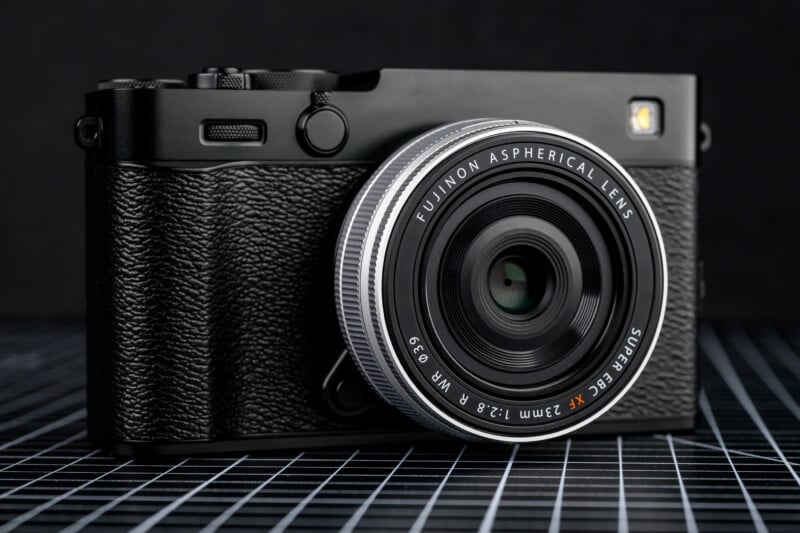
“To me, the X-E5 is really the best X100 of all time. When I want a similar kind of experience, I can throw on the little 23mm lens and head out. However, I also get the versatility of all the other lenses available for X mount and some of the best handling I’ve ever used on a camera,” Chris Niccolls wrote.
Rounding out the year is the Fujifilm X-T30 III launched in October. It is an interesting camera, delivering many of the same features and specs as its predecessor, the X-T30 II, including its 26.1-megapixel sensor.
However, there are some notable improvements, like the Film Simulation dial, better video, and much-improved autofocus. Ultimately, it’s more of the same, but that’s not always a bad thing. The price is right, and it’s a good camera. No complaints.
Where Have All the Lenses Gone?
Now it’s time for complaints. Fujifilm has not had a particularly prolific year of new lenses for a while now. There were just three this year, and one of them is so specialized it hardly counts. Last year had four, but two were the same lens with different mounts. 2023 had four, too, but at least they were all novel. There were five in 2022, all good ones, too. 2021 was the last super-busy year for Fujifilm glass, with the company debuting two GF lenses and five XF lenses.
At this point, you might be thinking, “Most companies don’t release that much more glass than that.” Yes, that’s true, but it’s important to keep in mind that Fujifilm is making lenses for two completely different systems, the APS-C X Series and the medium-format GFX system. There is so much possibility for interesting lenses for both, and I think Fujifilm can do more.
But I’m not here to harp on what didn’t happen. This is mostly about what did, and there’s not a lot to say.
The XF 23mm f/2.8 R WR was announced alongside the X-E5, and it’s a perfectly fine, compact 35mm equivalent prime lens. It’s cute, affordable, and pairs nicely with the X-E5 and other X Series cameras.

The other new X Series lens this year was the XC 13-33mm f/3.5-6.3 OIS. It is notable for being the smallest X Series zoom lens, but not much else. The lens delivers roughly a 20-50mm equivalent focal length and is a nice companion for the X-T30 III.
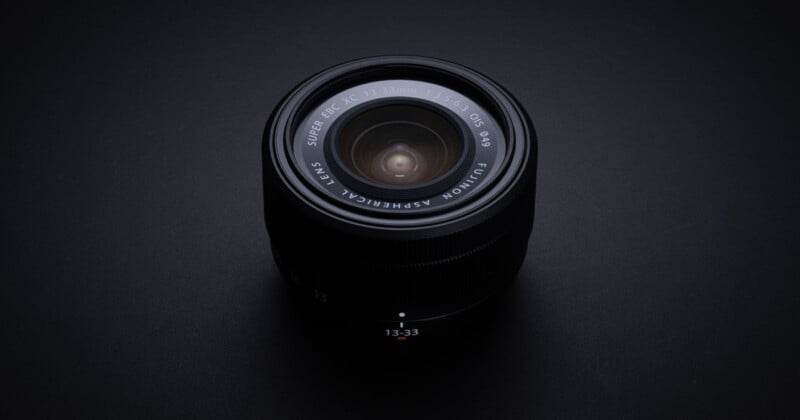
While these two new lenses are fine, worthwhile additions to the X Series, where is the exciting glass? There are a lot of older XF lenses in dire need of updating to keep pace with the latest sensor and autofocus advancements, too, for what it’s worth. Maybe I shouldn’t expect more than this, but I think it’s reasonable to hope for better lenses in 2026.
The third and final Fujifilm lens released this year was teased way back in 2023 in an updated Fujifilm lens roadmap. The GF 32-90mm T3.5 Power Zoom has the distinction of being the most expensive GFX lens yet at $5,995. It also features Fujinon’s gorgeous green accents the company uses for video lenses. What a beaut!
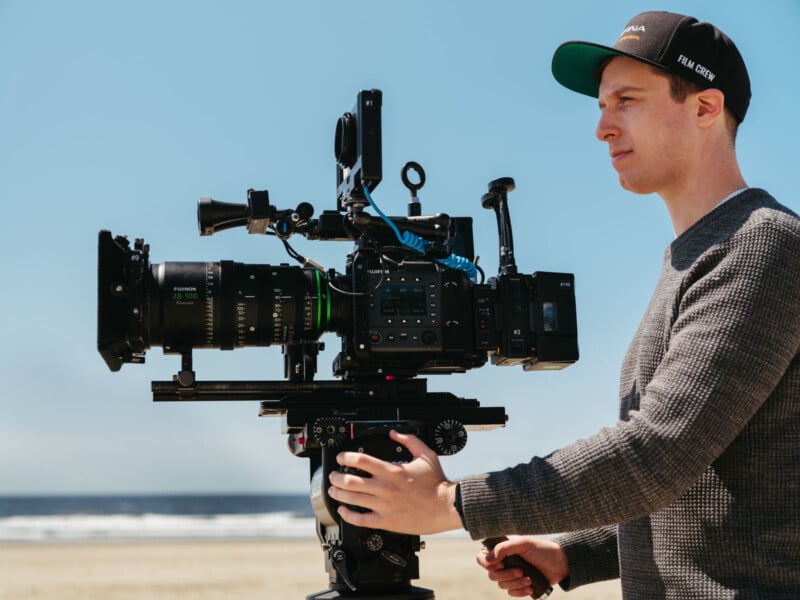
This is a difficult one to evaluate because it’s not really for me. Frankly, it’s not for all that many people. I hope Jordan Drake gets his hands on one next year.
Grading Fujifilm in 2025
It’s a safe bet Fujifilm is gearing up for its next generation of X and GFX cameras, and 2025 felt like a bit of a gap year for the company overall. However, there was plenty of interesting stuff happening. The GFX100RF is very cool, and the X-E5 is genuinely excellent. The X half is fun, and I applaud Fujifilm for doing it, but I wish it were actually good from a technical perspective. I’d love to see its neat film-inspired features on more cameras.
I think Fujifilm is capable of really incredible things, and the company is never afraid to roll the dice. But I don’t believe this year showcased the company at its best. I fully expect to be very impressed in 2026, though.
Grade: C+
Image credits: Fujifilm. Featured photo created using an asset licensed via Depositphotos.