This is the Most Distant Black Hole Merger Ever Photographed
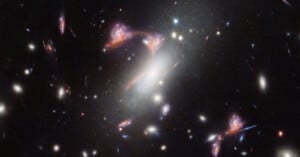
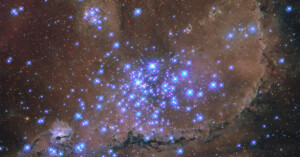
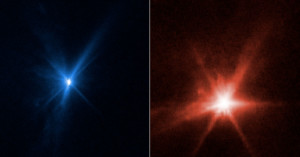
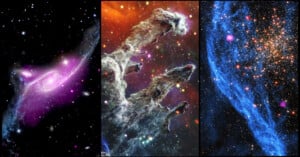
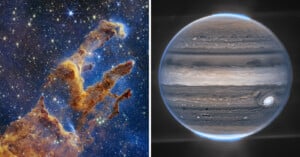
An international team of astronomers using the James Webb Space Telescope (JWST) detected the most distant black hole merger ever observed.
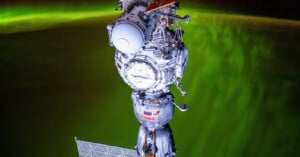
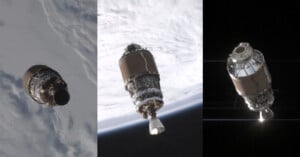
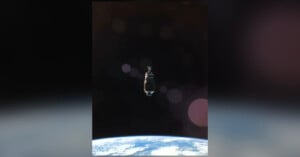
A satellite was able to capture a rare photo of the International Space Station as the two spacecraft hurtled past each other in space just 43 miles (69 kilometers) away.
After a giant sunspot launched a series of solar storms toward Earth, photographers and general onlookers alike were greeted by supercharged aurora lights on Friday night.
A SpaceX vehicle captured a gorgeous orbital sunrise as it deployed Starlink satellites into the Earth's pull.
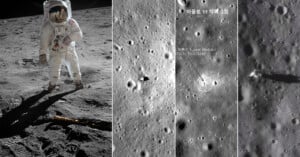
Many conspiracy theories retain a foothold along the edges of society. Some of them are relatively innocent; others are downright dangerous. But few persist and propagate as effectively as conspiracies surrounding the Apollo 11 Moon landing.
Artificial intelligence is used for a lot more generating fake images, scientists also use it to locate patterns in data that would otherwise have been impossible to see. Astronomers also use AI to improve image quality and analyze space photos. Some AI may even help save Earth from a catastrophic asteroid.
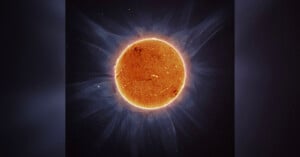
The European Space Agency (ESA) published a new video captured from its Solar Orbiter that provides an up-close, detailed look at the Sun's corona.
Cue the anti-space litter campaigns. A satellite captured a historic photo of space debris during a new mission.
While NASA's James Webb Space Telescope is helping astronomers craft 122-megapixel photos 1.5 million kilometers from Earth, the agency's newest camera performs groundbreaking space science with just 36 pixels. Yes, 36 pixels, not 36 megapixels.
NASA has released a fascinating flight map that charts all the Mars avigations taken by the space agency's recently defunct Ingenuity helicopter.
NASA has revealed its best photos of 2023 showing spectacular space technology as well as the people behind it.
Walking through the streets of Brooklyn, people poured out of storefronts, giggling and looking up at the sky with their paper glasses. Everyone, it seems, was focused on one thing: the solar eclipse.
NASA's Lunar Reconnaissance Orbiter (LRO) and the Korea Aerospace Research Institute's Danuri lunar orbiter crossed paths recently, and the former managed to snap a photo of the latter zipping past it at the relative velocity of 7,200 miles per hour.
It's the morning of April 8, 2024. My camera equipment is packed in their bags, and vital Sun rotation information and eclipse timing information are scratched in a notepad. Somehow, despite years of notice about this historic total solar eclipse, the first to hit my home state of Maine since 1963 and the last until 2079, I'm committing the cardinal sin of photography: I'm trying to photograph a once-in-a-lifetime event with nebulous plans and no scouting.
Total solar eclipses in North America are exceedingly rare and for those lucky enough to be in the path of totality for yesterday's eclipse it may be the only one they ever see in their lifetime.
On March 30th, SpaceX launched a pair of its Falcon 9 rockets. After these rockets are launched and deploy their payloads, the primary part of the rocket separates from its reusable boosters, which undergo controlled deorbit burns. Arizona-based photographer Jeremy Perez photographed the deorbiting debris, and his images have puzzled and amazed viewers.
Astrophotography is hard enough as it is -- but one photographer makes it even tougher by capturing celestial events on 35mm film.
After more than two decades and a few delays, the Legacy Survey of Space and Time (LSST) Camera is finally built and ready to be sent to the Rubin Observatory in Chile, where it will capture 3,200-megapixel photos of deep space and help scientists unravel the mysteries of the Universe.
My Exmouth eclipse expedition could be a case study on the 'sunk cost fallacy' or proof that even blind persistence can pay off. Either way, it is a saga.
In 1181, a supernova explosion appeared in the night sky for 185 days. Historical records show that the supernova, which some witnesses said looked like a "temporary star," shined as bright as Saturn in the constellation Cassiopeia.
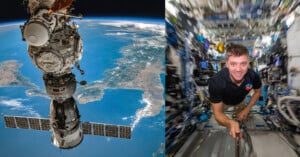
A SpaceX Crew 7 astronaut revealed how he attempted to photograph Japan's Mount Fuji but ended up taking a picture of a notorious piece of space junk instead.
Astronomers using the groundbreaking Event Horizon Telescope (EHT) have captured the first view of the magnetic fields surrounding the supermassive black hole at the center of the Milky Way galaxy, Sagittarius A* (Sgr A*). The novel new image was captured using polarized light.
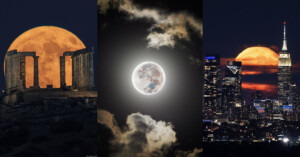
A glorious full Moon lit up the skies last night with celestial observers able to capture spectacular photos of March's full Moon, known as the Worm Moon.
With the total solar eclipse now just weeks away, the American Astronomical Society has advised people to take great care when viewing the celestial event. And that includes photographers.
Canon's groundbreaking micro-satellite, CE-SAT-IE, has entered orbit and successfully communicated with the ground station at Canon Electronics' Akagi Plant in Japan.
Using the remarkable 570-megapixel Dark Energy Camera (DECam), astronomers have made a 1.3-gigapixel image of the ghostly Vela Supernova Remnant. The beautiful, detailed, and colorful image is the largest DECam image ever at 35,786 by 35,881 pixels, putting even the highest-resolution medium-format interchangeable lens cameras to shame.
With less than a month to go before the 2024 total solar eclipse, astrophotographers Andrew McCarthy and Dan Stein have released a gigapixel image of last year's annular solar eclipse.
As it used the last of its power reserves, the Intuitive Machines Odysseus Moon lander captured one final photo before shutting down.
Nikon Inc. and NASA have entered into a Space Act Agreement to support NASA's Artemis mission program through the Handheld Universal Lunar Camera (HULC) development. The star of the HULC's show is the Nikon Z9, the company's flagship professional mirrorless camera.
As scientists continue to use the James Webb Space Telescope (JWST) to do incredible things, like find the first direct evidence of a neutron star in a nearby supernova remnant, it also generates many beautiful images that are easy for anyone to appreciate. That's where the monthly Webb Picture of the Month comes in. This month's new photo is of the barred spiral galaxy NGC 1559.
The world's newest capital city has been captured emerging from the jungle in satellite photos taken from space.
The Sun has been very active so far this month, with powerful sympathetic solar flares dazzling scientists and viewers alike and recent X-class flares making many wonder about communications network integrity. NASA's Solar Dynamics Observatory (SDO) constantly monitors the Sun and captures the recent powerful solar flares in exquisite detail across multiple wavelengths.
An astronaut has captured a snow-covered Grand Canyon from space while passing over the iconic landmark onboard the International Space Station traveling at 17,500 miles per hour.
Award-winning astrophotographer Mihail Minkov is best known for his landscape images that heavily feature the night sky and the Milky Way in particular. Over the past year, Minkov has been working on a single-exposure nightscape project focused on incorporating people into his compositions.
Scientists using the James Webb Space Telescope (JWST) have made a monumental discovery, finding evidence for a neutron star at the heart of a young supernova remnant.
While the hotel brand Days Inn by Wyndham is offering a pair of photographers "2024's hottest gig" and $10,000 by flying them up in a private helicopter to capture the total solar eclipse in April, American company Delta Air Lines is selling a special flight to view the eclipse for other umbraphiles, a fancy word for someone who chases eclipses.
Two powerful solar flares erupted from the Sun on the evening of Wednesday, February 21, and again in the early morning today, February 22. Coincidentally, there were widespread cellular outages across the United States this morning as well.
The Odysseus moon lander, developed by Houston-based company Intuitive Machines, has sent incredible photos back to Earth. The private space exploration behind the lander has selected four to share with the world.
Two lucky photographers will be paid $5,000 each and fly in a private helicopter to capture the total solar eclipse when it takes place in April.
Scientists are calling on astrophotographers to capture a comet's broken tail and keep the Earth safe from the Sun.
This week, NASA Goddard released a new video that highlights the Landsat program's achievements in 2023. A joint mission between NASA and the United States Geological Survey (USGS), satellite imagers have been orbiting Earth since Landsat 1 was launched in July 1972.
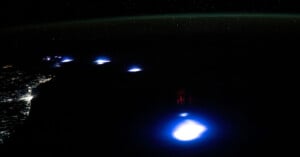
Swedish astronaut Marcus Wandt recently returned from a three-week mission on the International Space Station (ISS) and captured some incredible photos and videos during his time in orbit, including footage of a powerful thunderstorm.
Google is working alongside the Environmental Defense Fund (EDF) to better understand methane emissions and potential mitigations.
The Hubble Space Telescope (HST) has done it again, delivering a spectacular image of the cosmos that is a veritable smorgasbord of color and detail.
The Mars Perseverance Rover captured an eclipse last week from the surface of Mars as a moon passed in front of the Sun.
When galaxies collide, they don't necessarily destroy the stars within them. As NASA explains, contrary to popular belief, such a galactic "rough-and-tumble" actually triggers the generation of new stars and -- presumably -- planets.
Swedish astronaut Marcus Wandt has just returned from a 20-day voyage into space and he shared some incredible images of the views he saw while in Earth's orbit.
NASA engineers are working hard to resolve a critical issue with the Voyager 1 but communications with the longest-operating spacecraft in history may ultimately be lost.
A photographer spent five years traveling the world to turn the lens on amateur astronomers who have contributed to science.
On February 7, 1984, astronaut Hoot Gibson aimed his camera out of the crew cabin window of the space shuttle Challenger towards Bruce McCandless II as he floated freely in space. What resulted is one of the most, if not the most, iconic photos and most requested images. It turns 40 years old this week.