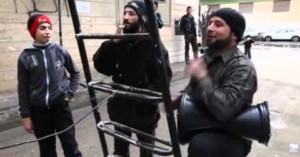
A French photographer who goes by the pseudonym Mani was recently in Homs, Syria documenting the urban warfare between government forces and rebel fighters. The video above, broadcast by Channel 4 News in Britain, shows the amazing footage Mani was able to capture by fearlessly putting himself in the midst of skirmishes.

While the world has become used to grainy shaky and gruesome footage and images from Homs fed through whatever Internet connection is available, Mani’s crystal clear and incredible footage gives perhaps the clearest and most frightening account of what Homs has been like for the past three weeks.
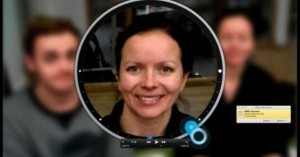
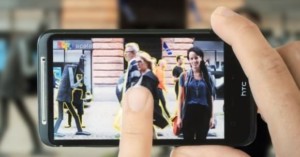
Last year imaging company Scalado showed off an app called Rewind that lets you create perfect group shots by picking out the best faces from a burst of shots and then combining them into a single image. Now the company is back with another futuristic photo app: it’s called Remove, and lets you create images of scenes without the clutter of things passing through (e.g. people, cars, bikes). It works like this: simply snap a photograph, and the app will outline everything that’s moving in the scene with a yellow line. Tap that person or object, and it magically disappears from the scene! Read more…
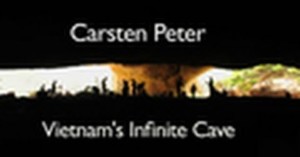
National Geographic photographers get to do the coolest things. In this video, photographer Carsten Peter takes us along with him on a journey into Son Doong, the world’s largest cave located in Vietnam. The biggest chamber in the cave is over 3 miles long and more than four times taller than the Statue of Liberty.
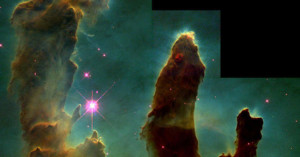
Captured on April 1, 1995 by the Hubble Telescope, the photograph Pillars of Creation is one of the most famous space images ever made. Here’s a crazy fact though: did you know that the “pillars” seen in the photo were already long gone by the time the image was captured? Astronomers have concluded that the pillars — which measure up to 4 light years in length — were destroyed about 6,000 years ago by the shock wave from a supernova. Because of how long it takes light to travel across such vast distances, we can currently see the shock waves approaching the pillars but won’t actually see their destruction for another thousand years or so!
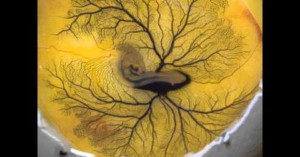
Anna Franz, a researcher at the the Sir William Dunn School of Pathology at Oxford, has won Nikon’s first annual Small World in Motion competition with an amazing video that shows the beating heart and blood vessels of a 72-hour-old chick embryo. Franz cut a window into an egg to expose the embryo, and then carefully injected ink into the yolk sac artery in order to visualize the beating heart and the vasculature of the embryo.
L.L.Bean recently decided to celebrate its 100-year anniversary by having commercial photographer Randal Ford recreated a classic 1933 catalog cover as a photograph. It’s amazing how faithfully Ford and his team was able to recreate the illustration — some of the vintage clothing had to be purchased off eBay! Read more…
Here’s something that’ll blow your mind (sorry that it’s an ad): stare at the colored dots on this girl’s nose for 30 seconds, then quickly look at a white wall or ceiling (or anything pure white) and start blinking rapidly. Congratulations, you just processed a negative with your brain!
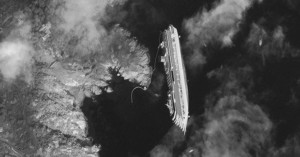
Here’s a satellite photograph showing what the Costa Concordia disaster looks like from space. On January 13th the gigantic Italian cruise ship ran aground and partially sank, killing at least 13 people.
NASA photographer Lauren Harnett captured this photograph of the International Space Station passing in front of the moon. What’s amazing is that it didn’t require any fancy astronomy equipment — Harnett was shooting from a parking lot using a Nikon D3S, 600mm lens, 2x teleconverter, heavy duty tripod and sandbag, and a remote shutter release. She shot at 1/1600, f/8, and ISO 2500 in burst mode, and then combined the resulting photographs into this one image.
The folks over at Triposo wanted to know when people around the world take pictures, so they harvested the timestamps and geolocation data from photos shared on the Internet and created this beautiful visualization showing one year of photos taken around the world (be sure to watch it full screen and in HD). It’s neat seeing certain parts of the world light up with photo activity on special days. Read more…