Researchers Film Gorillas Forming a ‘Living Ladder’ to Reach High Branch
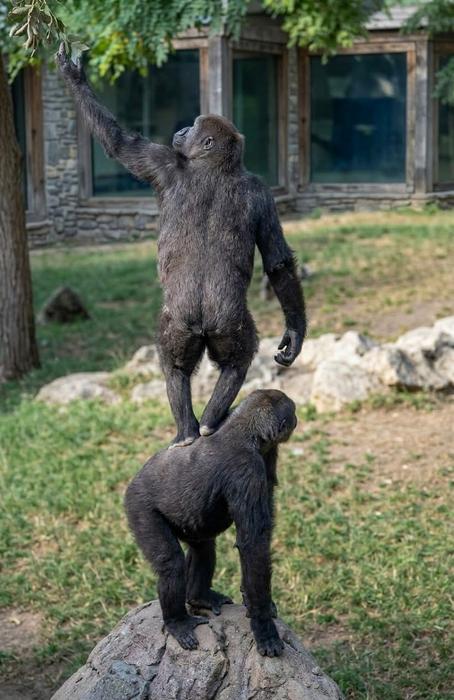
Scientists captured extraordinary footage of two gorillas climbing on each other’s backs and forming a “living ladder” to reach a high branch on a tree that was out of reach.
The pair of female western lowland gorillas were filmed displaying what researchers describe as rare behavior in their species: one positioned herself to provide a stable platform while the other climbed onto her back to reach vegetation they could not access individually.
Researchers from Tel Aviv University documented the behavior at the Ramat Gan Safari in Israel, recording three separate instances of spontaneous cooperation between the adult gorillas. According to a study published in the journal Primates, the events took place in 2021, 2024, and 2025 and involved the same two half-sisters, Amelia and Lisha.
In each instance, the gorillas performed the same roles. Lisha provided a stable platform, while Amelia climbed onto her back to reach nearby branches. Neither animal had been trained to perform the behavior.
The most extensively documented event occurred in September 2024, when keepers noticed the two females peacefully eating bark and leaves from a large branch that had previously been beyond their reach. To find out how they had accessed the food, staff reviewed security camera footage.
The recordings revealed a coordinated series of actions. Amelia first walked over and climbed onto a rock beneath a Peltophorum dubium tree. Lisha then joined her, standing firmly on all fours on the rock. Amelia climbed onto Lisha’s back, stood upright, and stretched upward to grasp and break off a branch approximately 15 feet above the ground.
The combination of the rock, Lisha’s stable position, and Amelia’s additional height allowed her to reach the branch. An electric barrier around the tree trunk prevented the gorillas from climbing it directly.
The Origins of Cooperation in Humans
Michael Levitzky, who initiated and led the study, says the footage shows genuine cooperation, with Leisha independently choosing to help Amelia achieve their shared goal rather than simply being used as a tool.
“When I first watched the footage, it was clear to me that this was something extraordinary. What I find fascinating is that Leisha did more than simply serve as a ‘step’ for Amelia,” Levitzky says in a statement. “She appeared to participate actively and willingly in solving the problem, approaching on her own initiative and positioning herself in exactly the right place, without Amelia physically guiding her. This is the difference between using another individual as a tool and true cooperation, in which both individuals work together toward the same goal.
Levitzky says that gorillas may be more socially and cognitively intelligent than previously thought, and that further research could reveal more about how they cooperate and what this tells us about the origins of cooperation in humans.
“For years, gorillas were considered less cognitively sophisticated than other great apes,” Levitzky explains. “As more observations like these accumulate, we will be able to deepen and refine our understanding of their social and cognitive abilities. Future studies involving systematic documentation and audio recordings could help us decipher how they coordinate with one another, and perhaps also teach us something about the roots of cooperation in our own species.”
Affiliate Disclosure PetaPixel articles may include affiliate links; we may earn a commission if you buy through one.