Camera Makers Should Share Tariff Refunds With Customers
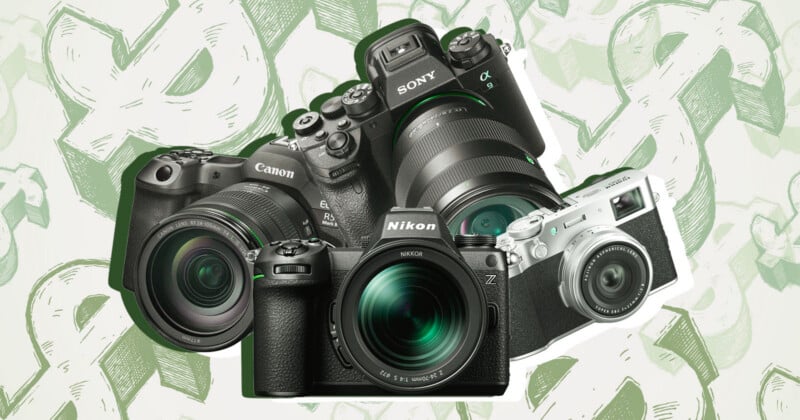
Canon, Nikon, and Sony raised prices during the tariff period, citing increased costs. Now that the Supreme Court has invalidated the IEEPA tariffs and US Customs has opened a refund process for at least some affected importers, the photography community deserves transparency about whether companies will seek refunds and, if they do, whether any portion will flow back to customers who paid higher prices.
The situation is more complex than it might first appear. Canon estimated that tariffs cost the company roughly $294 million in the second half of 2025 alone. Sony saw a $682 million decrease in operating income due to them. Nikon, Sony, and Fujifilm all raised prices during this period, in some cases by double-digit percentages, with tariffs widely cited as a major reason. But there’s much we don’t know: how much of the tariff burden companies absorbed before raising prices, when specific inventory entered the country and became subject to tariffs, and what legal costs companies will face in pursuing refunds.
With up to $166 billion potentially flowing back to importers, some companies have started making public commitments. Costco pledged to pass refunds to members through “lower prices and better values.” FedEx has also said it would refund the parties that actually paid the tariff-related charges and both it and UPS have begun filing for refunds.
Camera manufacturers, however, haven’t yet said whether they’ll seek refunds, much less what they might do with any money recovered.
The Case for Sharing Refunds
To the extent that camera companies passed tariff costs to consumers and recovered those costs through refunds, the ethical case for sharing is straightforward. Photographers who bought equipment during the tariff period — roughly April 2025 through February 2026 — paid prices that companies justified in substantial part by citing tariff expenses. If those expenses are later refunded, the underlying rationale for at least some of those price increases changes.
The challenge is that we don’t know the full picture. Camera companies faced tariffs in two separate rounds. They may have absorbed substantial costs before reluctantly raising prices. In at least one case, prices weren’t changed a second time when tariffs went up: Sigma ate that increase. Import timing also varies — some inventory may have entered before tariffs hit, some during, creating a complex mix. A photographer who paid $3,000 for a lens during this period can’t know how much of that price reflected actual tariff costs passed through versus costs the company absorbed or other factors.
This uncertainty, however, doesn’t eliminate the principle. If a company receives significant refunds for tariffs it demonstrably passed to customers, some portion of that windfall reasonably belongs with those customers.
What We Don’t Know Matters
Several factors complicate any simple demand for refunds:
- Cost absorption: Companies may have eaten substantial tariff costs before raising prices, meaning refunds might only partially offset their actual losses.
- Inventory timing: Not all products sold during the tariff period necessarily incurred tariffs, depending on when they cleared customs.
- Two tariff rounds: The staggered implementation means different products faced different cost structures at different times.
- Legal and administrative costs: Pursuing refunds through CAPE and related procedures is not free—companies will incur accounting, legal, and administrative expenses that could be substantial.
- Supply chain complexity: With global manufacturing and distribution, attributing specific costs to specific products sold to specific customers is genuinely difficult.
These are legitimate complications, not excuses, but they do mean that any refund program would require careful design rather than simple across-the-board rebates.
What Camera Companies Could Do
If companies receive tariff refunds and conclude that a meaningful portion represents costs passed to customers, several approaches could work:
- Transparent disclosure: Publicly state whether they’re seeking refunds, estimated amounts, and what percentage, if any, represented pass-through costs versus absorbed expenses.
- Targeted rebates: For customers with proof of purchase during peak tariff periods on products with documented price increases, offer rebates reflecting estimated tariff pass-through.
- Price reductions: Roll back current prices on affected product lines to pre-tariff levels, benefiting future customers even if past customers can’t be individually compensated.
- Community investment: If individual refunds prove too complex, direct funds toward photography education, grants for working photographers, or other community benefits.
The key is proportionality. No one expects companies to refund money they never collected or to ignore their own absorbed costs. But total silence while collecting potentially substantial refunds would strain trust with a community that accepted price increases when companies said they had no choice.
Why This Matters to Photographers
Photography equipment isn’t discretionary for professionals — it’s how they earn their living. Photojournalists, wedding photographers, and nature photographers stretched budgets or delayed necessary upgrades because of elevated prices. Many bought anyway, trusting that companies were being truthful when they cited tariffs as a major reason for increases.
The Supreme Court’s February 2026 ruling held that the IEEPA tariffs were unlawful, and the Court of International Trade directed Customs to implement a refund process. Whatever one thinks about the politics, the legal reality is that importers now have a path to seek repayment of duties collected under those tariffs, although the process is being rolled out in phases, and not every claim is equally straightforward.
Analysts predict most companies won’t pass refunds to consumers. UBS chief economist Paul Donovan wrote that it “seems unlikely anyone will rush to lower prices.” Tax Foundation economist Alex Durante told The New York Times he does not expect firms to show an immediate urge to help consumers. The photography industry has an opportunity to prove that prediction wrong.
A Question of Transparency
No one outside these companies knows whether they’ll seek refunds, how much they might receive, or what portion represents costs actually passed to customers. That’s exactly why the first step should be disclosure.
Camera companies have built loyal communities over decades. Photographers invest not just in individual products but in entire systems, committing tens of thousands of dollars based on trust. When companies raised prices citing tariffs, they asked customers to share that burden. If refunds materialize, transparency about where that money goes would honor that relationship.
Refund claims are now possible, or at least possible for many affected entries. What camera companies do next will signal whether they view customer relationships as partnerships that work both ways, or as one-way transactions where costs flow down but windfalls stay up.
The photography community isn’t demanding the impossible. We’re simply asking: if you get money back for tariffs we helped you pay, will we see any of it? That seems like a question that deserves an answer.
Image creditsBackground of header photo licensed via Depositphotos.com.
Affiliate Disclosure PetaPixel articles may include affiliate links; we may earn a commission if you buy through one.