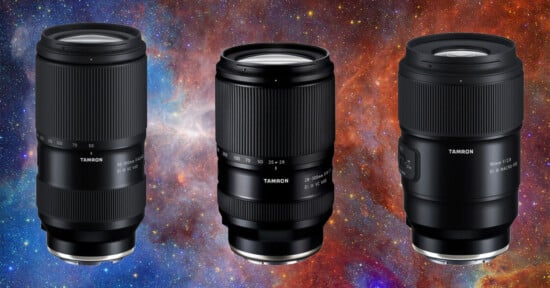
Tamron in 2025: A Quiet Year With Some Good Zoom Lenses
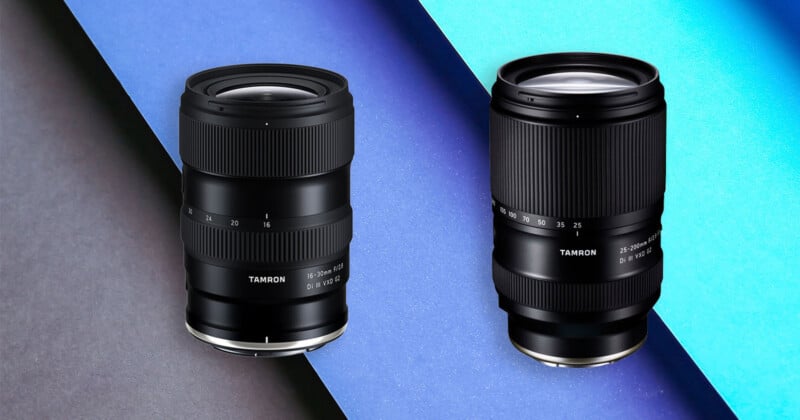
This one will be short and sweet, as Tamron released just two lenses this year. This output is not far off the three lenses the company launched in 2024 and matches Tamron’s pair of new lenses in 2023.
In fact, Tamron has been very consistent over the past four years, launching either two or three lenses per year, not counting existing lenses released in new mounts. This also doesn’t count lenses Tamron makes for other brands, which accounts for nearly half of all of Tamron’s sales. In fact, when accounting for all the lenses it makes, including ones sold under other brands, Tamron says it has the highest total sales of any third-party lens maker.
While that is all impressive, today we are focused solely on all-new Tamron lenses with Tamron’s name on them, which in 2025 proved a pretty short list.
Even More Zooms
Much has been made of Tamron’s recent insistence on making zoom lenses. Since 2019, when Tamron released a whopping four prime lenses, the company has released but one, last year’s excellent 90mm f/2.8 Di III Macro VXD. Tamron says it will make more primes, if that’s what photographers want, but the company has been almost exclusively focused on zooms in recent years.
2025 didn’t change the story at all, as Tamron released two new full-frame zoom lenses, starting with the very good 16-30mm f/2.8 Di III VXD G2 in July. This lens completes Tamron’s second-generation trinity of f/2.8 zooms, or “Daisangen,” as Tamron calls it.
The lens lives alongside the company’s great 28-75mm f/2.8 G2 and 70-180mm f/2.8 G2 zoom lenses, both available for both Sony E and Nikon Z-mount cameras. The 16-30mm f/2.8 is also the replacement for Tamron’s beloved 17-28mm f/2.8 wide-angle zoom lens, offering photographers greater flexibility at both ends of the focal length range.


We enjoyed the Tamron 16-30mm f/2.8 Di III VXD G2 for its compact form factor, affordable $929 price tag, and professional-grade optical performance. It’s an excellent wide-angle f/2.8 zoom lens at a much more palatable price than first-party options with similar specs.
Tamron’s second lens of the year, the 25-200mm f/2.8-5.6 Di III VXD G2, may have had some of its thunder stolen by the more versatile but slower Sigma 20-200mm f/3.5-6.3 DG that was announced at essentially the same time, but that doesn’t mean the Tamron 25-200mm isn’t a good travel lens.
It is lightweight, affordable, and offers a fast f/2.8 aperture at its widest end. It is also a notable improvement over Tamron’s prior-generation travel zoom, the 28-200mm f/2.8-5.6 Di III RXD. Without sacrificing any light-gathering abilities, Tamron widened the lens’s focal length by 3mm, which is more dramatic than it sounds.

In a vacuum, Tamron’s new 25-200mm is a dynamite travel zoom lens. However, it doesn’t exist in a vacuum, and it’s hard not to notice the Sigma 20-200mm’s extra wide-angle flexibility. For photographers who prefer versatility, that is the better of the two new travel zooms released this year. However, those who value a faster aperture will thoroughly enjoy Tamron’s offering. It’s a great lens.
Grading Tamron in 2025
Tamron arguably had a slightly better year last year than this one, but that does not mean Tamron’s 2025 lenses are bad. They’re not. In fact, they’re both very good, especially the 16-30mm f/2.8 zoom lens.
While I personally wish that Tamron would focus more on prime lenses, as the company has demonstrated that it can make incredible ones, there is no denying that zoom lenses are the more popular option in the market today. People want the flexibility and versatility of zooms, and I appreciate that.
My colleagues were harsh on Tamron in their own annual recap, and I get why. But looking at Tamron’s overall performance over the past handful of years, 2025 was standard fare for the company. Good lenses at reasonable prices, although not very many new models. I hope 2026 is better, of course, but 2025 wasn’t bad by Tamron’s established standards.
Grade: B-
Image credits: Header photo created using an asset licensed via