One of the interesting features in Olympus’ OM-D EM-5 retro-styled camera is the 5-axis image stabilization, which shifts the sensor in 5 different axis directions (existing systems generally use 2) to compensate for camera shake. It’s a feature that caught the eye of Vimeo user Fiatopichan, who suffers from essential tremor (a neurological disorder that causes his hands to shake at about 5-10 Hz). He decided to buy the camera to test out the new system, and reported his findings in the video above. The stabilization is quite impressive.
YouTube member eaglejm shot this video in downtown St. Louis to show the Canon 5D Mark III’s high ISO video performance. Be sure to watch it full screen and in HD.
As newspapers and magazines struggle to keep eyeballs from turning to the free world of the Web, more and more blogs are rising up to fill the niches once dominated by print. Despite the changing landscape, magazines are still able to command high advertising rates that blogs can’t match (yet). Wanting to find out whether magazines or blogs provided the best bang of each advertising buck, photographer Trey Ratcliff recently spent $26,000 placing ads in three major photography magazines, comparing the results to his online affiliate ad returns. His conclusion?
If I was consulting for one of these product companies that puts significant funds into magazine advertising, I would challenge them to try something new for six months: Try taking 50% of that money and put it into several hundred blogs, podcasts and review sites and measure the results. Cut the worst performers and find new ones.
Only one of the three magazines actually made Ratcliff money (the other two lost over ten thousand dollars) — the one that included an online ad rotation as part of the package.
Wondering whether or not the shutter speeds on your camera are accurate? Instead of taking it to a shop or buying expensive testing equipment, you can use an old television or CRT monitor as a simple shutter speed tester! Camera enthusiast Rick Oleson has an easy to understand diagram showing what you can expect to see from the screen at different shutter speeds. For a more technical explanation and tutorial, check out this article that appeared in a 1967 issue of Popular Science.
Jim Harmer of Improve Photography conducted an interesting experiment in which he stacked the Gary Fong Lightsphere up against an ordinary piece of tupperware:
The Gary Fong Lightsphere costs $50. For a hunk of rubber that produces only marginal improvements over the on-camera flash in my opinion, that is just way too much money. The fact is that the darn thing looks like a piece of tupperware to me. So, I got curious. Was this product doing anything that any other hunk of plastic couldn’t do?

His conclusion is that there was absolutely no difference in quality, and that you should save your money by using a makeshift diffuser.
Here’s a test comparing the 1080p HD video recording capabilities of the iPhone 4S and the Canon 5D Mark II. Vimeo user Robino Films shot the same scenes at the same time with both cameras using a special rig, and then synched the footage together. They also tried to match the exposure, shutter speed, frame rate, and picture style as much as possible.
Last September, Sony issued a notice informing customers that its pellicle mirror cameras would overheat during extended periods of video recording. Rather than maximum clip lengths, the company’s cameras are apparently limited by how long the sensor can endure high temperatures. In the video above, someone tests Sony’s new NEX-5N mirrorless camera for this overheating issue, and finds that you can record about 23m22s of video from a “cold start” before the camera issues a warning and shuts off automatically (the temperature indicator turns on at 12m23s).
You can supposedly record 29 minutes of footage on the camera if the sensor doesn’t overheat, though that’s probably impossible to achieve under normal circumstances — unless you’re shooting at the North Pole or something…
You’ve probably read plenty of articles touting the benefits of Sony’s translucent mirror technology (e.g. high fps, AF for video, quietness, etc…), but what about the cons? One of the main downsides to having a translucent mirror is that the light hitting the sensor passes through an additional layer (the translucent mirror), which reduces the amount of light and the image quality.
Ray over at TheSyberSite attempted to quantify how much the mirror affects the resulting image quality by removing the mirror on his A55 and comparing the resulting photos. He confirmed that about 1/2 stop of light is lost, and estimates that 5% of the detail in each shot is lost due to the mirror. Head on over to the article for some side-by-side comparisons.
On June 21, 2011, non-profit organization Shoot Experience sent out six photographers to various parts of London to see the current state of photographers’ rights.
Some used tripods, some went hand held, one set up a 5 x 4.
All were instructed to keep to public land and photograph the area as they would on a normal day. The event aimed to test the policing of public and private space by private security firms and their reaction to photographers.
The result? Every one of the photographers was confronted at least once, and in three cases the police were called.
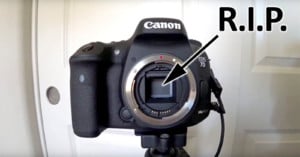
How much does a camera vibrate due to your finger pressing the shutter or the mirror flipping? Camera Technica decided to conduct a test by strapping a laser pointer to the hot shoe of a Canon 7D. They then filmed the red dot on a far wall against some text while shooting normally (i.e. pressing the shutter with a finger), using a remote shutter release, and finally with a remote shutter as well as mirror-lockup.
You might be surprised at how much movement the camera experiences even if the shutter is pressed carefully. Lesson learned: for the sharpest possible photos, use a tripod, a remote shutter release, and the mirror-lockup feature on your camera.