
Fujifilm Has Over 40 New Lens Ideas: ‘It’s Difficult to Convey How Much We Care About Our Lenses’
This week on the PetaPixel Podcast, we sat down with Yuji Igarashi, General Manager of Professional Imaging Products in Fujifilm’s Imaging Solutions Division. Echoing Fujifilm’s successful Focus on Glass event in early March, we mostly chatted about glass, including where Igarashi thinks Fujifilm succeeds, and where it can go from here.
“We pride ourselves in manufacturing lenses,” Igarashi tells PetaPixel. “We’ve done that for over 80 years.”
“But I think lenses are quite difficult because many features you cannot really quantify. So you have the bright f-number and you have resolution, but you also have chromatic aberration, you have many things — distortion — you have to think about. And it’s difficult to convey how [much] we care about our lenses.”
Fujifilm’s desire to show photographers its passion for was the impetus for the Focus on Glass event a couple of months ago. The event provided Fujifilm a chance to showcase its existing optical technologies and lens design philosophies, while also sharing concepts for future lenses.
Fujifilm fans could then vote for their favorite lens concepts, which attracted many enthusiastic votes.
“If we didn’t get any votes, that would’ve been quite sad,” Igarashi says.
After a couple of weeks of voting, the most popular lens concept was the XF 16-80mm f/2.8 fast zoom lens. It took a very early lead, and it never looked back. Over 16 percent of photographers picked this as one of their top three lens ideas.
This didn’t surprise Igarashi in the least.
“We already have our popular XF 16-55mm f/2.8, and basically [the XF 16-80mm] is an extension of that with the same aperture,” Igarashi remarks. “So we thought it was going to be quite popular.”
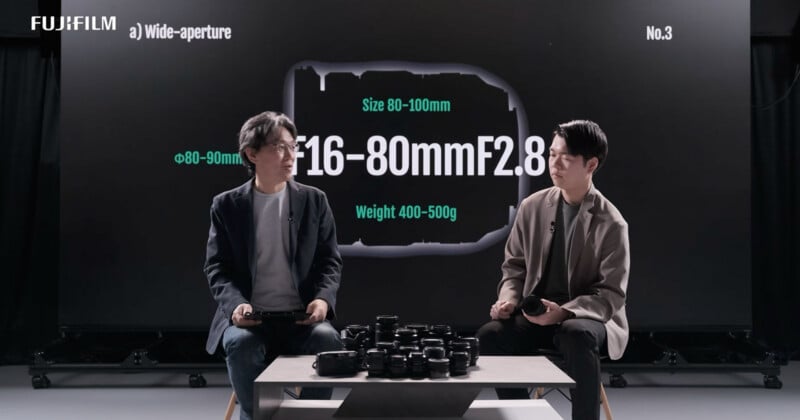
Although all 14 Fujifilm X lens concepts the company shared are just that, concepts, that doesn’t mean they weren’t extensively and carefully considered. While these aren’t necessarily in development now, Fujifilm’s optical engineers and R&D teams came up with over 40 realistic ideas, each with plausible specifications. While none of these concepts is guaranteed to exist, they could. These aren’t pipe dreams requiring Fujifilm’s engineers to break the laws of physics.
“We usually communicate a lot, the R&D and product planning teams,” Igarashi says. “We already had a lot of ideas. For us, it was actually more difficult to narrow down the numbers. Initially we had over 40, and we were like, ‘Hey, this is too many. We’re never going to get through this.'”
Fujifilm may need to hold another vote later to get feedback on its many ideas that didn’t make the final cut for the Focus on Glass event.
While the popularity of a 24-120mm f/2.8 equivalent zoom lens is far from shocking, Igarashi was surprised by some of the lens ideas photographers loved.
“One thing which surprised us was the dual focal length lens,” Igarashi says.
The XF 18 and 30mm dual focal length prime, equivalent to a 24mm and 45mm prime in one, is inspired by the classic Fujifilm Travel mini film camera. This 35mm camera had two prime lenses in one, a 28mm and a 45mm. Photographers could switch between these two fields of view in a flash. Without a true zoom lens covering all the intermediary focal lengths, Fujifilm could make the Travel mini extremely compact. For the XF 18 and 30mm lens concept, Fujifilm says the lens could weigh as little as 100 grams and be less than 50 millimeters (under two inches) long.
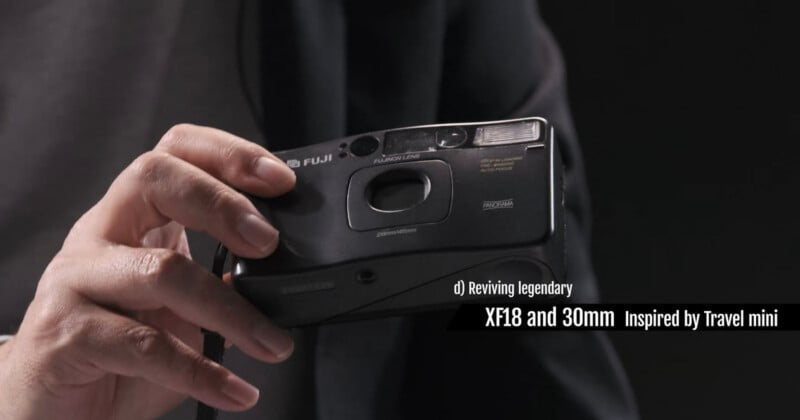
“We thought it was interesting,” Igarashi says of the idea. “But we didn’t expect that to come in third place.” It received support from just over 12 percent of respondents.
The second-place lens, the XF 18-50mm f/1.4, was also no surprise to Igarashi.
“It’s a bright lens. We thought it was going to be popular.”
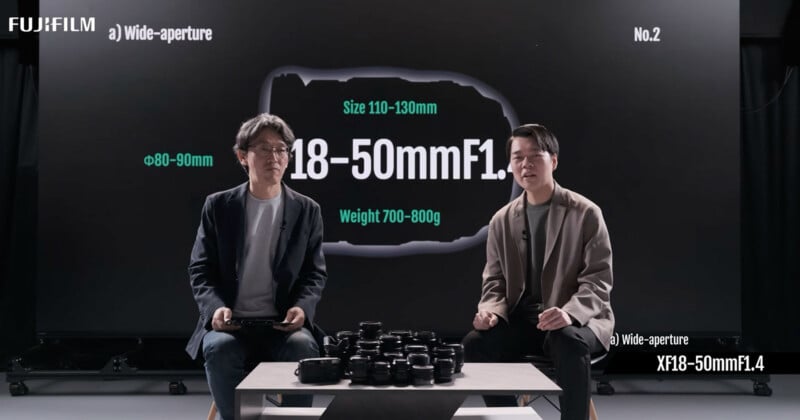
Fast apertures and shallow depth of field are very popular right now, but an 18-50mm f/1.4 lens is especially ambitious. It would undoubtedly be large, heavy, and pricey.
The Focus on Glass event not only let Fujifilm talk more about its lenses and its approach to optical design, but also gave optical engineers and product planners Yukitaka Takeshita and Yuma Miyauchi a chance to share their passion for glass with the world.
“They’re used to explaining about lenses which are being announced, but they’ve never expressed themselves talking about their dream lenses,” Igarashi says. “They were really excited.”
While Focus on Glass looked both back at what Fujifilm has already done and ahead at what the company might do, we wanted to know where Igarashi thinks Fujifilm’s X Mount has the most room to grow. The company makes many great lenses, but that doesn’t mean there aren’t gaps.
“I think we have more space to grow on the telephoto side,” Igarashi explains. “We started with three primes for the X-Pro1, and we’ve built a lot of primes, which we are proud of… [but] I think [telephoto] is still an area which we can grow.”
“[Telephoto] is the weakest,” Igarashi admits.
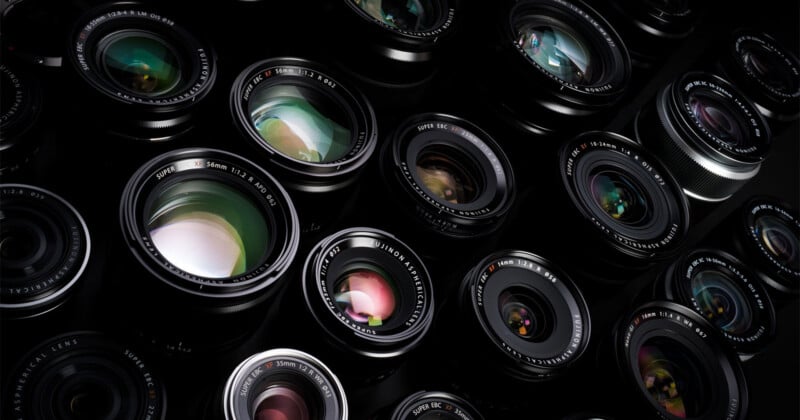
As Igarashi told us, the industry has changed a lot since the X-Pro1. Photographers are increasingly not only photographers but also videographers. New X Mount lenses have to be great at everything, only heightening the engineering challenges Fujifilm and its competitors face. Fortunately for Fujifilm, it has a rich history in broadcasting and cinema optics as well. All of these teams live under the broader Professional Imaging roof Igarashi oversees.
“We want to continue to develop, evolve in this industry, and there are so many ways to do that,” Igarashi says. “We don’t want to forget about our heritage of knowing photography. That’s also very important. So how can we make people excited about photography? That’s a very big theme for Fujifilm.”
If the company wants to make people even more excited about photography and its history and culture, there are few better ways than getting direct feedback from real photographers about what they want. Focus on Glass was a huge hit and emblematic of how Fujifilm cares about photography and photographers.
Our wide-ranging conversation with Igarashi covered many more topics, so be sure to watch or listen to the full conversation in this week’s PetaPixel Podcast.