The Mount Etna Eruption Photo that Won $200,000 at HIPA 2025
HIPA, the world’s most profitable photo contest, announced its 2025 winners with the theme Power on 11th November in Dubai, the most populous city in the United Arab Emirates.
This is the 14th season of the yearly photo contest, which over the last two years has annually awarded a staggering $1 million in prize money across six categories, with the lowest prize being five $20,000 prizes and the top prize netting $200,000. There were 15 other awards ranging from $30,000 to $100,000 to celebrate a total of 22 delighted prize winners attending in person from around the world.
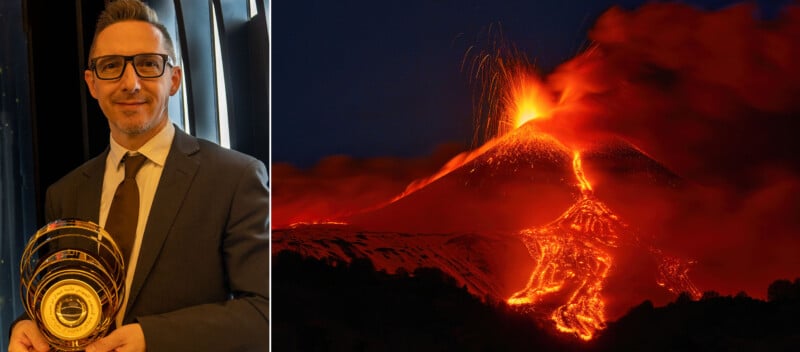
PetaPixel sat down with grand winner, amateur Italian photographer Gianluca Gianferrari, as the reality that he had won nearly a quarter of a million dollars slowly sank in.
Getting to Photograph an Active Volcano
Gianferrari was home, sick with fever, when his friend from Tuscany called. There was an eruption on Mount Etna, and he was interested in photographing it. Now, Etna on the coast of Sicily, Italy, is one of the world’s most active volcanoes and is in almost constant eruption, so eruptions are unlikely to be very strong or visually rewarding.
Being a passionate landscape photographer, he decided to take on the challenge and fly to Sicily from his hometown of Correggio, Italy (about 100 miles southeast of Milan), along with a local friend.
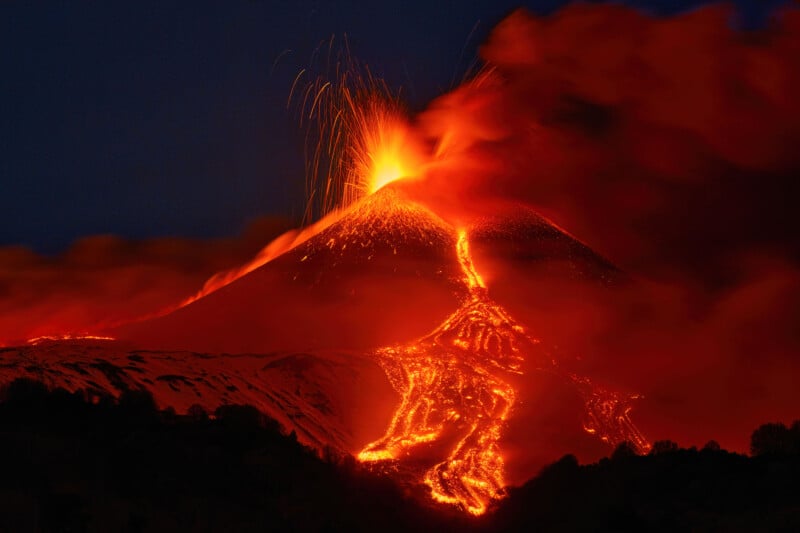
“Every time there is an eruption, it lasts two to three hours maximum,” says Gianferrari, explaining the behavior of the volcano. “So, I cannot go, take a plane, take a car. It’s impossible. This time, it was a strange paroxysm that lasted one week because it was not with peaks but was slow.
“Okay, even if it’s a small eruption, no problem. We stay together and have fun with the other third friend.”
The first two days, starting with the 1st of December 2023, were the usual lackluster, small routine eruptions, even leading them to wonder whether they had made the right decision.
“On the third day we were there, everything changed,” says Gianferrari as the volcano erupted with violent paroxysms. “So brutal, very lucky. We went down to eat something, and then saw it was exploding. Grabbed the camera and ran back.”
Mount Etna, the largest volcano in continental Europe at 11,165 feet, was putting on an exclusive performance for three Italian friends, as there were only four or five other photographers present at around 9 pm when Etna blew its top, with golden lava streams flowing down its flank.
Gianferrari captured around 1,000 plus frames on those three fateful days on his Sony A7R IV, with a Sony FE 200–600 mm F5.6–6.3 G OSS using his Italian Gitzo Traveler Series 2 tripod. The winning shot of Etna’s Paroxysm at 236mm was recorded at f/9, 1.3 sec, and ISO 640.
The photographer was kept at a distance of over 1 kilometer by the police, so the 200-600mm super telephoto zoom came in handy for getting a close-up of the exploding beast.
“It was so windy, so I had to find a place near a small wall to stay down[low] and to cover from the wind,” remembers Gianferrari.
“I was excited, really excited, because it was a dream. I didn’t expect to find a nice eruption. And I was also emotional by the sound that I heard, so brutal. It was my first. The sound is loud, like an earthquake.
“Before we were really near the volcano. This is funny: we started taking [photographs] of some peaks, and at a certain point I said to my friend who lives there, ‘It’s starting to rain.’ And he said, ‘It’s not rain, let’s go away immediately,’ because there were the drops of lava, drops small that could ruin the camera and the dress, because I felt, tink, tink, tink [he simulates the sound]. I thought it was raining.”
These are the photographer’s only images of an erupting volcano, as his earlier trips to Iceland and the Canary Islands in Spain were unsuccessful.
“In the first picture we took when the lava ash [was] falling on our heads, we felt some warmth…
“We were dressed for the mountain, because it’s a high mountain, so there, I didn’t feel [hot] because we were far and there was a lot of wind. And Sicily is a cold place.”
The Quality of the RAW Image
The RAW image file was processed in Capture One, which he has been using for the past 7 years. The photographer believes that Adobe Lightroom is now equally good, with no real difference. He uses Affinity, but it was not used in this winning image. Topaz Labs was used for noise reduction, but now he is using less of it and more of DxO.
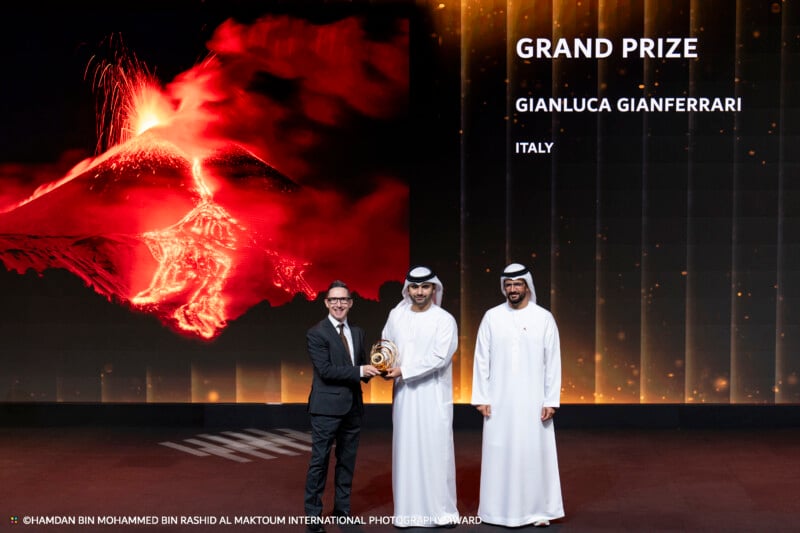
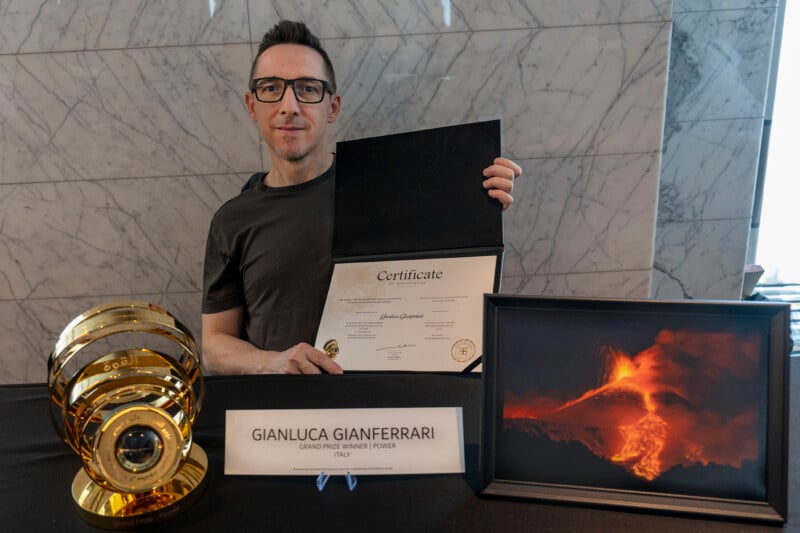
The photographer shot Etna’s Paroxysm in Uncompressed [he emphasizes the word] RAW to win the top prize of Hamdan International Photography Award (HIPA), founded in 2011 under the patronage of the crown prince of Dubai, Sheikh Hamdan bin Mohammed bin Rashid Al Maktoum.
“So, 61 megapixels. Now I have the Five (Sony a7R V) and I shoot lossless compressed. I want the maximum quality, because I make prints two meters [6.6 feet] wide,” says the landscape artist.
“[It is the] best sensor along with an R5 [Sony a7R V]. It’s the same sensor as the a7RV, and this is the best sensor in terms of image quality and sharpness. And despite what everyone says, that the ISO is noisy, I think it’s not so noisy for me.”
Gianferrari feels that even a Sony a7 IV with 33 megapixels could have taken an equally good photo.
“My friend who lives here has taken a lot of photos with a Canon. Every time now there is a paroxysm, he goes and uses a Micro Four Thirds [camera].
I think there is no need for a 61-megapixel camera, but if you have one, it’s better. It is more useful when you shoot something like animals [with] a lot of detail. But for this photo, I think that APS-C or Micro Four Thirds is sufficient.
He uses a 32-inch monitor on a Mac and is proud to be called a pixel peeper. In this winning image, the highlights were more important to the photographer than the shadows, as he did not want to lose any details. He did not bracket the exposure and used a remote to fire the camera while shielding it with his body from the wind.
The photographer sees a double V formation in the image. The first inverted V is of the mountain, and below it is another V formation.
“It converges [into] the double V. Everybody says about order. My photographs are order, every detail in the right place, at the right point. Otherwise, I’m not satisfied.”
From Photographing Motorcycles to Landscapes
“I started to make photographs in the 70s because my older brother, 12 years older than me, had a passion for photography, doing some contests, models, and motor sport,” recollects the award winner. So, he takes me to Imola [racetrack] one day, maybe 1982. I remember it like it was yesterday. Then I was yes 10 years old, 11 years old, and he taught me how to do panning on motorcycle [racers].
Gianferrari has worked at one of the oldest banks in the world, Banca Monte dei Paschi di Siena, founded in 1472, for 35 years as an officer servicing corporate clients.
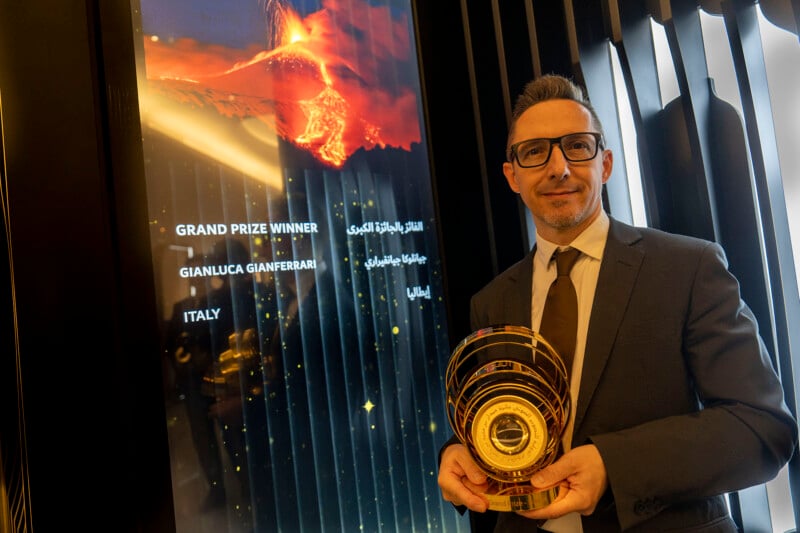
The banker prefers landscapes but has also shot animals.
“I’m a naturalist, and [photograph] landscape possibly without house or building [maybe] sometime, yes, but I prefer only nature. Three or four years ago, I started making a bit of animals, birds, and so on. I went to Kenya last year and did some astrophotography. I like the main landscape with the Milky Way.
“Recently, I photographed the comet, C/2025 A6 (Lemmon). There is a famous mountain one hour from my house, and I planned this shot for three or four years, spending a lot of time studying it. Getting the right position, right time, and photographing the comet is difficult using an astro tracker.”
A Winning Dream
Signore Gianferrari did not expect to win a prize in Dubai.
“No, no, because last year there were five winners, correct? The fourth and the fifth don’t gain nothing. So I said, ‘Okay, I’ll go.’ It’s an experience. I find some new friends.
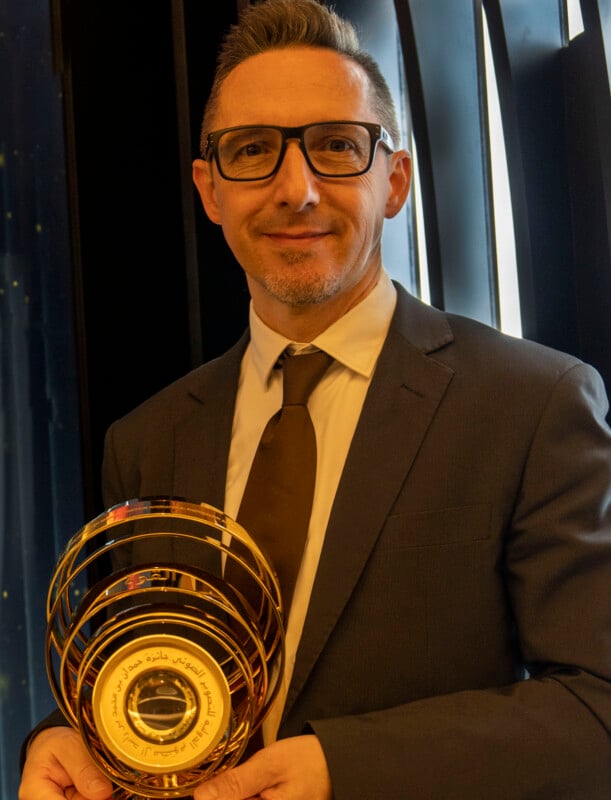
“But I sure will be fifth or fourth. Then in a call, they told me that there were only three, only third, second, and first, and I said, Oh, wow. So, third, incredible. Everything more than the third for me was a success at this time. I never expected [to win the top prize.]
Even now, I can’t perfectly realize what is happening. And if it’s reality or a dream. Everybody, I say, ‘Please don’t wake me up’.”
Affiliate Disclosure PetaPixel articles may include affiliate links; we may earn a commission if you buy through one.