Stop Using AA Lithium Batteries in Portable Strobes and Speedlights
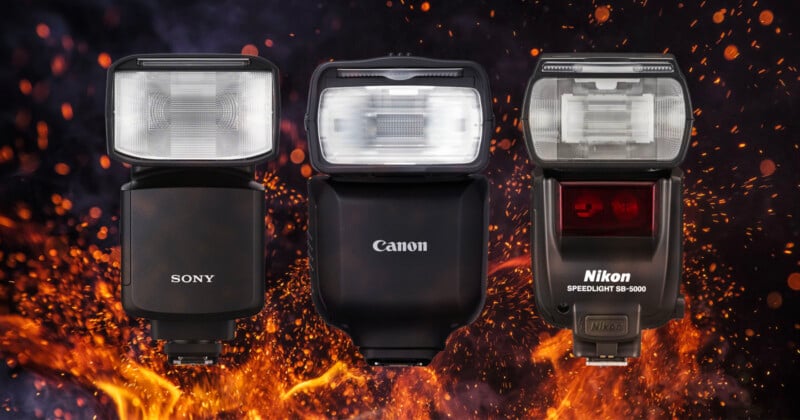
This week, Canon published a Service Notice to its websites urging photographers not to use lithium or lithium-ion batteries in its Speedlites, battery packs, and macro twin light products, surprising many that this was suddenly an issue. The thing is, it’s not sudden at all, and almost every manufacturer cautions against it.
The long list of affected products includes 21 Canon Speedlites — which is the company’s term for shoe-mount flash units, which are also colloquially called speedlights — as well as four macro twin light strobes and four compact battery packs. The notice is classified as an “update,” which likely means this was a service notice that had previously been posted but had been updated with more products this month.
“Please note that lithium batteries and lithium-ion batteries cannot be used with the Speedlites/Macro Ring Lites/Macro Twin Lights, and compact battery packs in general. Please be aware that using certain lithium and lithium-ion batteries will result in an extremely high temperature of the battery,” Canon says.
What’s interesting about this notice is that, while it might appear new to many, it’s been a Canon warning for some time. Looking back at its user manuals, there has been an explicit note not to use lithium or lithium ion batteries in these products. Looking at the EL-10 and EL-100 specifically, the note is clear: “Do not use AA/R6 lithium batteries.”
It’s Not Just Canon
Curious, PetaPixel checked with other first-party speedlight manufacturers to see if this was unique to Canon or more widespread. It turns out it’s the latter.
Looking at the Sony HVL-F28RM user manual (and the language is mirrored in the manuals for the HVL-F60RM, HVL-F60RM2, HVL-F46RM, and HVL-F46RMA) the company does specifically call out lithium batteries and says not to use them, albeit for a different reason than Canon states: “Do not use lithium-ion batteries in this flash unit as they may prevent the flash unit from delivering full performance.”
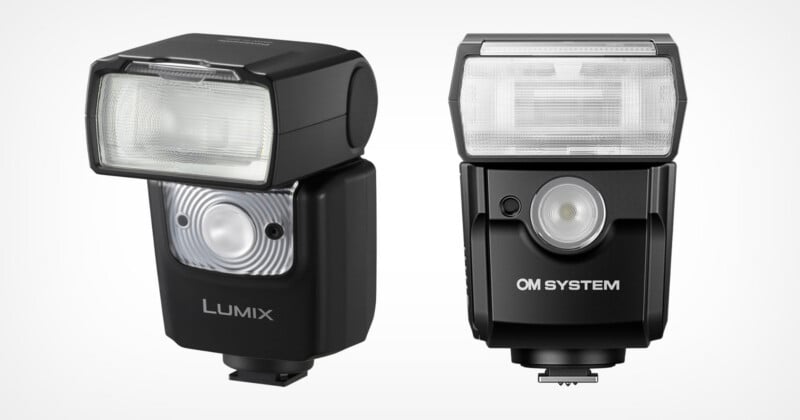
The OM System FL-700WR speedlight manual also states that photographers should not use lithium batteries: “Avoid using AA lithium batteries. Some AA lithium batteries may become extremely hot during use.”
Panasonic Lumix and Nikon are less specific about the dangers of lithium batteries. For its DMW-FL360L flash, Panasonic says that either alkaline or rechargeable nickel metal hydriede (Ni-MH) batteries should be used. No mention of lithium batteries, but curiously the company does say that manganese dry batteries are specifically to be avoided.
Nikon is the most lenient. It takes a similar approach as Panasonic Lumix with its SB-5000 strobe, only stating that alkaline or Ni-MH batteries should be used, with no specific call out against lithium. However, Nikon is far more specific in its now-discontinued SB-900 speedlight manual. This particular speedlight doesn’t explicitly or implicitly forbid the use of lithium batteries, and actually does the opposite and states they should be fine to use. Alkaline, lithium, Oxyride, and Ni-MH batteries are all approved for use in the SB-900.
The company goes the extra mile here, and publishes a full performance chart based on battery type:
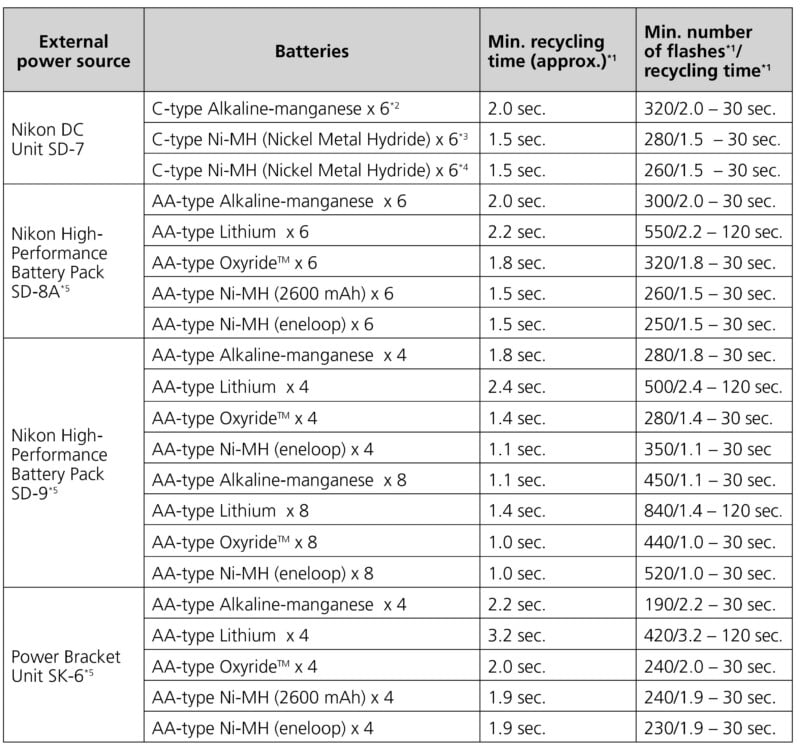
What’s interesting is that Nikon shows lithium batteries regularly have the slowest minimum recycle time across use cases but they also have the highest number of flashes over the full capacity of the battery. However, it’s not so many more flashes that photographers would likely be willing to wait nearly twice as long for a recharge in some cases. For wedding and event work, recycle time is the most important feature, making lithium batteries the worst choice among the four options.
One last note: Godox doesn’t publish any restrictions or information about battery type for its speedlights and strobes, only “recommending” the use of Ni-MH batteries or alkaline batteries. It doesn’t appear the company has any explicit restrictions.
What Constitutes a Lithium Battery?
Over the years, lithium has grown in popularity for batteries of all types, both rechargeable and disposable. For example, Energizer offers disposable lithium batteries while brands like Nitecore (among many others) offer AA-sized Lithium-ion batteries. The caution against use applies to all AA-shaped lithium batteries — it doesn’t matter if they are disposable or not.
Also note that the warnings against lithium and lithium-ion being discussed here refer to AA-shaped batteries and do not apply to a manufacturer’s included rechargeable batteries. Canon, for example, offers the EL-5 and the EL-1, both of which operate on the Canon LP-EL battery. Obviously, Canon is not warning against the use of its own batteries in its strobes.
Lithium Is Either Dangerous or Just Worse
PetaPixel‘s editorial staff is made up entirely of current or former photographers and photojournalists (and camera store employees) and, somewhat embarrassingly, not a single one of us knew about the lithium restriction in speedlights. While some of us may have just opted to use disposable alkaline batteries for work, it wasn’t because we knew that lithium posed a particular problem.
It appears that main issue is heat: either just the flat-out heat generated from so many successive flash pops close together being dangerous in general or just the design of these strobes being poor for heat dissipation. Whatever the case, lithium and lithium-ion batteries are, in most cases, recommended against due to the risk of fire or damage to the strobe unit.
The wide variety of approved battery types across brands (and even within some brands’ product lines) goes to show that photographers should always check the user manual for battery instructions on their specific strobes before using them.
But even in the cases where lithium and lithium-ion aren’t explicitly warned against, they’re not a good choice for a working photographer anyway. Per Nikon’s test chart, the recycle time is significantly worse in many cases versus the alternatives, so even if it’s okay to use them, photographers probably won’t want to.
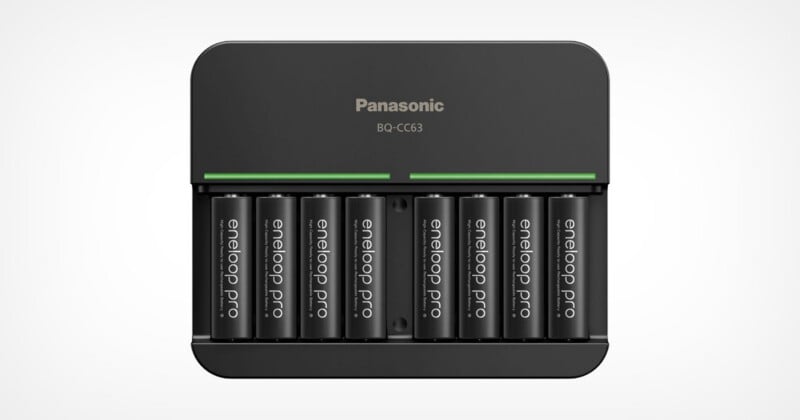
As a result, PetaPixel feels fairly confident in recommending photographers stick to classic alkaline batteries or get Ni-MH rechargeable batteries, specifically Panasonic Eneloop.
Eneloop have been reliably great for use in speedlights for more than a decade and while the upfront cost is higher than a big box of disposable alkaline batteries, they pay for themselves over the course of a year.
Image creditsElements of header photo licensed via Depositphotos.com.
Affiliate Disclosure PetaPixel articles may include affiliate links; we may earn a commission if you buy through one.