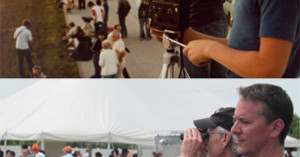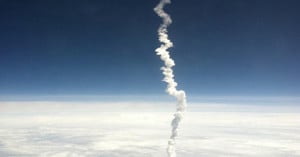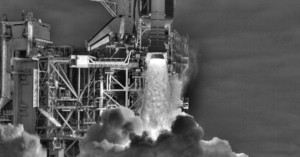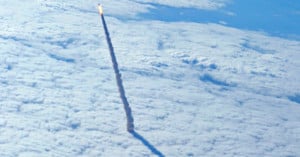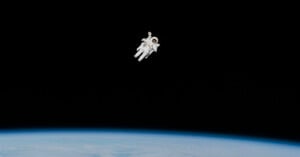
The end of NASA’s Space Shuttle program in 2011 meant the end for more than the shuttles themselves. One aspect of the program you may not have known about was the plethora of incredible photo and video equipment that was used during the program’s heyday to capture each launch. At any given launch, about 138 professional still, video and TV cameras were pointing at the shuttle, and some of them were downright incredible. Read more…
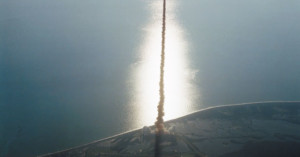
NASA’s Space Shuttle Discovery’s first launch was back on August 30th, 1984 from the Kennedy Space Center in Florida. During the event, astronaut John W. Young was flying nearby in a Shuttle Training Aircraft, which astronauts use to assess weather conditions prior to launches and landings.
Shortly after Discovery lifted into the air, Young pulled out his camera and snapped the above picture-perfect photograph of the orbiter climbing into space. He managed to catch the shuttle and its fiery trail framed by the reflection of the sun on the Atlantic Ocean. You can find a much higher resolution version of this photograph here.
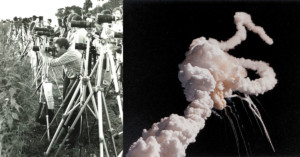
Two days ago marked the 10th anniversary of the Space Shuttle Columbia disaster, in which 7 astronauts lost their lives during reentry as the rest of us watched horror-struck from the ground. The following day, newspapers the world over were announcing the tragic news, all of them using the same photo taken, not by a prolific AP photographer, but a cardiologist and his 6.3MP Canon D60. Read more…
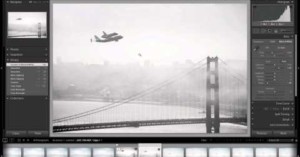
When Space Shuttle Endeavour was making low level flyovers of famous landmarks across the United States a couple of months ago, Adobe Lightroom Quality Engineer Ben Warde was able to photograph it flying by the Golden Gate Bridge. The 10-minute video above shows how Warde post-processed one of his best shots from that day using basic Lightroom adjustments. While the information may be basic for many of you, it should be helpful for people who are just starting out with programs like Lightroom, Adobe Camera Raw, or Aperture. Read more…
If you’ve been following the news over the past week, you probably know that the Space Shuttle Endeavour spent October 11-14 rolling through the streets of Los Angeles, going from the Los Angeles International Airport to its new home at the California Science Center. News crews and large camera-wielding crowds were constantly by the shuttle’s side, documenting its progress.
For those of you who weren’t lucky enough to personally witness the neat sight of the giant shuttle moving through the city, check out the beautifully-made time-lapse video above that shows the four-day journey in under three minutes. Read more…
McLean Fahnestock of Long Beach, CA took high definition video of all 135 Space Shuttle launches and synchronized them into this mesmerizing video titled “Grand Finale”. It’s a beautiful project with a twinge of sadness.
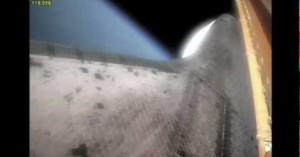
We’ve seen quite a few videos lately by people who send cameras up to the edges of space on weather balloons. Here’s the big-budget version of that: footage from a camera attached to a NASA Space Shuttle’s booster rockets. Lift off from Earth occurs at 0:27, separation from the shuttle occurs at 1:57, and splashing into the ocean occurs at 7:21. The sound captured by the cameras has been remastered by George Lucas’ Skywalker Sound.
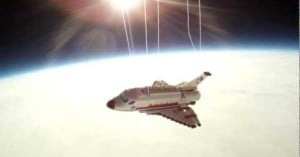
On December 31st, 2011, Oaida Raul decided pay a tribute to the recently-retired Space Shuttle program by creating a GoPro video of a Lego Space Shuttle model traveling up to the edges of Earth’s atmosphere on a weather balloon. You can read an in-depth description of the mission and the components used — the entire project was launched and completed in a span of about a week — over on Raul’s blog.
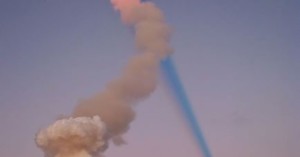
During a 2001 launch of the Space Shuttle Atlantis, NASA photographer Pat McCracken captured this amazing photograph of the shuttle’s smoke plume casting a shadow across the full moon rising in the horizon.
[...] the Sun, Earth, Moon, and rocket were all properly aligned for this photogenic coincidence. First, for the space shuttle’s plume to cast a long shadow, the time of day must be either near sunrise or sunset. Only then will the shadow be its longest and extend all the way to the horizon. Finally, during a Full Moon, the Sun and Moon are on opposite sides of the sky. Just after sunset, for example, the Sun is slightly below the horizon, and, in the other direction, the Moon is slightly above the horizon. Therefore, as Atlantis blasted off, just after sunset, its shadow projected away from the Sun toward the opposite horizon, where the Full Moon just happened to be. [#]
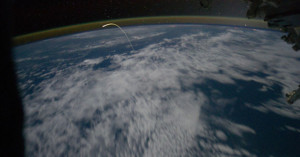
As Space Shuttle Atlantis left the International Space Station to head back to Earth for the final time, one of the astronauts on the ISS captured this beautiful image of the shuttle’s glowing re-entry. Any guesses for what shutter speed this was shot at?
Update: Someone from the Photo Operations Group at the Johnson Space Center was kind enough to leave a comment with the answer: 1.6 seconds, f/2.8 at an ISO of 10000.