

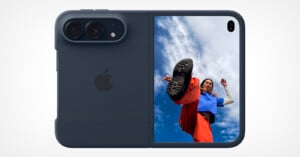
This Battery and Card Case Looks Like a Fujifilm Camera and I Love It
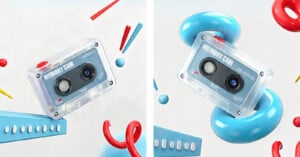
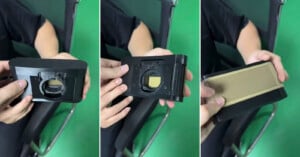
A Chinese design account, PerceBound, shared a clever 3D-printed Fujifilm camera-themed battery and memory card case. It's a silly, but great idea.
Once upon a time, in the last century, before hipsters and when only restaurants had menus, photography was film and film was photography. Both consumers and pros used film, and every camera jockey had a favorite kind: large format, medium format, 35mm, APS, 126, Disc, etc.
Ricoh Imaging recently revealed to PetaPixel that it was having a difficult time figuring out how to make the DSLR popular among a wider group of people, admitting that the current fan base of the brand wouldn't be enough to keep it afloat. I argue the best route forward is to pull a Sega.
For professional photographers, there’s more to it than just composing a photo and exposing it correctly. It's great fun, but any photographer can set up a business and benefit from it.
The Consumer Electronics Show (CES) is in full swing in Las Vegas, and tech companies are clamoring to stand out. Usually, that means highlighting one eye-catching product, but RadioShack went with the opposite strategy: throwing everything at the wall in the hopes that something will stick.
The Kodak Charmera digital keychain camera, despite its significant technical shortcomings, has been a holiday hit. Companies could not wait to rip it off.
We got not one, not two, but three fantastic mid-range full-frame cameras in 2025: the Panasonic Lumix S1 II, the Canon EOS R6 Mark III, and the Sony a7 V. These join the Nikon Z6 III, which launched just 18 months ago. The mid-range mirrorless camera segment has never been this competitive, fresh, and fantastic, which is outstanding news for photographers.
There are so many fantastic, capable digital cameras available these days. Nearly every new camera from all the major manufacturers can take great photos, has reliable autofocus, and offers a competitive feature set. Ultimately, the biggest differentiator between most cameras is the experience of using them. 2025 delivered many new cameras that not only provide a great experience, but a different one that celebrates the act of photography itself and what it means to capture photos.
A series of investigative reports sent shockwaves through the tech and privacy communities when it was revealed that dozens of Flock Safety’s AI‑powered surveillance cameras were left streaming live footage to the open internet, unprotected and accessible to anyone who knew where to look.
As photographers, we often concentrate on technical perfection and the compositional layout. However, arguably more important than either of those is adding meaning to your photos. It can be challenging, but adding meaning can genuinely elevate your photos to the next tier.
Now for the fifth year in a row, PetaPixel has gathered its team together to gaze into the future and see the facts, the truths, that will come to pass in the camera industry in 2026. As always, we are prepared to be very wrong.
When Kodak re-released Kodacolor in 100 and 200 ISO variations a few months ago (which is probably just Kodak Color Plus in a new box), the film community got very excited. Now that dust has settled and I am not hearing a lot about the film much these days, but that should change. This film rocks.
Martin Parr made a huge impression on me early on in life, in no small part because his most famous photos were shot very close to my home city of Liverpool.
Your favorite holiday tradition is back! Yes, it is time for our annual Best and Worst camera gear roundup. Jordan and I get together to battle it out with some not-so-friendly challenges, drink more than we probably should, and reminisce about the last year’s gear releases.

This year we saw some really outstanding cameras come to market. In fact, somehow, 2025 was even more packed than last year. Yet now as the dust settles and we are winding down, I am regularly seeing complaints that the Sony a7 V and the Canon R6 Mark III -- two of the year's most impressive cameras -- have "gotten boring." Excuse me, what?
After popular YouTuber Kai Wong reviewed the a7 V last week and mentioned potential issues with third-party lenses, concerns about whether the a7 V is taking a different approach to E-mount's famous openness spread like wildfire. However, while there is always the chance that certain lenses, particularly third-party ones, may have compatibility issues with new cameras, there is no reason to believe that the Sony a7 V represents any departure from Sony's longstanding view toward third-party optics.
Earlier this year, 7Artisans announced the Floral Bloom Art Cine Lens series, with the first being a 37mm T2.9 for PL mount only. It sounded interesting, so we agreed to check it out. We appreciate the effort and applaud the company for trying something new, but unfortunately, this lens is terrible.
When someone says Slovenia, what comes to mind? Dragons, mountains, craft beer? Maybe so, but Slovenia is a country that no one really talks about. Originally part of Yugoslavia, Slovenia became independent in 1992, and few travelers have mentioned whether they’ve been to Slovenia.
I've been thinking a lot about the Canon EOS R lately. From why I think the underlying concept of the maligned M-Fn Touch Bar should be revisited to just how weird the EOS R camera itself actually was, Canon's entry into the full-frame mirrorless camera market has been on my mind of late.
Sometimes it is the least obvious choice that produces the most striking results. That is why I ended up photographing a hockey game in the Swiss National League, with a Sigma 135 f/1.4 Art and a Lumix S1 II and not your standard f/2.8 zoom -- and boy was I up for an exciting shoot!
This time last week, I had never appeared on a podcast before; now I've been on two. And it's all thanks to The Stringer: The Man Who Took the Photo, a documentary questioning Nick Ut's authorship of Napalm Girl that recently landed on Netflix.
I recently installed iOS 26 on my iPhone. I'm slow, I know, but as I was swiping past my Photos widget, I noticed that one of my photos was in 3D. The image wiggled around as I moved my phone in my hand. "What the hell," I thought.
The Stringer: The Man Who Took the Photo, which lands on Netflix this week, opens with a line implying Nick Ut is a liar: "What you do know is what you didn’t take." But is that really true? I've always thought the inverse makes more sense.
Between writing the polarizing opinion that Canon should revisit the EOS R's much-maligned Touch Bar and reviewing the excellent Canon EOS R6 III in recent weeks, it has become even clearer just how bizarre the original Canon EOS R actually was when it arrived in 2018.
Earlier this week, Arri announced that it would be closing two facilities, both of which were focused on lighting production. Seeing Arri significantly reduce or outright exit the lighting industry makes a lot of sense if it wants to get acquired.
The "MP" in Leica MP stands for "Mechanical Perfection." That’s a big claim that I decided to put to the test with a roll of Leica’s brand new Monopan 50 and a trip to the English Cotswolds.
Last year, when Nikon announced the Z6 III, it did not accompany it with a Z7 camera like it had the two previous times the series had been announced. At the time, I argued there wasn't really a need for it, but now a year later, I'm changing my tune.
When my colleague Jordan Drake swiped the Epson R-D1 series of digital rangefinders out from underneath me in our recent Fantasy Camera Draft, I was disappointed. But my frustration also got me thinking about why the Epson RD should return and become more than just a quirky bit of digital camera history. The Epson RD series deserves better.
The maligned Multifunction Touch Bar, commonly called the "Touch Bar," on the original Canon EOS R mirrorless camera is an excellent example of what happens when interesting, even good, ideas try to do too much. However, it's time for Canon to revisit the Touch Bar, or at least the underlying concept of expanded touch on modern mirrorless cameras. Technology is better now, lessons have been learned, and there is still room for improvement in camera ergonomics.
Last week, Vogue France published a short snippet from an interview where Jisoo -- an incredibly popular member of the K-pop group Blackpink -- talks about her love of the Fujifilm X-Pro3. Describing the photos it takes as "cinematic" and "atmospheric," she also touches on another angle of why she and her friends like it: how it looks.
There has been a lot of big news in the photography space in the past month, so it's perhaps not too surprising that Nikon's pair of new APS-C lenses has flown a bit under the radar. That's a shame because the Nikkor Z 16-50mm f/2.8 VR and Nikkor Z DX MC 35mm f/1.7 actually address a major complaint many have had about the Nikkor Z system: the lack of new high-end APS-C lenses.

Sean Murray, the founder of Hello Games, was once one of the most derided figures in video gaming. In 2016, he and his studio released No Man's Sky, a game that was so disappointing at launch that it was jokingly called "One Man's Lie." Nine years later, and Murray has earned that respect back by delivering the game he originally promised -- and more.
Annie Leibovitz has once again been attracting plenty of criticism this week after her photos of actor Timothée Chalamet graced the pages of Vogue magazine's December edition. But is any of it justified? PetaPixel writers have their say.
A camera's native ISO range used to be a huge deal and was an integral part of how companies advertised their latest and greatest cameras. However, these days, companies sometimes don't mention ISO at all, relegating it to side, separate detailed spec sheets.
It's very strange to watch a movie in 3:2 or 4:3 aspect ratios. As photographers, those are kind of our aspect ratios, while Hollywood's have traditionally been the ultra-wide 2.39:1. But rules are made to be broken.
It’s no secret that things are changing in the camera and imaging space. As technology advances and the old guard passes the torch to the new, we’ve seen the digital camera evolve from a work instrument only accessible to industry professionals to a creative tool that even those of modest means can access.
An international news website, Chronik.fr, claimed today that a photographer captured an incredible photo of an eagle carrying a slice of pizza in a "shocking urban encounter." The lead image is obviously fake, but the story is not. In fact, it's a great story, which is why we covered it when it happened in March 2023.
Earlier this year when the Canon C50 was announced, I saw a significant amount of chatter online about how well-designed and well-priced it was for the average content creator. I wanted to agree, but thought it lacked two major features that those content creators were going to miss: in-body image stabilization and an electronic viewfinder.
This past week, Adobe added several new features to Lightroom Classic that are powered by AI. My knee-jerk reaction to any new AI feature is immediate skepticism, but after looking at the updates, the additions all look like welcome improvements.
Despite the controversy surrounding its use of generative AI to create a trio of Christmas advertisements last year, Coca-Cola has once again returned to the world's driest well, churning out yet another terrible AI-generated advertisement.
Sigma is a premier optics manufacturer. That is not just an opinion, it is becoming an unassailable fact. In the last several years, Sigma has cemented its reputation as one of the top optical manufacturers in the world. It is, therefore, becoming impossible to ignore that its lenses are not available on Z-mount.
Today Affinity announced that it was going free to use for everyone, a move that probably surprised a lot of you because it was certainly unexpected to me. However, the more I think about it, the more it makes perfect sense.
The top 200 photographers requested by Midjourney users have been exclusively revealed to PetaPixel -- and it's a world-famous, still active photographer that tops the list.
When Nikon added the gold ring to the lens mount of its 28-135mm f/4 PZ earlier this year, I was ecstatic. Finally, Nikon was leaning into its brand color. I was saddened to learn it would only do this on select products moving forward. That got me thinking: every brand is leaning away from color when they should be leaning into it. For a tool designed to create art, the camera tends to be dreadfully boring.
Is our pursuit of exquisite photos inconsistent with what is expected in art? Or is beauty something we should continue to strive for?
Far be it from me to criticize one of my fellow PetaPixel writers, but I feel it necessary to counter Bimal Nepal's recent "Stop Making Digital Look Like Film" op-ed.
I shoot digital. I don’t do film, and I have never touched a film camera. I have never spent hours in a darkroom waiting for a print to appear under red light. My photography career began entirely digital, and I have grown to appreciate the possibilities it offers. Every modern camera provides clarity, precision, and control that film could never fully deliver. Every detail, every color, every expression is there, ready to tell the story as it happened.
Last week, I received multiple emails from different case makers showing supposed designs for the iPhone 17 series. Then this week, that ramped up to Dbrand, Moment, UGreen, and basically every case maker at IFA showing the same thing, all flaunting the same design. Apple is historically excellent at keeping a secret, so what changed this year?
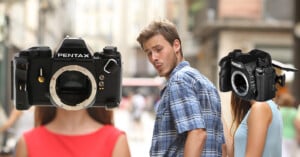
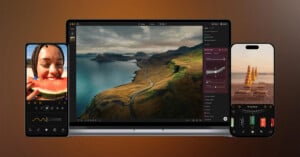
In an effort to learn to love the 35mm full-frame focal length, I took the latest Meike 35mm f/1.8 Pro lens out for a spin. The Meike 35mm f/1.8 is an affordable take on the popular focal length, but it has some handy tricks up its sleeve that belie its lower cost. Many creatives who are looking for a compact and sharp lens will find the Meike 35mm ideal for street photography and travel. I carried it on a little road trip around southern Alberta, and it proved to be a handy companion.
It is hard for anyone to deny the positive effect that the transition from film to digital has had on photography. The sheer number of photographs taken each year has increased exponentially in the digital age, particularly now that cameras are included on nearly every cell phone. But we have lost one aspect of photography: the photo album.