This Dumb but Fun App Sends Photos to Your Friends at the Speed of Bird
The creator of a new vibe-coded iOS slow-messaging app, Carrier Pidge, admits that his app is pointless and has minimal, if any, practical use.
Carrier Pidge was actually released months ago, shortly before a similar viral slow-messaging app, Roost, launched on iOS and Android, a point Carrier Pidge’s creator Noah Iarrobino has been quick to note on social media. However, I only learned about it today when a buddy texted me about it.
“Have you heard about the app Carrier Pidge?” he asked.
After telling me it’s a messaging app, I joked, “Does it take as long to send a message as it would take a bird to fly there?”
That is exactly what it does.
Spent 3 weeks building a texting app slower than email. Messages fly at pigeon speed — LA to NYC takes 22 hrs. Sometimes the bird dies & the message isn’t delivered. pic.twitter.com/MwHcldFr0Y
— Noah (@noah_bino) August 12, 2026
Users download Carrier Pidge, sign in, and then find friends to add to their “flock.” Once you’re friends with someone, you can send them a message, which can be text or a photo from your library, via a virtual pigeon.
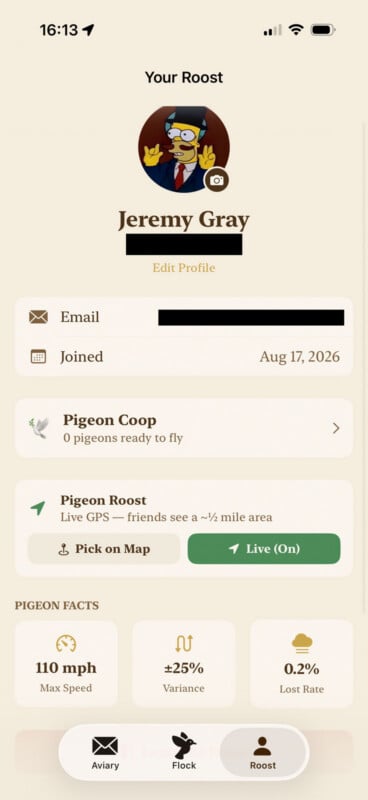
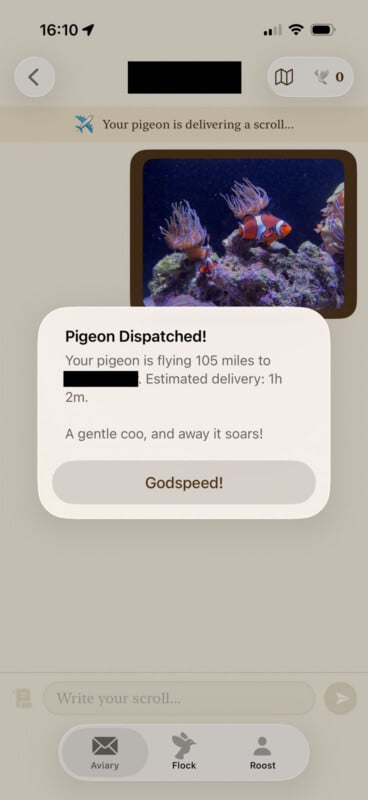
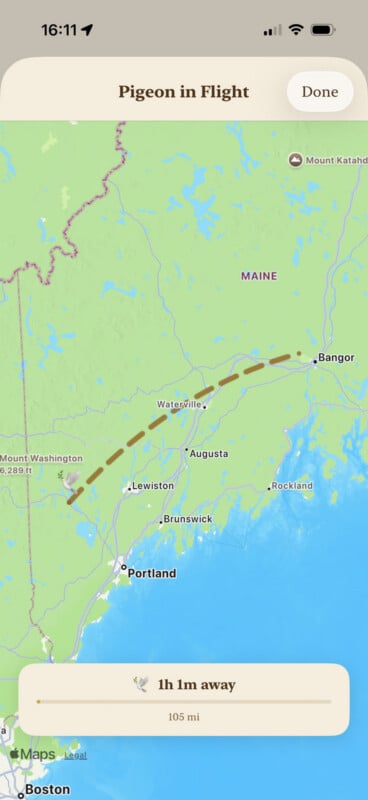
In my case, I’ve chosen to send my friend a photo I took at the New England Aquarium during a recent trip to Boston. As I write this story, my virtual pigeon is making the 105-mile journey northeast at an average speed of around 110 miles per hour, which is actually nearly twice as fast as the average speed of the real-life feathered postal heroes that are actual carrier pigeons.
There is a bit of a wrinkle, though, as my virtual pigeon has a 0.2 percent chance of falling victim to a random act of virtual misfortune. Real-life carrier pigeon loss rates can be quite a bit higher than this, depending on the scenario. In any event, users shouldn’t send anything too precious via their digital pigeon, although I guess you could always try again with a fresh bird.
I sure hope my bird makes it!
While it’s not a major issue to wait an hour for a message to get delivered to my friend here in Maine, what if I wanted to send something to PetaPixel editor-in-chief, Jaron Schneider, who is located on the other side of the country, about 2,500 miles away? That’d take my bird nearly a full day! A lot can go wrong in 2,500 miles.
Photographers have seemingly embraced slower ways of doing things lately, like a camera that captures photos that users have to wait to arrive in the mail as 4×6 prints.
In any event, Carrier Pidge is just dumb fun and thankfully free to use. While I’m far from a fan of AI, I much prefer AI being used to code a goofy app like this than, oh, I dunno, make garbage movies. Of course, I’d really prefer that a person code this app without AI, but that’s a tall order when it comes to making an app that virtually simulates carrier pigeons.
Image creditsHeader photo licensed via Depositphotos.com.
Affiliate Disclosure PetaPixel articles may include affiliate links; we may earn a commission if you buy through one.