Fujifilm Finally Forced to Increase Prices Due to Trump’s Tariffs
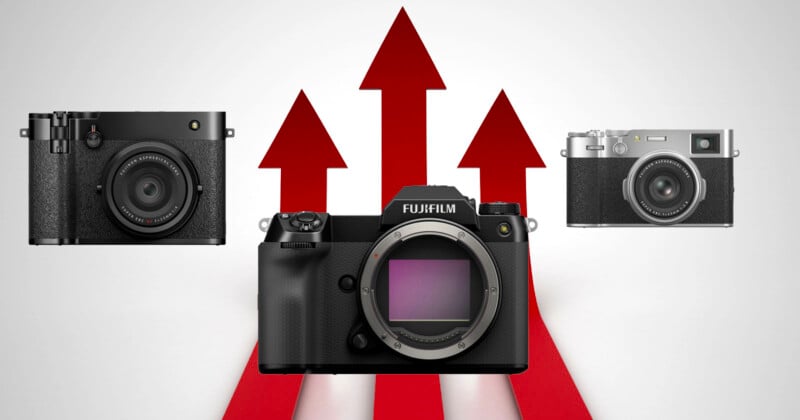
Despite initial speculation that Fujifilm would increase prices due to a new “massive” deal the US made with Japan that would result in 15% tariffs, the company is actually doing it for the first time, making it the last camera brand to change pricing due to the initial 10% tariff from April.
Correction 8/1: Initial reporting placed the blame for these increased tariffs on the new 15% tariff that Japan has been subject to, but that was inaccurate. This price increase is Fujifilm’s first and based on the 10% tariff instituted by the Trump administration in April. Fujifilm was, therefore, the last holdout against price increases across its product catalog.
After nearly seven months of oscillating percentages and threats, President Donald Trump announced that the US and Japan had agreed to a new 15% tariff on all goods coming from Japan, which is higher than the current 10% tariff in place that resulted in across-the-board price increases and product shipping delays earlier this summer.
Fujifilm had not raised the prices of its existing inventory due to that initial 10% increase, but that changes today as it becomes the last brand to make adjustments due to rising costs of doing business in the United States. Because tariffs are a tax on importers, that cost will always get passed on to the end customer, especially with products with such slim margins like cameras and lenses. It is, effectively, a sales tax on buyers.
Last week, Fuji Rumors reported that Moment sent an email to customers who had placed pre-orders stating that a price increase was incoming.
“Fujifilm just let us know they’ll be increasing the prices of some of their products soon, so l’m reaching out to assure you your order will be unaffected by the increase. Since you placed this order with us before the increase was announced, we’re be honoring your purchase price and eating the cost of the increase,” a Moment representative writes in the email. PetaPixel can verify this reporting is accurate.
This morning, PetaPixel spoke with Capture Integration — a camera and accessories retailer out of Atlanta, Georgia and is typically very fast to report changes to customers — which confirmed that a price increase is coming on August 1 and that it affects all Fujifilm GFX and X series products shipped by Fujifilm by or after that date, irrespective of when the order was placed. Fujifilm also says that orders received prior to August 1, which would be all outstanding orders at the time of publication, are subject to being declined by the company. At its discretion, it may cancel current backorders and require them be re-submitted at the new higher prices.
Photographers who have placed orders with Capture Integration for a backordered product should expect to have to place that order again, unless otherwise instructed by the retailer. This might make matters more stressful for photographers since orders for GFX cameras are already on backorder through September.
Affected products run the gamut of cameras, lenses, batteries, and accessories, according to an updated price list seen by PetaPixel and all hover around between an 8% and 9% increase.
For example, the GF100-200mm f/5.6 lens is increasing from $1,999 to $2,149.95 (an 8% increase), the GF110mm f/2 is going from $2,799 to $3,049.95 (a nearly 9% increase), the GF110mm f/5.6 TS lens is increasing from $3,499 to $3,799.95 (an 8% increase), and the GF120mm f/4 is increasing from $2,699 to $2,949.95 (an 8.6% increase), and the GF45-100mm f/4 is going from $2,299 to $2,499.95 (an 8% increase), among others.
There are exceptions and some price increases are higher. The Fujifilm X100VI is increasing from $1,599.95 to $1,799.95 (a 12.5% increase) while the GFX100S II and GFX100RF are both seeing a 10% price increase from $4,999.95 to $5,499.95 and $4,899.95 to $5,399.95. The GF 50mm f/3.5 is also going up by 10% from $999.95 to $1,099.95.
It should be noted that Fujifilm already moved some manufacturing to Japan for cameras bound for the United States to avoid higher tariffs on goods coming from China. At this point, there is no nowhere left to move manufacturing for these cameras to, thus a price increase is unavoidable so long as these tariffs remain.
The above is, of course, not an exhaustive list of all price changes but does illustrate the general pattern. Also of note, there is unconfirmed reporting that some GF lenses are made in Thailand which is currently subject to a 36% tariff rate, but if this is the case, none of the products on the price list seen by PetaPixel stand out and are all relatively consistent.
PetaPixel has reached out to Fujifilm directly for comment, but due to an annual summer holiday in Japan, a response is not likely until next week after these price changes are already in effect.
PetaPixel’s Take
It is important to note that while Fujifilm was forced to make this change due to the initial 10% tariffs, which is laudable, but the price increases across the rest of the industry are unlikely to stop. Margins on cameras and lenses are razor thin and it is not likely that any camera or lens manufacturer will be able to absorb the new tariff rate of 15%, even after increasing prices in response to the 10% increase that came just a couple of months ago. PetaPixel will report on the price increases by other brands when information becomes available.
Secondly, the camera makers are not to blame here. These price hikes are, effectively, an additional sales tax on US-based customers put in place by the government.
Thanks to Capture Integration for its transparency and assistance in this reporting. The company says it does its best to be as forthcoming as possible as fast as possible, and that was on display here.