Tips

Photograph the Left Side of People’s Faces to Capture More Emotion

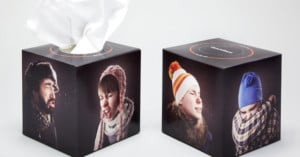
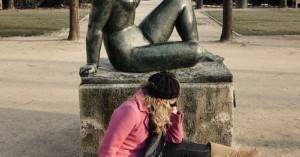
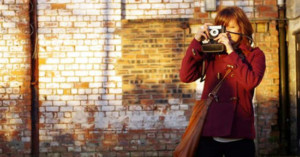
Everybody has had pictures taken that they can hardly stand to look at. Even professional portraits that eliminate blemishes and show you in attractive poses sometimes look strained, or emotionless. Well, a recent study published in Experimental Brain Research seems to say that the remedy could be as easy as turning the other cheek.
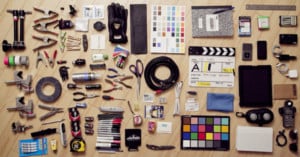
40+ Essential Items Every Photography Assistant Needs Now

Los Angeles-based photographer and photo assistant Shawn Corrigan has spent the past 10 years traveling the world assisting and shooting. Over time, he has developed an “everything but the kitchen sink, plus the kitchen sink” kit that he brings to each set. In addition to the absolutely essential leatherman and light meter that every assistant should carry around, here's a checklist of others things you should consider packing.
How to Compose Shots When Shooting Skateboarders

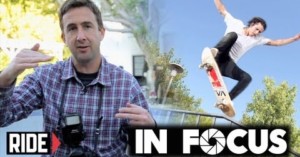
Here's a tutorial by skateboarding photographer Michael Burnett in which he discusses various composition tips and techniques. His area of expertise is in shooting skateboarders, but the tips are very applicable for other types of photography as well.

10 Photographers You Should Ignore

Editor's note: This is a piece by photographers Bryan Formhals and Blake Andrews on how famous photographers' styles are copied over and over again. Please do not read or comment if you take things too seriously.

The other day while reading the Internet I came across “The 10 Most Harmful Novels for Aspiring Writers.” I wondered whether there could be a list for photographers as well. I thought about it and then sent my list to Blake Andrews to see if he wanted to contribute and have some fun with it. Here's what we came up with.

Use a Red Dot Sight for Locating Subjects with Super Telephoto Lenses

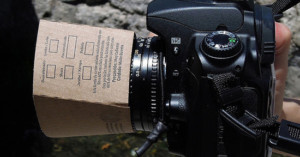
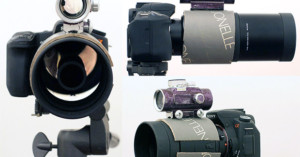
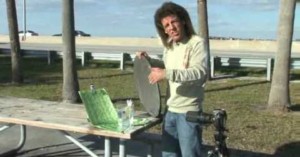
Photo enthusiast Chris Malcolm needed a better way to aim his 500mm lens at fast moving subjects (e.g. birds in flight), so he upgraded his lens with a DIY sighting aid by attaching a non-magnified red dot sight:

They're designed to clamp onto a gun sight wedge mount, so some kind of adapter is required. I played with the hot shoe mount, but it was too flexible -- the sight needed re-zeroing at every mount, and was easily knocked out of calibration. The degree of precision required to aim the central focus sensor at the target via the dot also made parallax error a problem on the hot shoe. So I decided to mount it directly on the lens. Least parallax error, plus the geometry of the lens barrel and the sight mount naturally lines it up with the lens. To protect the lens barrel I glued the sight clamp to a cardboard tube slightly too small, slit open to provide a sprung grab on the lens body. The slit also handily accommodates the focus hold button on the lens barrel.

Malcolm reports that the site "works amazingly well", making it "trivially easy to aim the lens at anything very quickly".

Beware: Light Painting with Steel Wool Can Be Hazardous to Your Lens’ Health

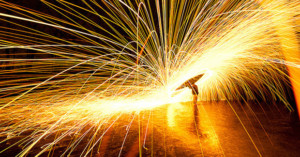
The beautiful light painting photo you see here was created using steel wool (here's a tutorial on the technique). Basically, you fix some steel wool on the end of a rope, set it on fire by rubbing a 9V battery against it, and then swing it around to fling sparks all over the place. While it's becoming a pretty common photo project, it can also be hazardous to your lens' -- and your body's -- health. Jon Beard, the photographer behind this photo, learned the hard way. See that thick yellow line in the upper right hand corner? That's one of the bits of burning metal striking his $2,000 Nikon 14-24mm f/2.8G lens.