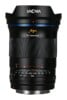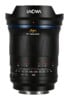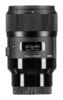
Sigma managed to design a very high resolution 1.4/85 with a very nice rendering in a surprisingly compact package.

Sigma managed to design a very high resolution 1.4/85 with a very nice rendering in a surprisingly compact package.
In terms of sharpness this 45mm 0.95 actually has the edge. Off center performance at portrait distances is slightly better, which is very welcome, and the close up performance is significantly better.
The 85mm 5.6 unfortunately follows the footsteps of the Laowa 10-18mm 4.5-5.6: a lens that sounds really great on paper (at least to me), but in the end has one flaw too many. As it is, it really needs a controlled environment with no stray or backlight to yield good results.
So far f/0.95 fullframe lenses have been special purpose lenses for shallow depth of field photography with plenty of compromises, too many compromises for myself to consider using them on an everyday basis.
This is the 17th 35mm lens I reviewed here and it might easily be the best of them. It is really hard to find a flaw with this lens, I would have to name the high vignetting stopped down or the high price, but then neither is unreasonable.
If you are using a fullframe camera it is probably a better idea to get a good 50mm f/1.4 lens in the first place which will do the same thing in a more compact package.
The Tamron 2.8/70-180 DiIII RXD was a unobstrusive and reliable option in my pocket for the time that I used it.
I can only recommend this lens in case you are looking for a very light and sharp, yet very 50mm lens for your landscape kit. In case budget and/or weight are less critical to you there are plenty other options which are better optically and more enjoyable to use.
The Sony GM 100-400 f/4.5-5.6 is a very solid performer, as it should be with its price tag. Sharpness is great for a zoom, bokeh is very smooth, CA correction is good and AF is fast and precise.
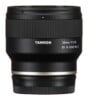
The Tamron 2.8/35 Di III OSD is a very sharp lens with good flare resistance and the unique feature of a 1:2 magnification. While it isn’t as compact as some competing primes it is still a lot smaller than any zoom covering 35mm and build quality leaves little to complain about.
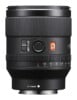
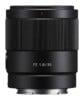
[T]he Sony 1.8/35 will easily keep up with most photographer’s expectations.
Because it is such a well balanced lens I would recommend the Sony FE 1.8/35 to most photographers looking for a 35mm lens.
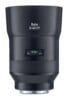
The Zeiss Batis 2/40 CF is an optically very capable but quite expensive lens with issues a lens at this price shouldn’t have.
This is lens feels in many ways very similar to the Tamron 28-75mm 2.8 Di III RXD: it combines a fast maximum aperture with compact dimensions and a resonable price at the cost of a more restricted zoom range.
In the end I find the Sigma more enjoyable to use (due to AF/MF switch and focus ring with mechanical coupling) and optically slightly better (less hard to correct loCA) and because of the lower price and less sample variation easier to recommend.
If you want a short tele prime lens with autofocus that is small and light enough to be pleasant to travel with, and which is fast enough to use for portraiture as well as landscape and general travel stuff it’s the best premium choice. The really fast bokeh monsters are too big.
Mirror, mirror on the wall, who is the sharpest of them all? It is the Sony FE 1.8/135 GM, at least for all lenses that I have used yet. It is the first lens where nothing happens when I stop down except of decreasing vignetting and increasing diffraction.
This is technically definetly not the greatest lens but it was fun to use and gave me many shots I like.
[F]or most photographers though the FE 2/28 should be a very attractive lens since it’s strengths like smooth bokeh, sharpness and speed will weight much more heavily than the cleverly chosen compromises which will rarely have any practical consequences for you [...]
On first sight the RX1RII is simply an amazing camera: it is pretty much an A7rII with a 35mm f/2.0 lens in a much more compact package.
The Sony GM 100 STF is a somewhat specialized tool. I would not recommend it as the only lens for portraits as its lack of light transmission limits its use to pretty good light or on a tripod at slower shutter speeds.
Sharpness wide open is anything but great, corners never reach the quality of most other primes and many aberrations like Coma or Astigmatism and even distortion are not well corrected.
The FE Macro 2.8/90 G OSS is the best lens from Sony I have reviewed so far. Optically there is a lot to appreciate: Sharpness is excellent in any scenario, CA very well corrected, there is very little distortion and bokeh is really smooth.
The Sony FE 4/70-200 is a jack of many trades but a master of none. For most applications the sharpness is very good, only the corners are a bit softer but still good enough for most applications.