What the Heck Is This Weird Micro Four Thirds ‘TikTok’ Camera?

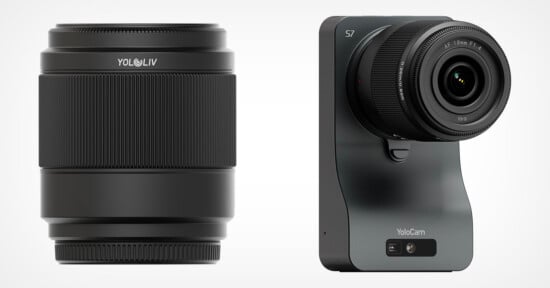
There’s a relatively new Micro Four Thirds camera on the market that costs $799, but you probably haven’t heard of it. It’s the YoloLiv YoloCam S7, and it’s weird.
I want to think I am pretty tuned into the camera industry, but every so often, some new product, like the YoloCam, from a relatively unknown or new company slips under my radar. I only found out that the YoloCam S7 even exists because Y.M. Cinema reported that “TikTok’s large sensor streaming camera just got cheaper.”
“TikTok’s large sensor streaming camera” piqued my interest, so I started poking around and found a bunch of content that seems odd and offers little by way of helpful information.
The YoloCam S7 launched earlier this year and has a striking design and a vertically oriented Micro Four Thirds sensor, which is interesting and well-suited for specific social media applications. Granted, the camera doesn’t have to be mounted in vertical orientation. It has an attachable bracket that adds a second mounting point for landscape orientation. It’s not nearly as elegant a solution as the one on the Canon EOS R50 V, which has a vertically-oriented tripod mount straight out of the box. But I digress.
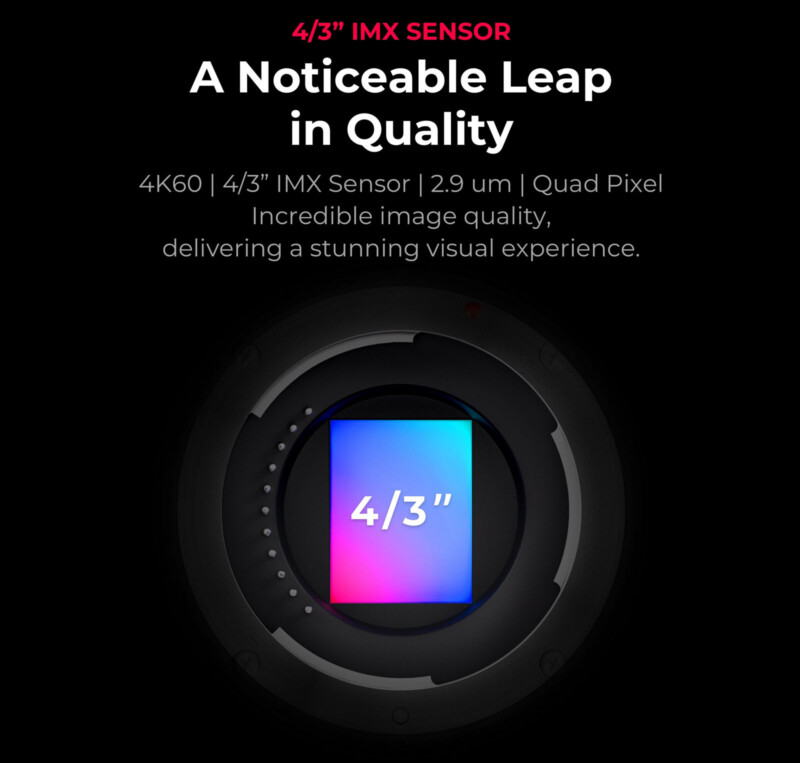
Speaking of the YoloCam’s Micro Four Thirds image sensor, that’s a relatively large sensor for a camera designed for streaming and being a webcam. Yololiv makes a big deal about this, which makes sense. While a Micro Four Thirds sensor is much smaller than a full-frame or even APS-C sensor, it is likewise much larger than the various Type 1 sensors found in compact cameras, smartphones, and most dedicated webcams.
But it’s also a puzzling sensor. While YoloLiv notes that the image sensor is a “Sony IMX” chip, the company stops short of saying exactly which sensor it is. Over on Yololiv’s official Amazon store, we learn that the camera has a “4/3 IMAX Sensor and 1071W Pixels.” I wish I were joking.
Let’s make one thing very clear: the $800 YoloCam S7 Micro Four Thirds streaming camera does not meet IMAX standards. YoloLiv meant to write “IMX.” But 1071W Pixels? That’s useless information. Who measures an image sensor in terms of watts?

Thankfully, elsewhere, we learn that the Micro Four Thirds sensor has 10.7 megapixels and 2.9μ pixel size. Yololiv claims the camera has dual base ISO and HDR capabilities as well. Maybe. The camera can definitely record 4Kp60 video; that much is verifiable.
As for autofocus, the Amazon product listing says the camera has phase-detection autofocus, which is pretty typical for modern mirrorless cameras, but Yololiv’s own store claims the camera uses “lightning-fast Time of Flight (ToF) AutoFocus,” which is a fundamentally different autofocus technology. The camera has the necessary hardware for ToF autofocus on its front, so I think it’s a safe bet the camera does use ToF for AF, which means it will have a relatively limited useful focusing range.
Another quirky aspect of the camera is that it has no buttons or controls. For some reason, YoloLiv thinks it’s a good idea to control a camera exclusively through software on a connected computer. Although the YoloCam S7 initially launched with Windows software, the company now offers macOS apps for Intel and Apple Silicon. However, for some reason, only Apple M1/M2 is listed, and the software is not even version 1.0.

The companion software, YoloLiv Compose, uses artificial intelligence to “automatically adjust” all the camera settings, including exposure and color settings. While this may be helpful for absolute beginners, there are, fortunately, manual controls in the software.
Some of the YoloCam S7’s features are fine, but I’m confused by the overall package and whether the camera is any good.
All the “reviews” out there are paid product placements. The official listing on Amazon has just three user reviews and the YoloCam S7 has just one user review on Yololiv’s own website.
While these heavily caveated “reviews” are mostly positive, even general news coverage of the YoloCam S7 gives me pause.
The articles that have been published, including by numerous notable websites that focus on video technology, are all regurgitated versions of Yololiv’s product breakdown with very minor tweaks. Then, of course, there is the fact that I heard about this camera because of an article about its price drop. This article poses questions about whether the camera will “reshape” TikTok, make social media content more cinematic, and other similarly lofty notions.
These are questions YoloLiv is undoubtedly happy for people to ask without offering any concrete answers. The answer is usually “no,” by the way. This camera will not reshape TikTok or usher in an era of cinematic brilliance on social media.
Admittedly, much about this camera is interesting, just not necessarily for good reasons. Confusing things often attract a lot of interest.

Buying a camera based on entirely subjective performance factors claimed by the manufacturer itself and not detailed technical specifications is a recipe for disappointment. The dearth of actual, untainted reviews only increases my skepticism.
Even if the camera is good, which is possible, the exceptionally high reliance on a companion app is weird, especially for a camera that tries to market itself as a “TikTok camera.” A lot of TikTok content is recorded out in the real world, and having to lug additional hardware to operate the camera sounds miserable.
There is no doubt that there are suitable use cases for the YoloCam S7. There are a lot of streamers out there who may benefit from the relatively large Micro Four Thirds image sensor and the ability to swap out lenses — although YoloLiv only recommends two lenses: the Panasonic 15mm f/1.7 and Panasonic 25mm f/1.7. Vertical video content is definitely popular, and we have seen more traditional camera makers focus heavily on that with their video-focused models in recent years.
But again, there is a lot surrounding the YoloCam S7 that strikes me as odd and frankly, stupid. I haven’t even bothered discussing the camera’s name, which is awful. Admittedly, most camera model names are, at best, boring. Maybe terrible is better than boring. Nonetheless, if it were my money, I’d hesitate to spend $800 (plus whatever I needed for lenses) for something like this. I sort of wish I could go back in time and not learn about it at all. But why listen to me? There are plenty of paid people to listen to about this camera.
The YoloCam S7 is far from the first bizarre camera to come out of China making lofty, occasionally unbelievable, claims. Unfortunately, it won’t be the last.
Image creditsYololiv. Header photo created using an asset licensed via Depositphotos.
Affiliate Disclosure PetaPixel articles may include affiliate links; we may earn a commission if you buy through one.