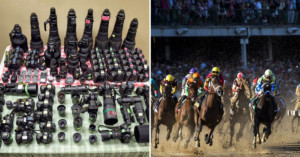
Afghan photographer Massoud Hossaini won the Putlizer Prize yesterday for his Breaking News photo showing a 12-year-old girl screaming after a suicide bombing in Kabul. His images of the mosque attack were so powerful that the New York Times, Washington Post, and Wall Street Journal all published them on their front pages on December 7, 2011. However, each one ran a different image captured at the scene, and only the New York Times ran the Pulitzer Prize-winning shot that showed the full extent of the carnage. Shortly afterward, The Washington Post interviewed the photo editors at each paper to discuss why they chose the images (and the crops) they did.
For those of you who are interested in the business and technology side of things, here’s an interesting 45-minute interview in which Digg founder Kevin Rose chats with Instagram founder Kevin Systrom:
They chat about Systrom’s growing up with computers, his time spent at Stanford, and landing an internship at a startup destined to be worth billions. This ultimately led to launching Instagram which is now 15 million users strong and one of the fastest growing social networks on the planet!
Here are five interesting interview excerpts with renowned street photographers. They’re from Everybody Street, a documentary on NYC street photographers that recently finished raising funds through Kickstarter. The video above features Bruce Gilden. Read more…
Here’s an inspiring and educational video in which Marc Silber sits down to chat with photographer Michael Zagaris — a man who has had a career as the official shooter for both rock bands (e.g. Rolling Stones, The Who, Led Zeppelin) and sports teams (e.g. San Francisco 49ers, Oakland A’s).
PetaPixel: Can you tell us a little about yourself and your background?
John Sypal: I had a very typical middle class and middle American childhood. A semester followed by a year abroad at a university in Japan led me to the place I am today, namely a suburb just outside of Tokyo. I’ve been interested in photography since high school and upon studying and living in Japan have been enjoying the photographic scene of Tokyo and the people who make it all possible. In 2008 I was taking part in a weeklong photography festival and asked a guy if I could take a picture of his camera. And since there were lots of people around with film cameras at this event I asked a few more. I had just seen my first tumblr a week earlier, and so after getting a few more pictures Tokyo Camera Style was born. Read more…
Ryan McGinnis is a photographer and storm chaser. You can visit his website here.
PetaPixel: Can you tell us a little about yourself and your background?
Ryan McGinnis: I am a storm chaser and photographer who lives in Nebraska; I have no formal training in photography outside of all the books I’ve read and the thousands of rolls of film I’ve blown through (and terabytes of drives I’ve filled up) over the years. I’ve had a life-long love affair with the weather; from as young as I can remember, I’ve been fascinated with storms and for most of my childhood I dreamed of one day chasing tornadoes. Living in this part of the country makes storm chasing less of a chore than if I had to drive here from, say, Virginia, but storm chasing here still requires lots of driving — on average around 600 miles per chase. These days I tend to storm chase around 15,000 miles a year, mostly in May and June. In 2008 and 2009 I was fortunate enough to get to tag along with and photographically document Project Vortex 2, a $12M science mission to learn how tornadoes tick, which was probably one of the best freelance investments of time and money I’ve ever made.
When I’m not shooting storms, my favorite subjects are candids and urban panoramas. Read more…
PetaPixel: Can you tell quickly describe the Triggertrap for people who haven’t heard of it yet?
Haje Jan Kamps: Triggertrap is an universal camera trigger. It’s “universal”, because it’s designed to connect just about any trigger source to nearly any camera. Right now, we’re supporting more than a hundred camera models, but we’re adding new cameras to our Supported Cameras list all the time.
The device has a sound and light sensor built in, and it can do linear and non-linear time-lapses. I’m most excited about the auxiliary port, though, which enables users to connect nearly anything they want to the device. One reader suggested connecting it to the final buzzer they use at basketball games, to take a photo of the state of play just when the buzzer sounds — what a great idea! Read more…
Oleg Gutsol is the co-founder and technical director of photo-sharing service 500px.
PetaPixel: Can you tell me a little about yourself and your background?
Oleg Gutsol: Ian and I met during our university years at Ryerson, around 2004. He was in business and finance program and I was in computer science. We both liked photography, travel and motorcycles, so there were some common points of interest. I think we both shared a passion for working on something meaningful, and although then we were not working together, we both were exploring opportunities to start our own business. Read more…
Jonathan Blaustein is the photographer behind the project “The Value of a Dollar“, which went viral on the Internet in 2010 and then was subsequently acquired by the State of New Mexico and the Library of Congress. Visit his website here.
PetaPixel: Could you tell us a little about yourself and your background?
Jonathan Blaustein: I’m a photographer, writer, and professor based in Taos, New Mexico, originally from New Jersey (who isn’t?). In addition to my career as a photographer, I’m also a correspondent for the photo industry blog A Photo Editor. My family and I live in a little horse pasture at the base of the Sangre de Cristo mountains, far from everywhere. I’m pretty fortunate, as Northern New Mexico has a really vibrant photography scene, and of course our light is legendary. As far as my background goes, I first studied History and Economics at Duke University, but returned to school to study photography, and I have an MFA in Photography from Pratt Institute in Brooklyn. I’ve been a practicing artist for the last 15 years, and my work has been exhibited in galleries, alternative spaces and museums around the United States. Read more…
Here’s a neat behind-the-scenes video by Samsung featuring short interviews with the developers and engineers behind its NX lenses. One of the things I found interesting was how the engineers are constantly working to overcome the prejudice that Korean-made lenses are inferior to those crafted in Japan or Germany. The video also briefly shows a Samsung 300mm f2.8 XF ED lens — a lens that doesn’t officially exist. Read more…