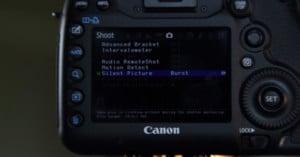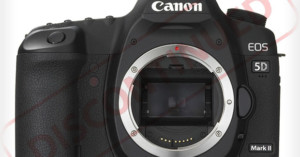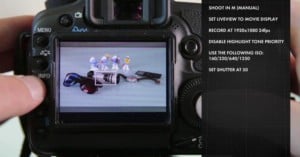
In what may very well be the most exciting Magic Lantern development ever, the team has discovered a RAW DNG output in live view on the 5D Mark II and 5D Mark III. What this means is that, in the near future, 5D Mark II and III owners may be able to record crystal clear 2K RAW video that blows H.264 output out of the water and then some. Read more…

The Canon 5D Mark II’s illustrious career is coming to an end. The DSLR, which Canon Rumors calls “Quite possibly the most popular and influential DSLR in history,” has been added to Canon’s official list of discontinued EOS products over in Japan.
Read more…

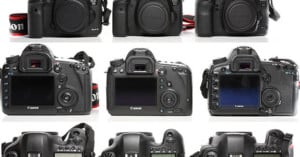
If you’ve been wondering how the Canon 6D compares to the 5D lineup in terms of size, control layout, and ergonomics, here’s a side-by-side comparison photo in which the 6D (center) is placed next to the new Canon 5D Mark III (left) and the older Canon 5D Mark II (right). The cameras are each ever-so-slightly different in their shapes, but the 6D is noticeably smaller than its higher-tier siblings. It’s more than 10% smaller in its dimensions, and is ~10% lighter than the 5D Mark II and ~20% lighter than the 5D Mark III. Here’s a larger version of the image.
(via LensRentals)
Image credit: Photograph by Roger Cicala/LensRentals

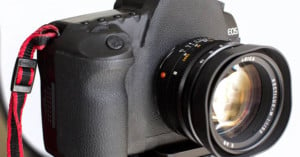
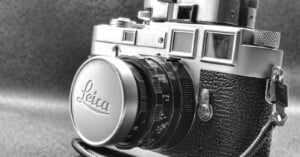
San Diego-based photographer Robert Benson had a curious problem a while back. He had a $6,500 Leica Noctilux 50mm f/1 lens, but no camera to use it on. Not being able to afford the Leica M9 at the time (and unsure if he wanted to ever buy one), he decided to make massive modifications to his Canon 5D Mark II so that it would accept any Leica M lens without needing an adapter. The frankencamera above is what emerged from the brand-change operation.
Read more…

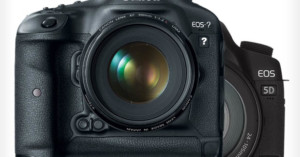
Two interesting Canon rumors are currently floating around. The first has to do with the 46MP DSLR that Canon is reportedly field testing and may be planning to unveil in late October. Northlight Images received a tip saying the camera’s body will be 1D-X-esque:
In an update to the high MP info, we’re told that a camera will eventually appear in a 1D X derived body, in the same way as the 1D C. The information said that the actual designation was not known, but it would essentially be a ’1 series’. There was also a warning that there would be a long wait between any ‘preview’ and any cameras being annouced and subsequently shipping.
If true, this means Canon is going for the larger pro-style body rather than following after Nikon’s 36.3MP D800.
Read more…
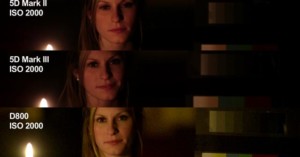
The folks over at NoFilmSchool recently did a low light comparison of the Canon 5D Mark II, Canon 5D Mark III, and Nikon D800. The cameras were used to film the same dark candlelit scene with the same settings, and the ISO was slowly pushed up to the cameras’ respective limits. It’s pretty striking how big of a difference in low light/high ISO quality there is in the cameras, especially in light of DxO Lab’s test results for the cameras’ sensors…
(via NoFilmSchool via Fstoppers)
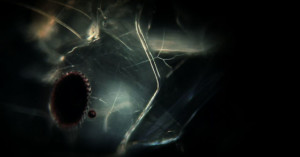
Photographer Clemens Wirth wanted to dive into microscopy, so he attached his Canon 5D Mark II to a monocular microscope using an adapter and pointed it at one small drop of water. He was amazed to find out how much activity goes on inside ordinary water, and how detailed that tiny world is. This short film, titled “Micro Empire”, is a beautiful combination of Wirth’s footage and audio by Radium Audio.
(via Laughing Squid)
Here’s a short sizzle reel created by Vashi Nedomansky that shows various shots captured by Shane Hurlbut by using Canon 5D Mark II DSLRs as crash cams.
(via Photography Bay)

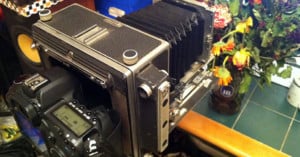
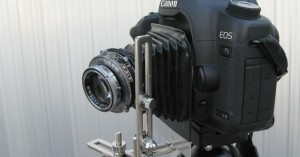
London-based photographer David Wilman recently did some experiments in which he used a Canon 5D Mark II as a digital back for his MPP 4×5 large format camera. He placed his lens-less 5D at the back of the camera at the film plane and then placed a black cloth over the two cameras to prevent any light from spilling onto the sensor. Light from the Schneider Kreuznach Xenar 4.5/150mm lens entered straight into the open mirror box of the DSLR without any physical link between the two cameras. Wilman was surprised to discovered that this pairing produced quite a respectable macro setup.
Read more…

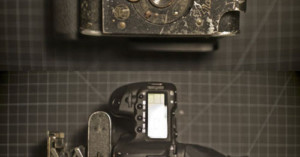
Director Jason Bognacki had a Contessa-Nettel Piccolette German folding camera from 1919 sitting around on his shelf for ages, and decided one day to bring it back to life by attaching it to his Canon 5D Mark II.
Read more…