

Where to Find the Small Worlds Most Photographers Walk Past
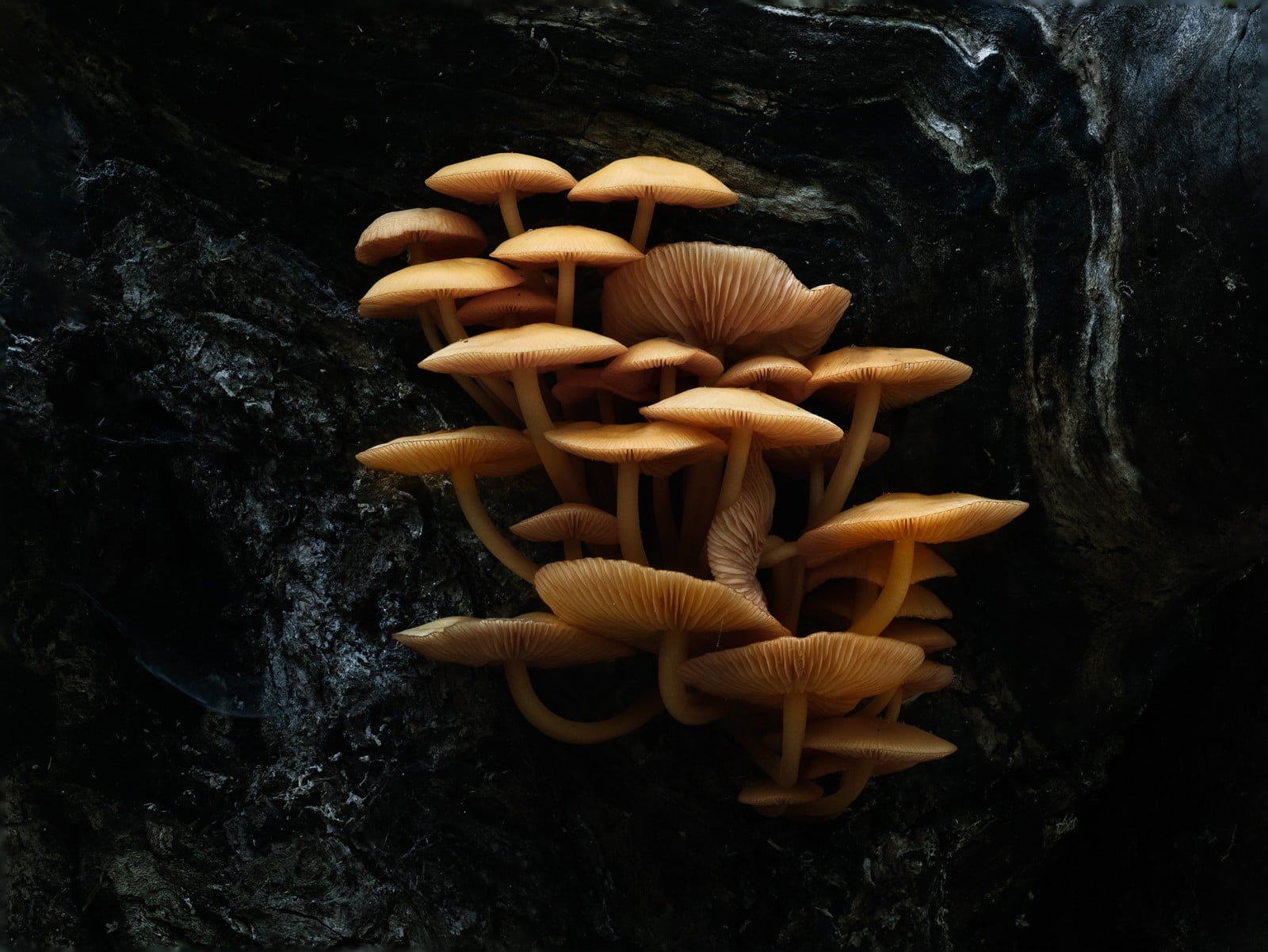
Peter Baumgarten was looking for centimeter-tall mushrooms when he spotted a cluster of orange caps on a rotting log. A few warm, rainy days had encouraged mushrooms to emerge in Canada’s McLean’s Park, a forest on Ontario’s Manitoulin Island where he regularly walks his dog. At six feet two inches tall, Baumgarten could easily walk past mushrooms that small if he weren’t specifically looking for them.
Full disclosureThis article was brought to you by OM SYSTEM.
At a Glance
Peter Baumgarten is just one of a number of OM SYSTEM ambassadors who specialize in macro photography and shared with PetaPixel their favorite places to look for small subjects and the encounters that keep them returning time and time again. For Lisa and Tom Cuchara, that includes the meadows and woodland around Little River in southern Maine. Chris McGinnis searches the rainforests of Costa Rica and Panama, while also expanding his macro photography portfolio in Maine and his own backyard.
Their photographs show the miniature world that can turn up on a rotting log or a garden stem. Baumgarten gets low on the forest floor to photograph mushrooms and the slugs that feed on them. The Cucharas and McGinnis have both made some of their favorite finds after dark, the Cucharas in a garden in the Northeast and McGinnis at a pond in Panama.
The Forest Floor on Manitoulin Island
In one of Baumgarten’s favorite macro photographs, a garden slug stretches along rotting wood beneath a cluster of orange mushrooms, its head raised toward one of the caps.
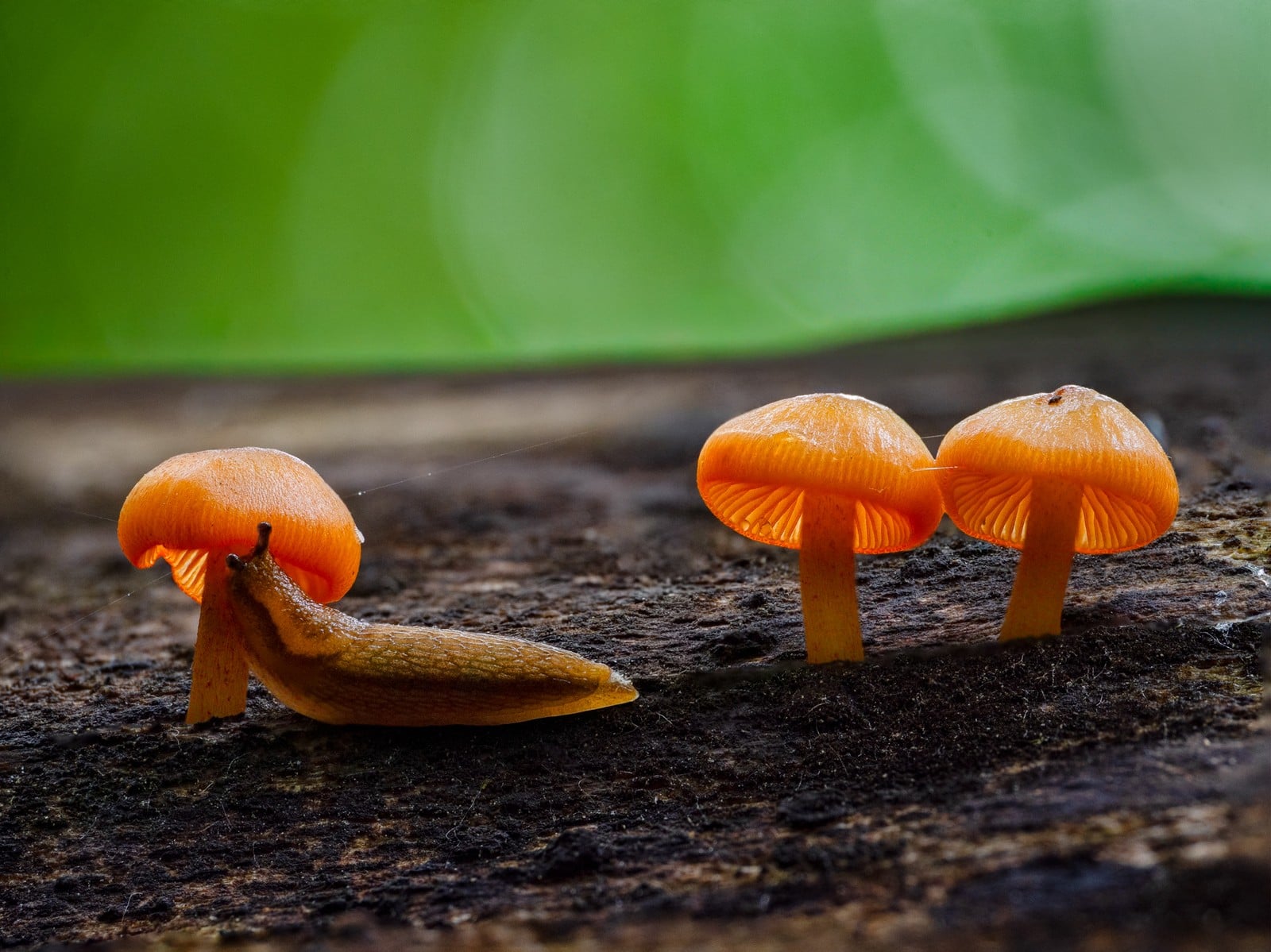
“What excited me the most was the garden slug getting ready to chow down, which isn’t a common shot,” he says.
Baumgarten takes many of his macro shots at a park close to home. McLean’s Park has several kilometers of trails through mixed forest, which he uses for hiking, biking, cross-country skiing, snowshoeing, and photography.
“It is about a 15-minute drive from my home,” he says. “I go there several times a week to walk my dog. As a mature forest there are plenty of fallen trees and branches that make for the perfect environment for a bunch of different types of mushrooms.”
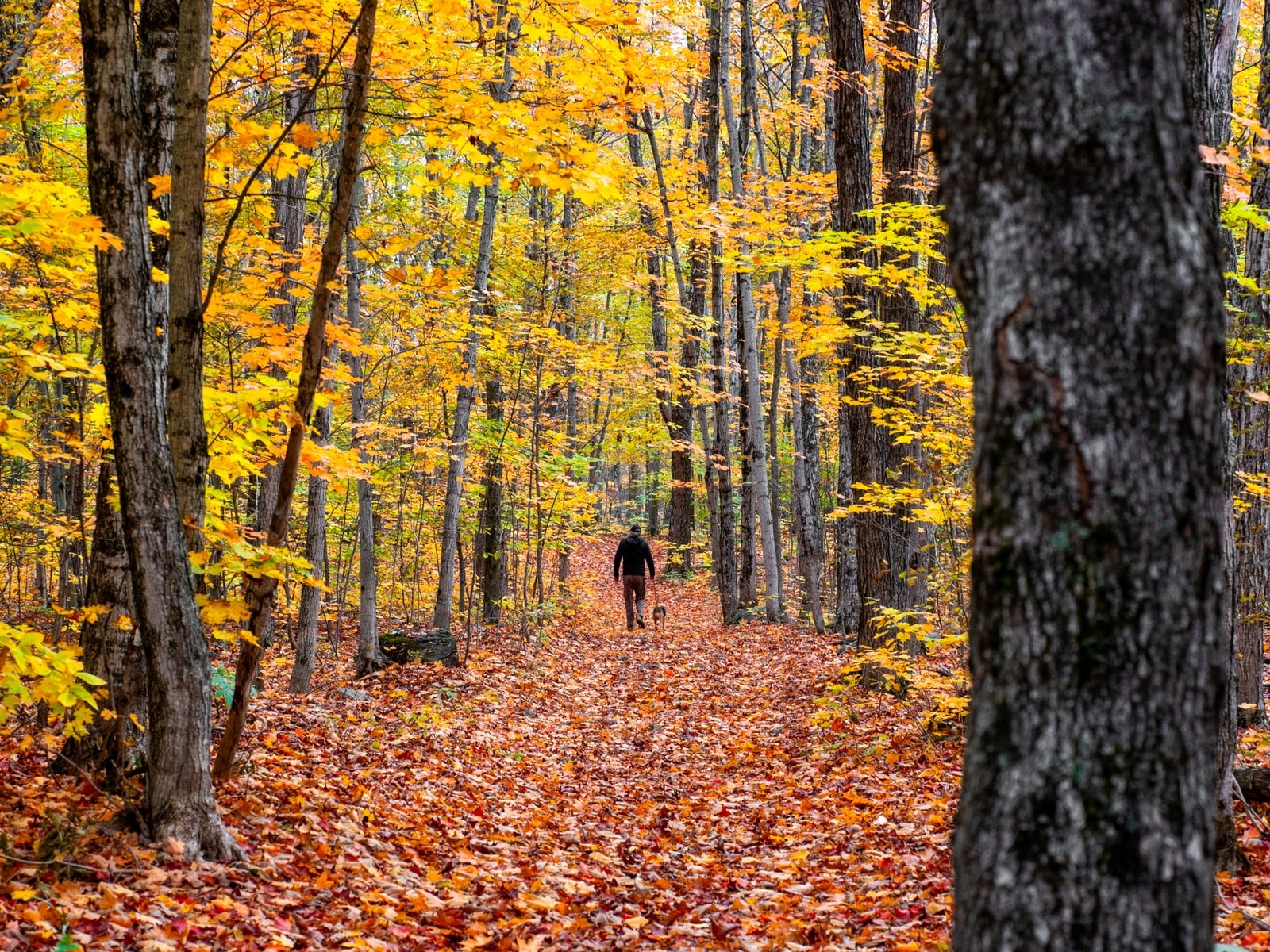
“What I love about the park is the variety of photographs I can take there,” he notes. “One day I might photograph a person walking their dog in autumn along a leaf-covered trail, with tall trees and yellow foliage all around. Another day, I might be down among the fallen logs and branches photographing mushrooms.”
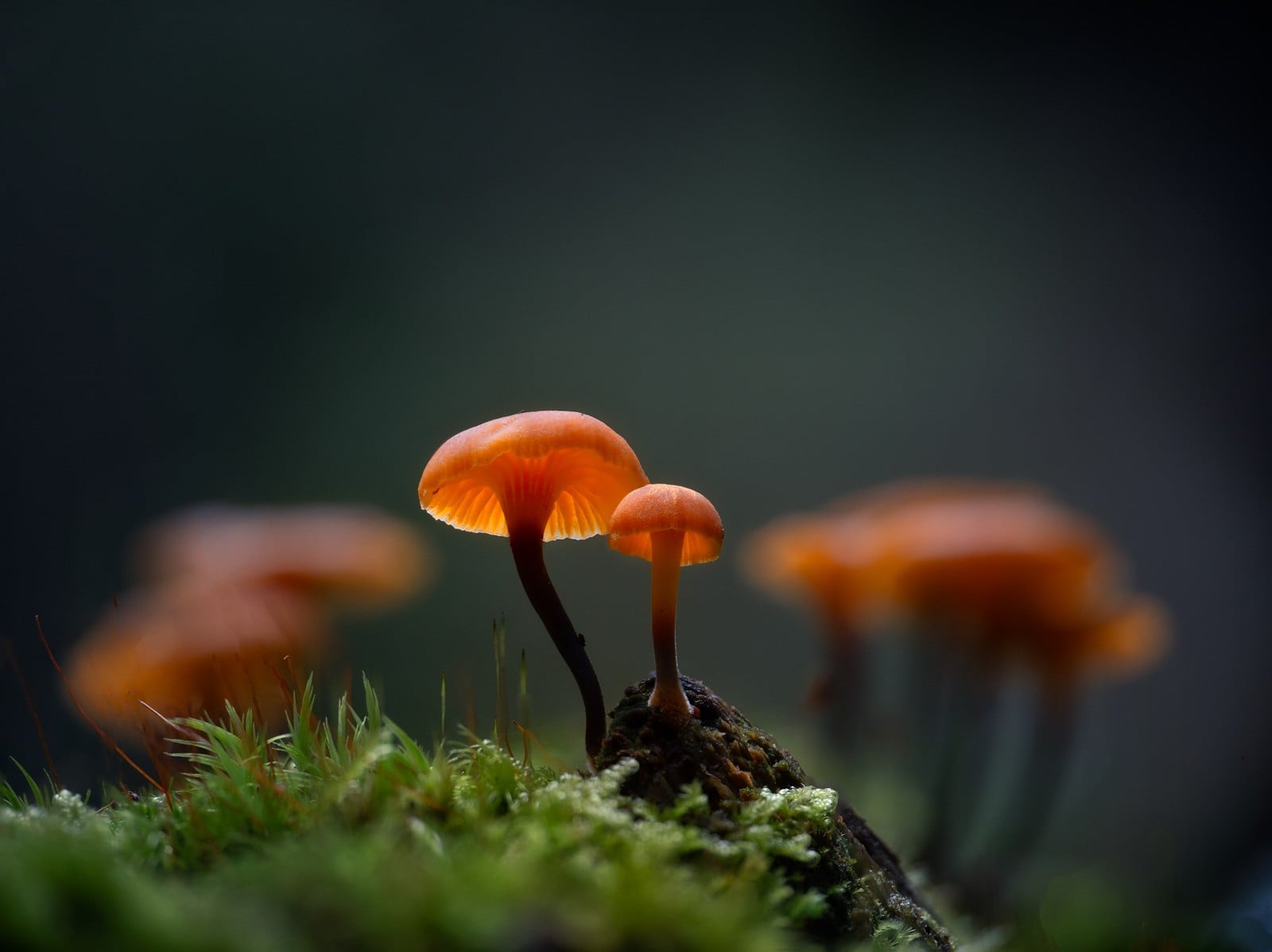
Baumgarten likes to shoot most of his mushroom macro photos below eye level. “I love capturing them from underneath,” he explains. “For me, the gill structure is perhaps the most interesting and photogenic part of the mushroom. I want a soft background that doesn’t pull focus from my subject. By shooting from just below the mushroom I can usually include the more distant, lush greenery of the forest.”
“While mushrooms don’t move, when I’m photographing a slug in the low light of the forest, I have to be aware that even its slow movement can cause blur,” he continues. “Shooting handheld, I might use a shutter speed of around 1/100 second to keep it sharp, raising the ISO if I need to.”
Bumping up the ISO, the camera’s sensitivity to light, lets him shoot at a faster shutter speed when the light on the forest floor is dim. With a mushroom, he can usually keep the ISO low and slow the shutter down instead. The image stabilization in his OM SYSTEM OM-3 lets him handhold exposures as long as half a second, even while using in-camera focus stacking, which combines the sharp areas of photographs focused at different distances to keep more of a close-up subject in focus.
“I capture mushrooms in a very similar way to how I photograph wildlife,” Baumgarten says. “For many wildlife shots I prefer to use my long lens. This gives me great close-up images of my subject. But a great close-up is not always the best way to showcase the animal. Showing the animal in its environment helps me tell more of the story about where it lives. That’s when I turn to using a wider lens. I will often do the same when photographing mushrooms.”
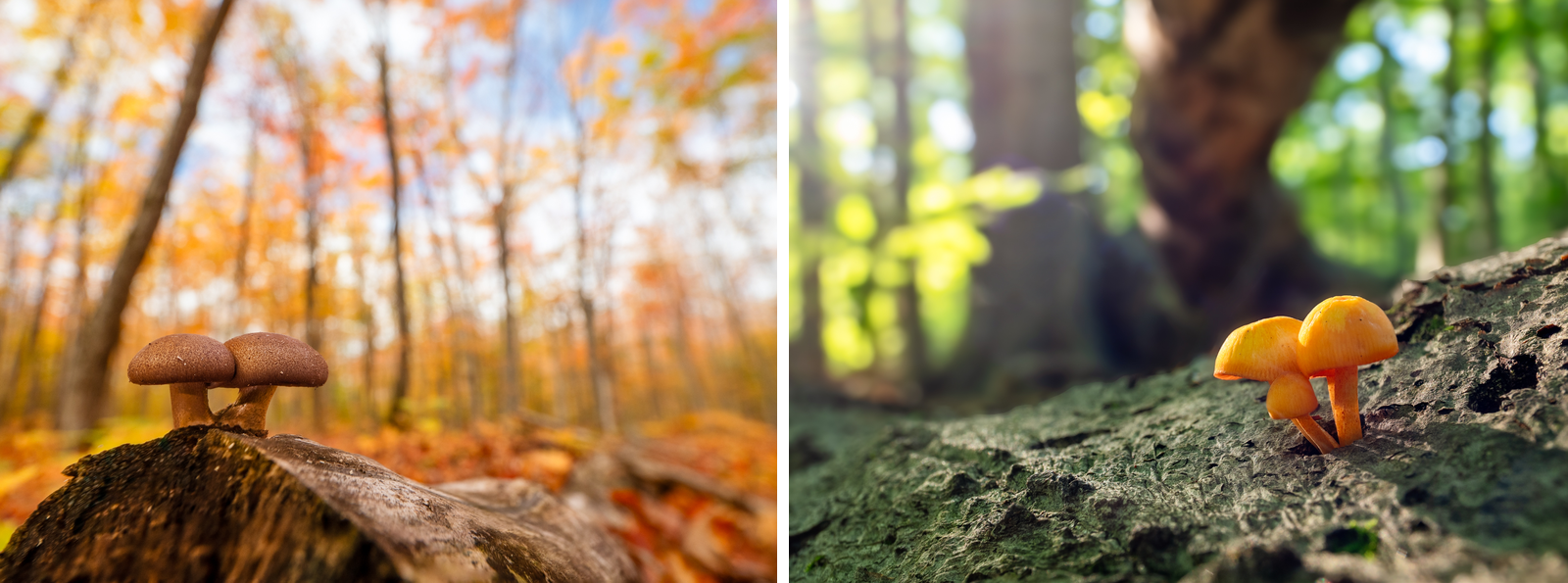
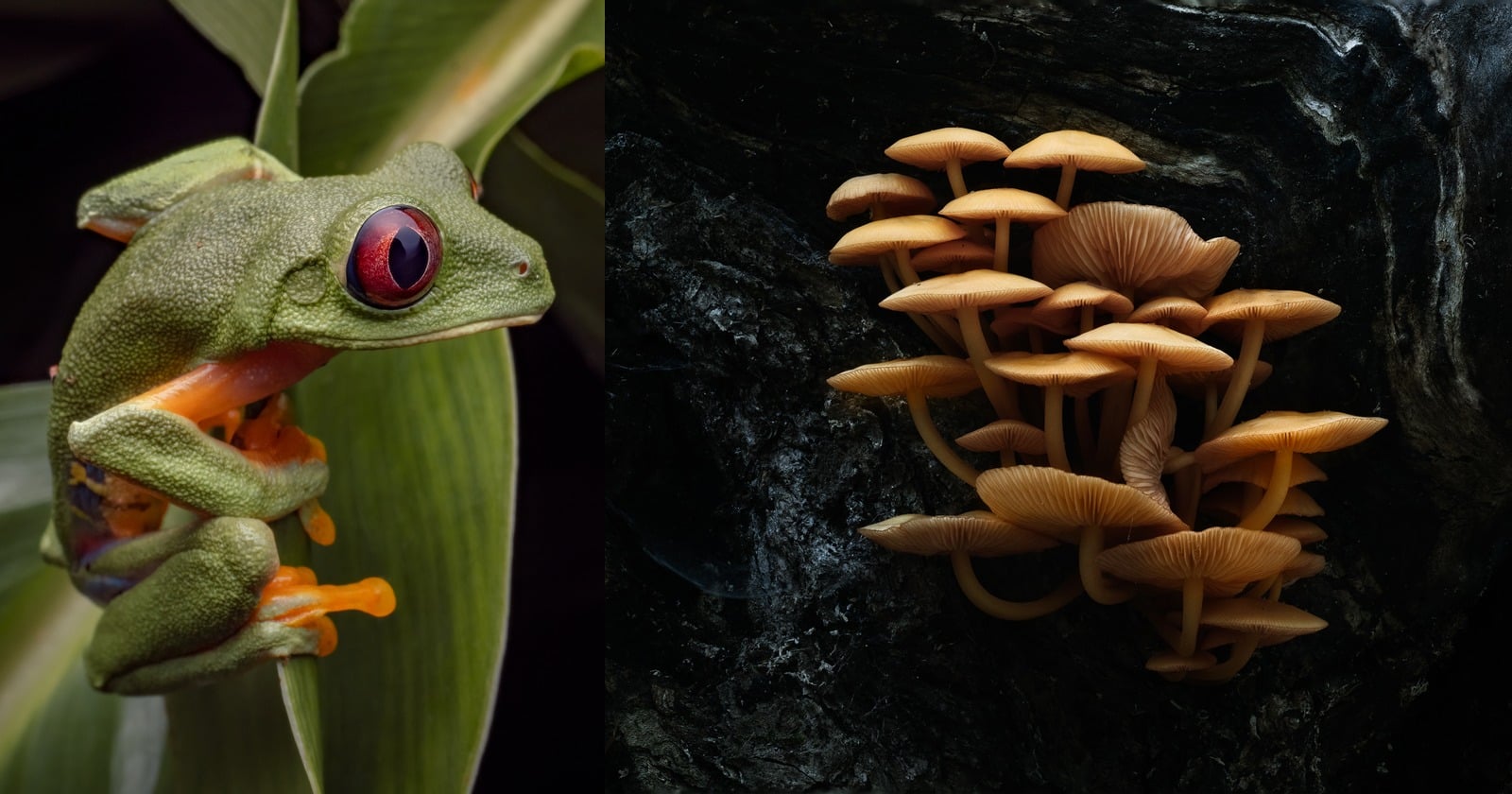
Right: Mushrooms • OM-3 • M.Zuiko Digital ED 8-25mm F4.0 PRO • 19mm (38mm equivalent) • 1/3sec • f/7.1 • ISO 200 • Focus Stacked
Mushrooms can appear quickly and may not stay in good condition for long, so Baumgarten recommends watching the weather to help decide when to go looking.
“Mushrooms need warm, moist conditions, so I recommend exploring one or two days after a good rain,” he advises. “I have had great success from late spring to late autumn. I recommend avoiding bright sunny days. The dappled sunlight on the forest floor can work for some shots, but often it is more of a hindrance than a help.”
A subject that stays put gives photographers new to macro more time to experiment with focus and composition.
“Photographing mushrooms is a great way to get into macro shooting,” he adds. “I love the geometry of most mushrooms and the infinite patience they have. I’ve never had a mushroom run away from me as I sneak up on it.”
Those quiet searches are also part of why he keeps returning to the forest.
“I often turn to macro photography to get me out of a rut,” Baumgarten says. “I primarily shoot landscapes and wildlife and over the years there have been many stretches of time where I just couldn’t capture shots that I was happy with. It’s at these times, when I feel a bit down, that I grab my macro lens and head into the forest for a bit of exploration and de-stressing. I slow down, observe carefully, and invariably find something in the macro world to photograph. And the best part is, I don’t have to go far. Macro subjects are everywhere, and a local park or garden can be a great place to start looking. I’m lucky to have McLean’s Park just a short drive from home.”
Garden and Meadow Discoveries
For Lisa and Tom Cuchara, some of the strangest subjects turn up after dark.
“One evening I headed into the garden to look for tiny nighttime wonders,” Lisa Cuchara recalls. “Imagine my surprise when I found a bright green hornworm sporting what looked like dozens of tiny white marshmallows. Those little white blobs weren’t eggs or fungus, though. They were the silken cocoons of tiny parasitoid wasps. The wasp larvae had developed inside the living caterpillar before coming out to spin their cocoons. It was creepy and fascinating at the same time.”
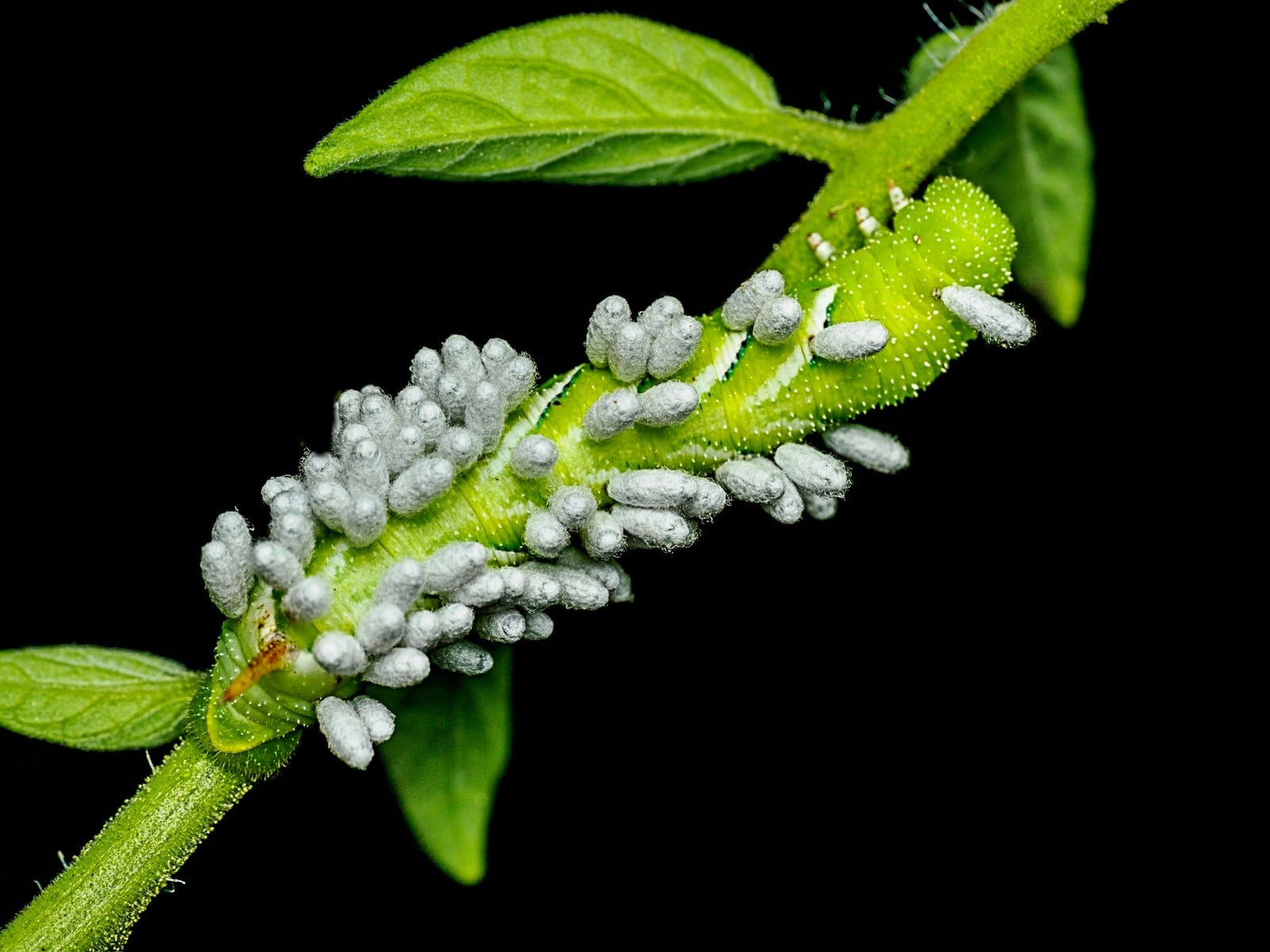
Gardeners don’t like hornworms, since a hungry one can make a massive amount of tomato foliage disappear overnight. The wasps, most likely a Cotesia species, are another matter.
“This was a perfect example of nature’s own pest control,” Lisa explains. “Unlike regular parasites, which generally don’t kill their hosts, parasitoids kill the animal they develop in. These tiny wasps help keep hornworm numbers down, which makes them real allies for gardeners.”
“When I saw this scene, I knew that the challenge was getting the detail of both the caterpillar and those wonderfully wonky white cocoons while working handheld in the dark,” Lisa recalls. “Even at f/11, there just isn’t enough depth of field to get everything sharp in a single exposure.”
An aperture of f/11 is a small lens opening that would normally extend depth of field, the zone of a photograph that looks sharp. In-camera focus stacking, used with the Cucharas’ OM-1 Mark II and the M.Zuiko Digital ED 90mm F3.5 Macro IS PRO lens, got around the problem.
“I was able to shoot a focus-stacked image handheld, without setting up a tripod or disturbing my subject,” Lisa notes.
For insects, the Cucharas use a small flash fitted with a diffuser.
“A bare flash gives you harsh highlights and deep shadows, especially on an insect’s shiny exoskeleton,” the Cucharas explain. “Using a diffuser turns that small flash into a much larger, softer light compared to a tiny subject. The flash also helps freeze movement, whether it’s a slight breeze moving a leaf or an insect shifting position.”
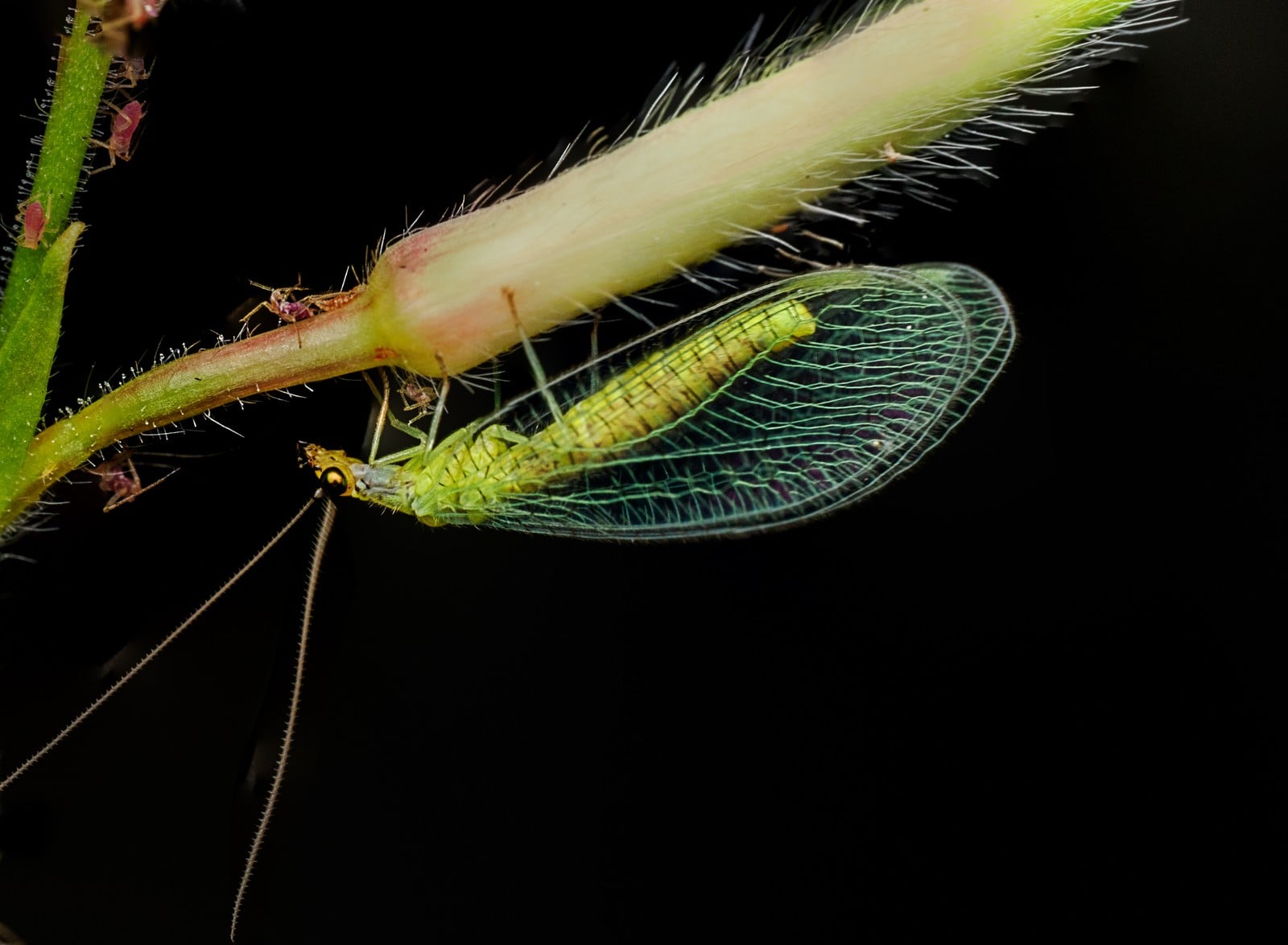
“Without a flashlight and a willingness to explore the garden after sunset, I might have walked right past an extraordinary biological story unfolding just inches away,” Lisa adds.
On other outings, the Cucharas have photographed a moth laying eggs at night and a crab spider grabbing an unsuspecting bumblebee. They’ve also watched a caterpillar that had just shed its outer skin, known as a molt.
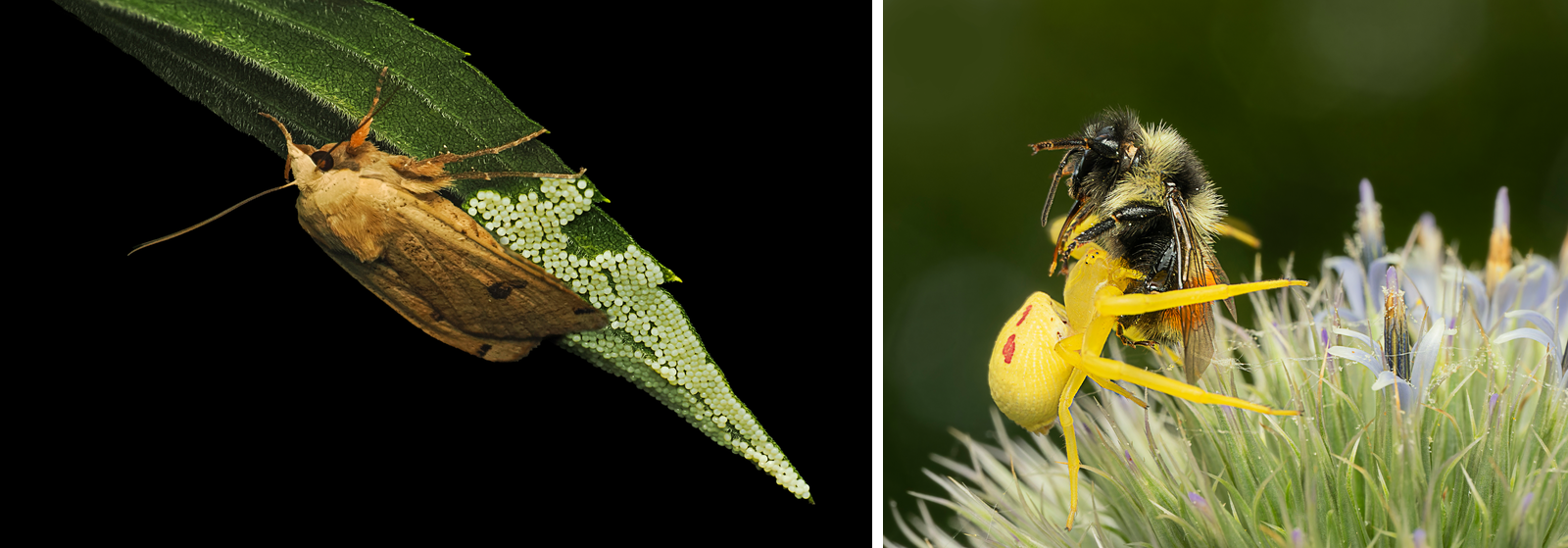
Right: Crab Spider with Bumblebee • OM-1 Mark II • M.Zuiko Digital ED 90mm F3.5 Macro IS PRO • 1/160sec • f/16 • ISO 2000 • Single Shot
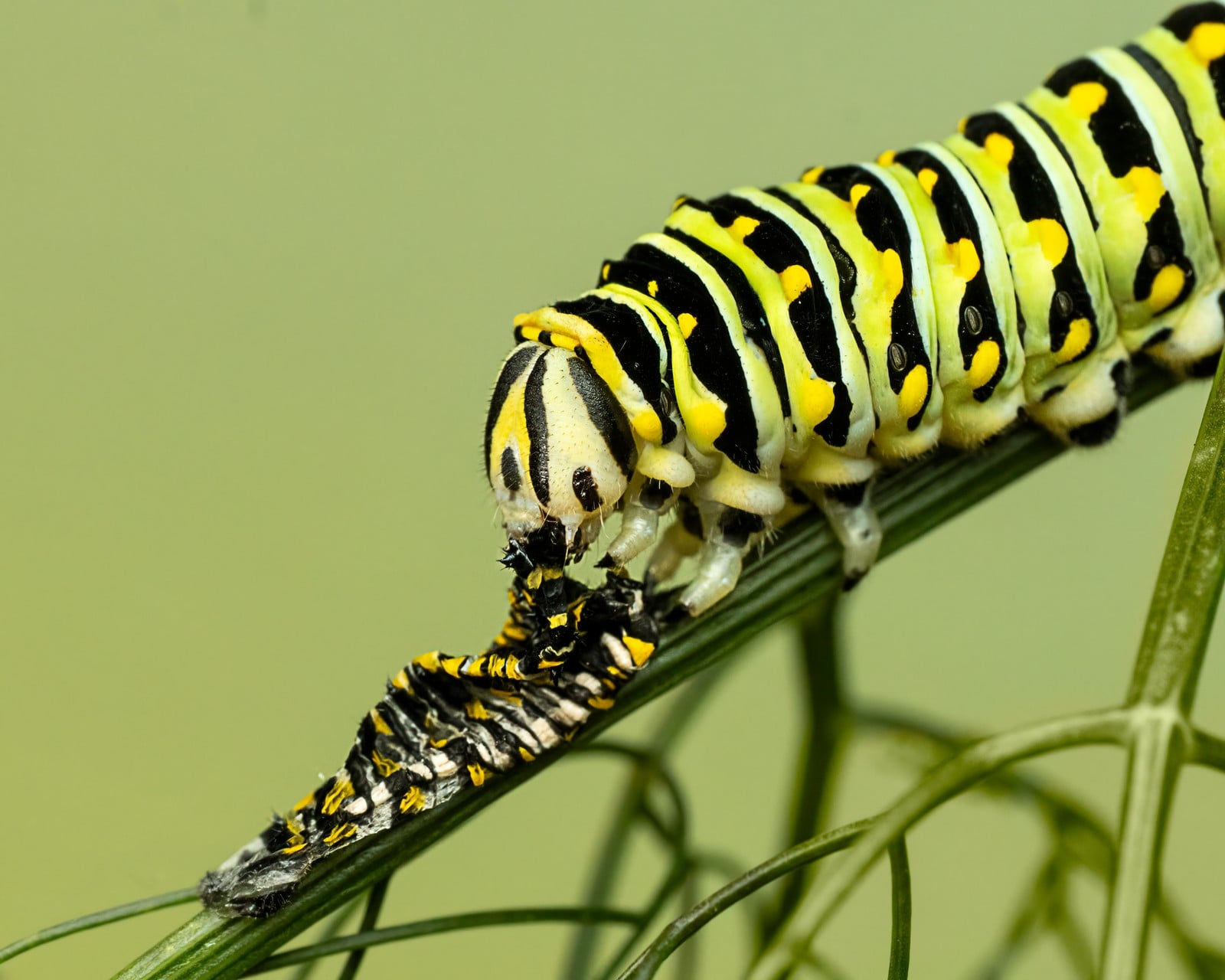
“A black swallowtail caterpillar will eat its own molt for energy,” they add. “Those spontaneous moments of seeing something so unique are just one reason we enjoy macro photography so much.”
The Cucharas have turned their own yard into a wildlife habitat, replacing most of the lawn with the goal of mainly native plants grown without pesticides or herbicides. They also lead macro and close-up photography retreats at Little River in North Berwick, Maine.
“We love places where you can move just a few feet and find a whole different world,” they say.
Insects are cold-blooded, so how active they are depends on the temperature and conditions around them.
“Pick a rainy, drizzly, or overcast day,” the Cucharas advise. “Insects like to hang out under the leaves and they’re less likely to move. And get there early, because a lot of insects are cold and slow in the early hours, which gives you more time to photograph them.”
“Slow down and look under every leaf,” they continue. “Don’t rush from flower to flower; pick a small area and explore it from a few angles. You start to see a jumping spider on a stalk, holes in a leaf from insects eating, or a curled leaf with a caterpillar inside.”
“If you’re just starting to practice macro photography, a stationary flower with some personality, pollen, or water droplets is a wonderful starting point,” the Cucharas note. “A flower past its prime, a crooked stem, a curled petal, or an oddly shaped mushroom can be a far more compelling story than a flawless blossom. And learn to notice the background, because it’s just as important as the subject.”
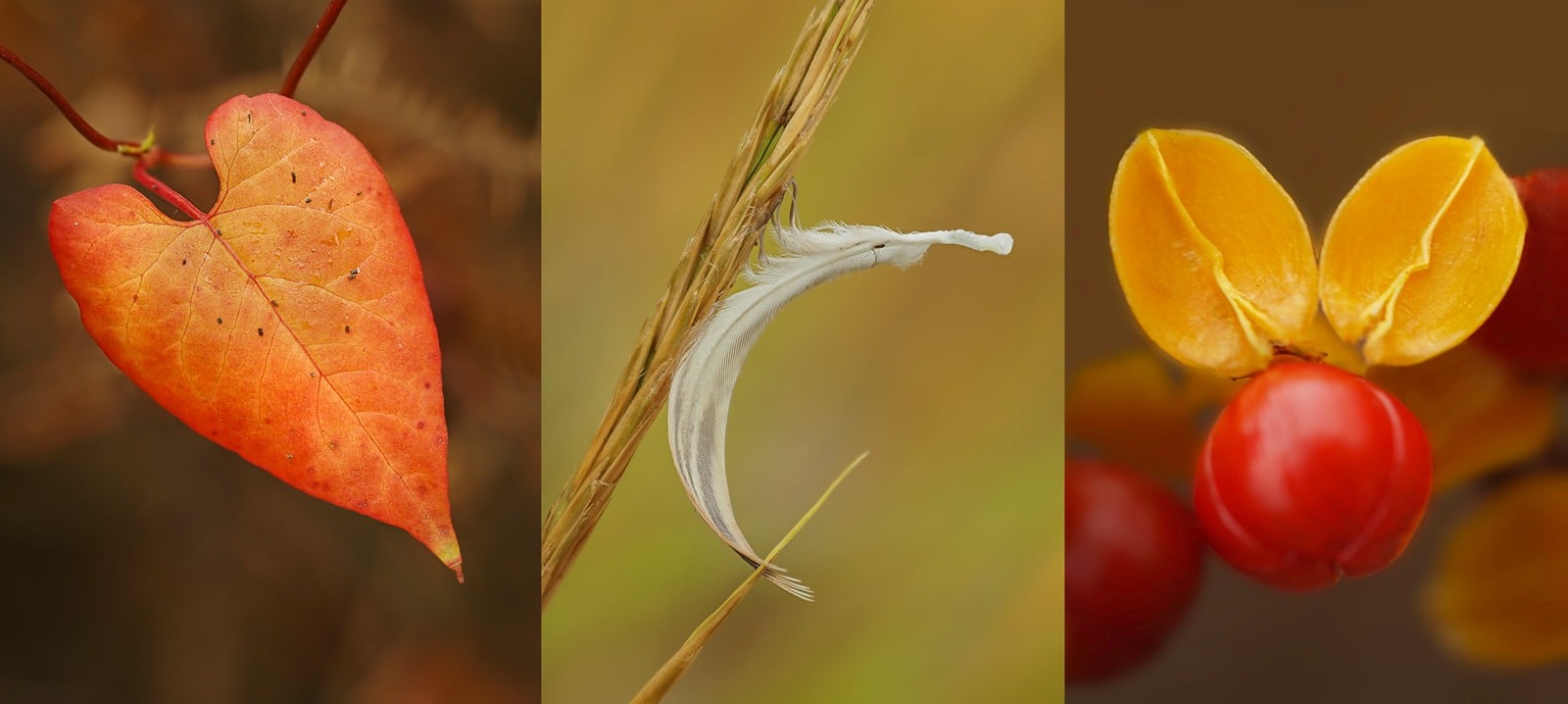
Middle: Bird Pareidolia • OM-5 Mark II • M.Zuiko Digital ED 60mm F2.8 Macro • 1/200sec • f/3.5 • ISO 400 • Single Shot
Right: Mickey Mouse Pareidolia • OM-5 Mark II • M.Zuiko Digital ED 60mm F2.8 Macro • 1/60sec • f/2.8 • ISO 200 • In-Camera Focus Stacking
“At one of our retreats, six groups rotated through my session to photograph a swallowtail chrysalis on its host plant,” Lisa recalls. “It gave me a chance to talk about fennel and other host plants, and about how to photograph it without disturbing the spot or making it more obvious to predators. No photograph is worth possible harm to the subject, including insects and the plants they’re on.”
Lisa also says that it’s not necessary to have a large piece of land to start creating your own macro photography sanctuary. “I always recommend planting more native and host plants everywhere, even if it’s just a few planters at your condo. Native plants are what attract the insects that look fascinating in a photograph.”
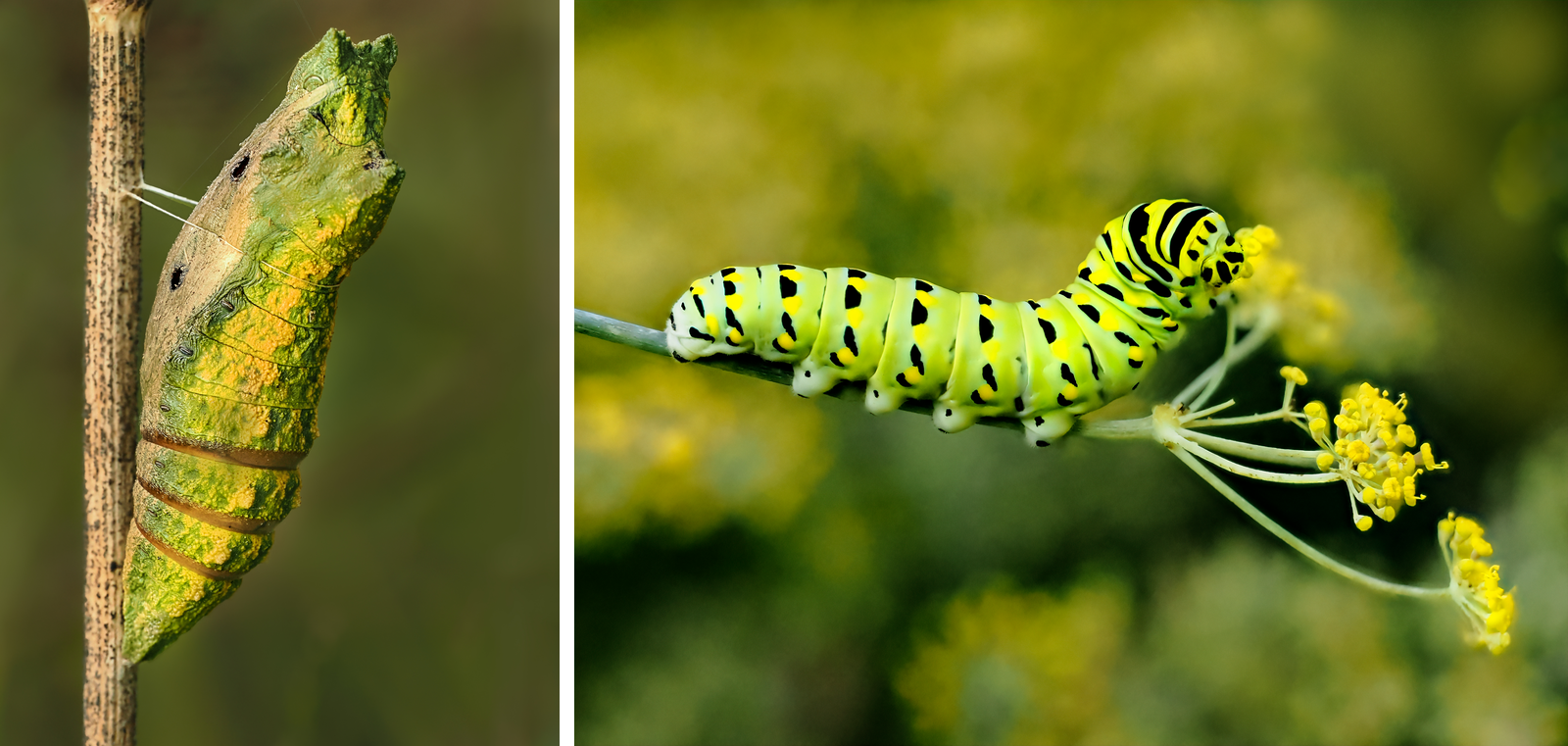
Right: Black Swallowtail Caterpillar • OM-1 • M.Zuiko Digital ED 40-150mm F2.8 PRO • 150mm (300mm equivalent) • 1/1250sec • f/3.2 • ISO 6400 • Single Shot
Even with their own garden, the Cucharas still head out to other spots for macro photography. However, unlike static landscape overlooks, macro photography is always delivering something new. “We often visit the same places again and again, and we always come home with different photographs,” the Cucharas explain. “Flowers open and fade, insect species change from month to month, and the light and weather change. Macro photography might be the best genre for photographers who are always looking to shoot, and learn, something new.”
From the Rainforest to the Backyard
Chris McGinnis has captured some of his favorite macro photographs after dark, in the rainforests of Costa Rica and Panama.
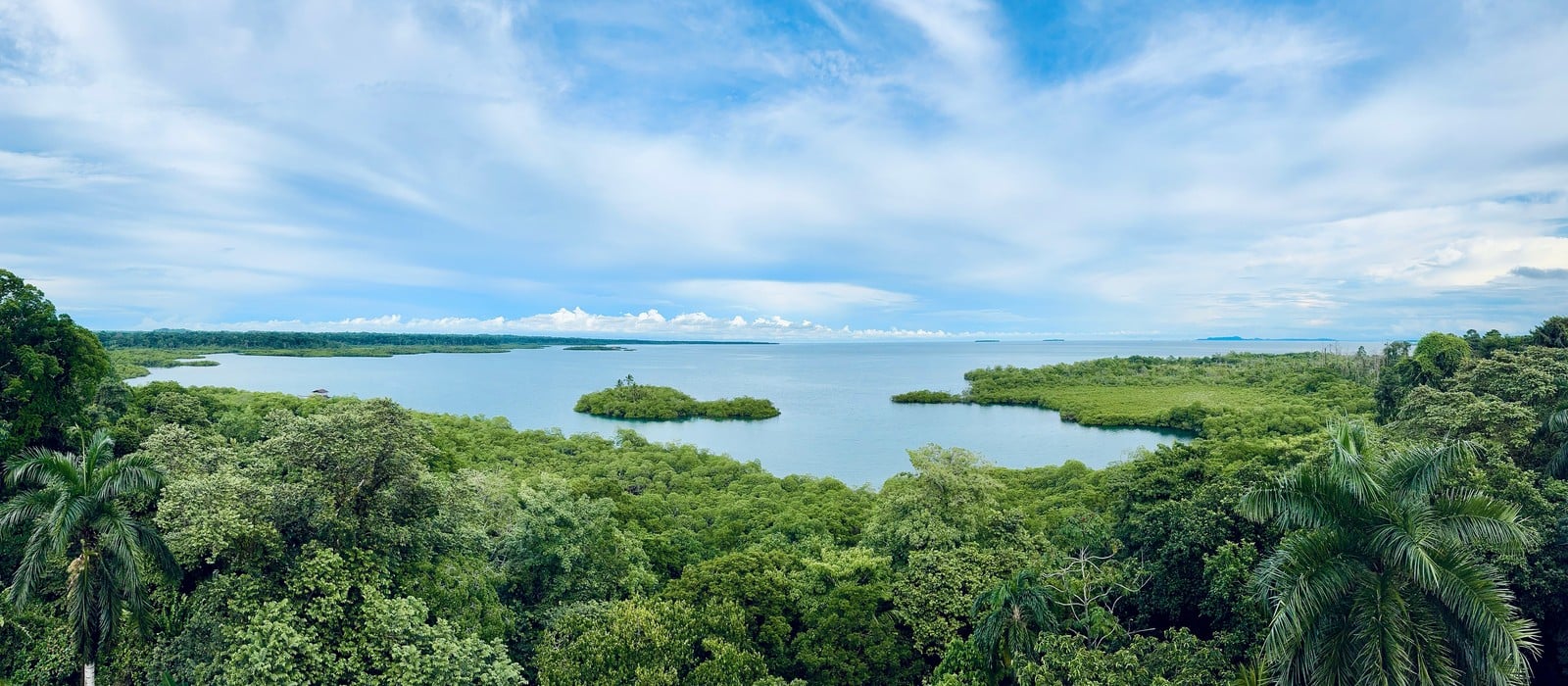
McGinnis says that one of the most interesting subjects in the Central American rainforest is the red-eyed tree frog. “With these frogs, I am constantly surprised with the variety of moments I am able to capture them in, and maybe my favorite moment was on a trip to Panama with fellow OM SYSTEM ambassador Lee Hoy,” McGinnis remembers. “We had some workshop clients with us, and they faded one by one and went off to sleep, but Lee and I stayed out shooting. We were on this little pond, looking for frogs, and we’d found and photographed several. All of a sudden Lee says, ‘Red-eyed tree frogs in amplexus.’ I said, ‘What? What do you mean?’, not knowing what amplexus meant. Lee pointed to a branch and there were two red-eyed tree frogs with the male on top of the female. I’ve photographed hundreds of these frogs before, but I had never seen them do this. The shot was a unique addition to my portfolio, and I learned a new word in the process.”
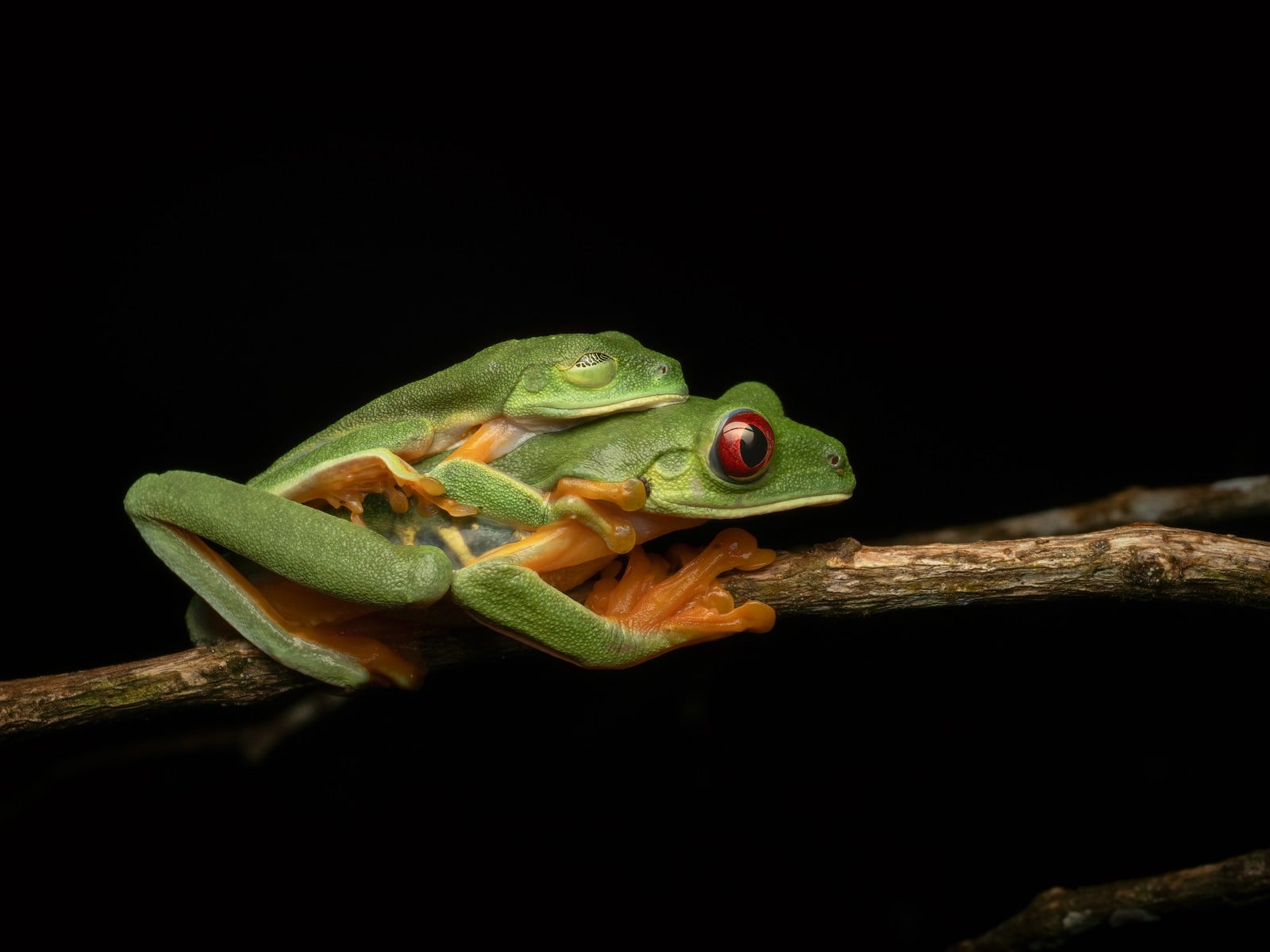
According to McGinnis, red-eyed tree frogs spend the day higher up in the trees and come down toward the water as the sun goes down, which is why he looks for them at night. But whether it’s day or night, he often chooses to shoot macro photographs with a non-macro lens.
“That night with the frogs was a time when I could have used my M.Zuiko Digital ED 90mm F3.5 Macro IS PRO,” he recalls. “I wanted to be up really close, but I wanted a wider view so the story was the frogs in their environment, as that can make a more interesting shot.”
Instead, he had the M.Zuiko Digital ED 8-25mm F4.0 PRO on his camera that night. It’s a wide-angle zoom that can focus close enough to fill the frame with a frog while still showing the branch the pair was sitting on.
“I don’t think I could ever get tired of searching for red-eyed tree frogs,” he adds. “It’s an addiction for me. I find one, I photograph it until it jumps away or I’ve exhausted every angle I can get. Then I could go back to my room and go to sleep, or I could try to find another one. And I have a really hard time walking away, because that next one might be something I’ve never seen before, like capturing two red-eyed tree frogs in amplexus.”
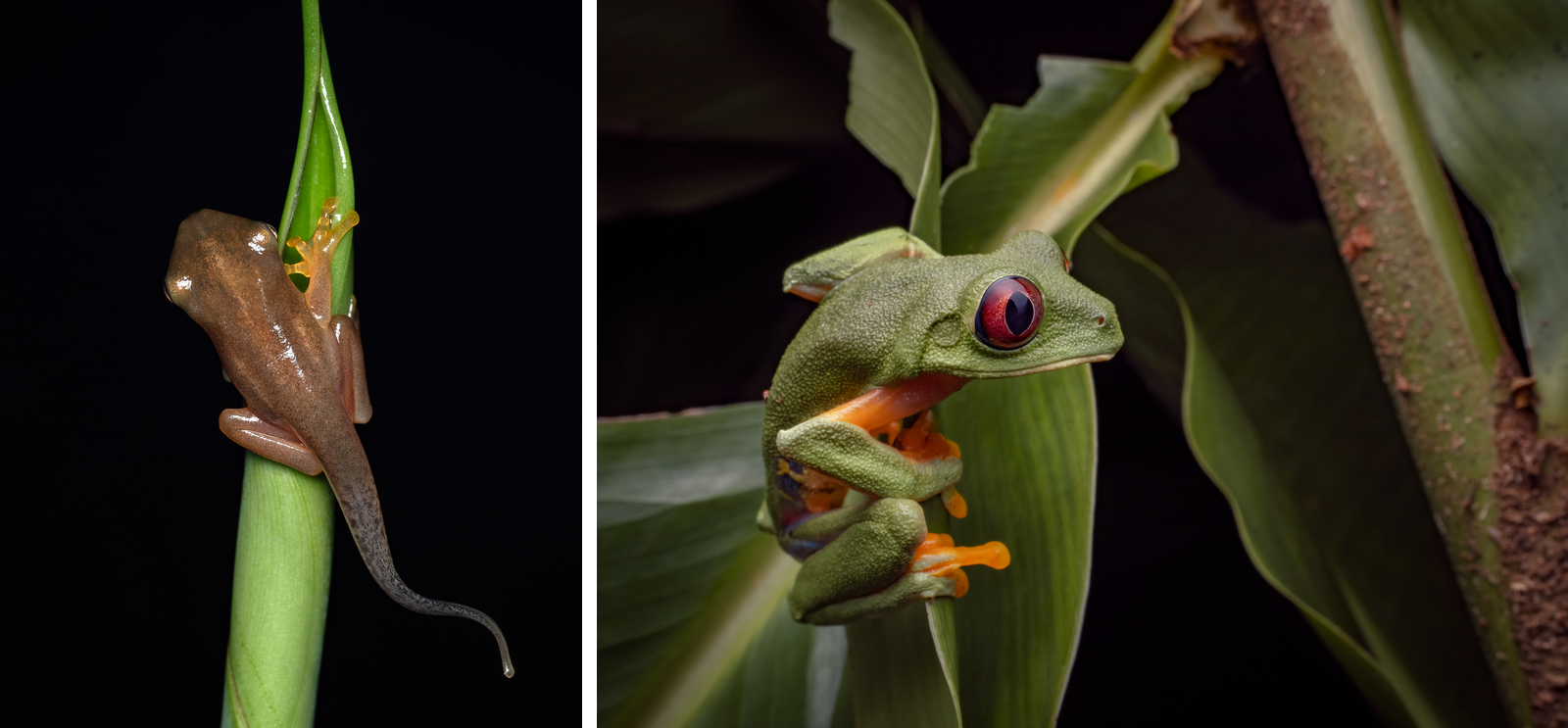
Right: Red-Eyed Tree Frog • OM-1 Mark II • M.Zuiko Digital ED 8-25mm F4.0 PRO • 1/100sec • f/16 • ISO 200
“The biggest challenge of the rainforest at night is getting lost,” McGinnis warns. “So I always get a guide, as there is incredible value in going out with someone who knows their way around the rainforest. Not to mention the danger hiding on the ground and in the trees. Central America has lots of venomous snakes. You grab the wrong thing, you step in the wrong place, and you could be in trouble. A local guide knows how to keep you from accidentally running into one of them.”
Rain is a given in a rainforest. “Photographing in the rain is challenging because it can be harder to find subjects or keep your clothing dry, but luckily I never have to worry about my camera gear in the rain, which eliminates one of the challenges,” he notes. With IP53-rated weather sealing, his OM-1 Mark II can keep shooting through snow, dust, and rain. “I’ve been shooting days on end in pouring, torrential rain in Central America, and I’ve never had a problem with my gear.”
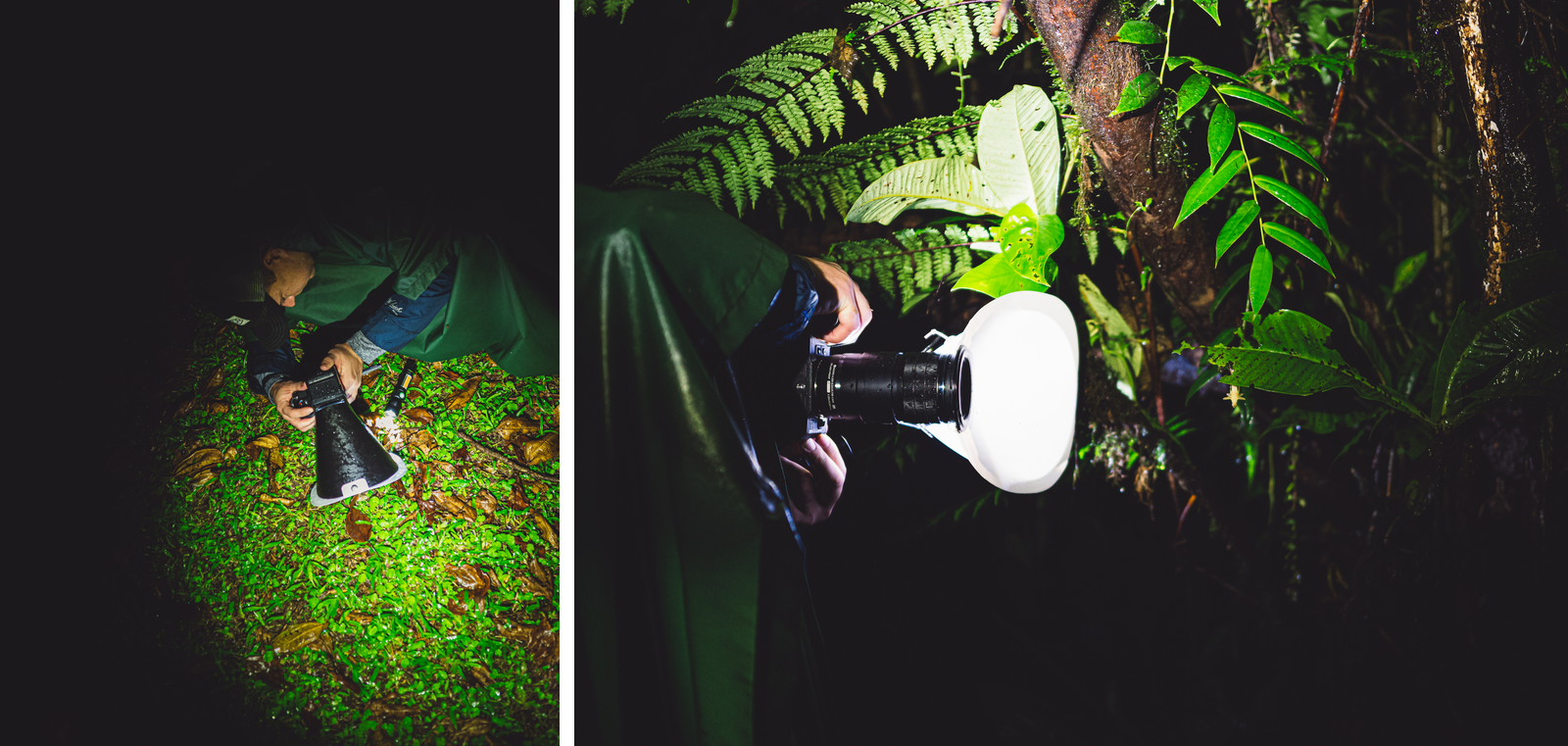
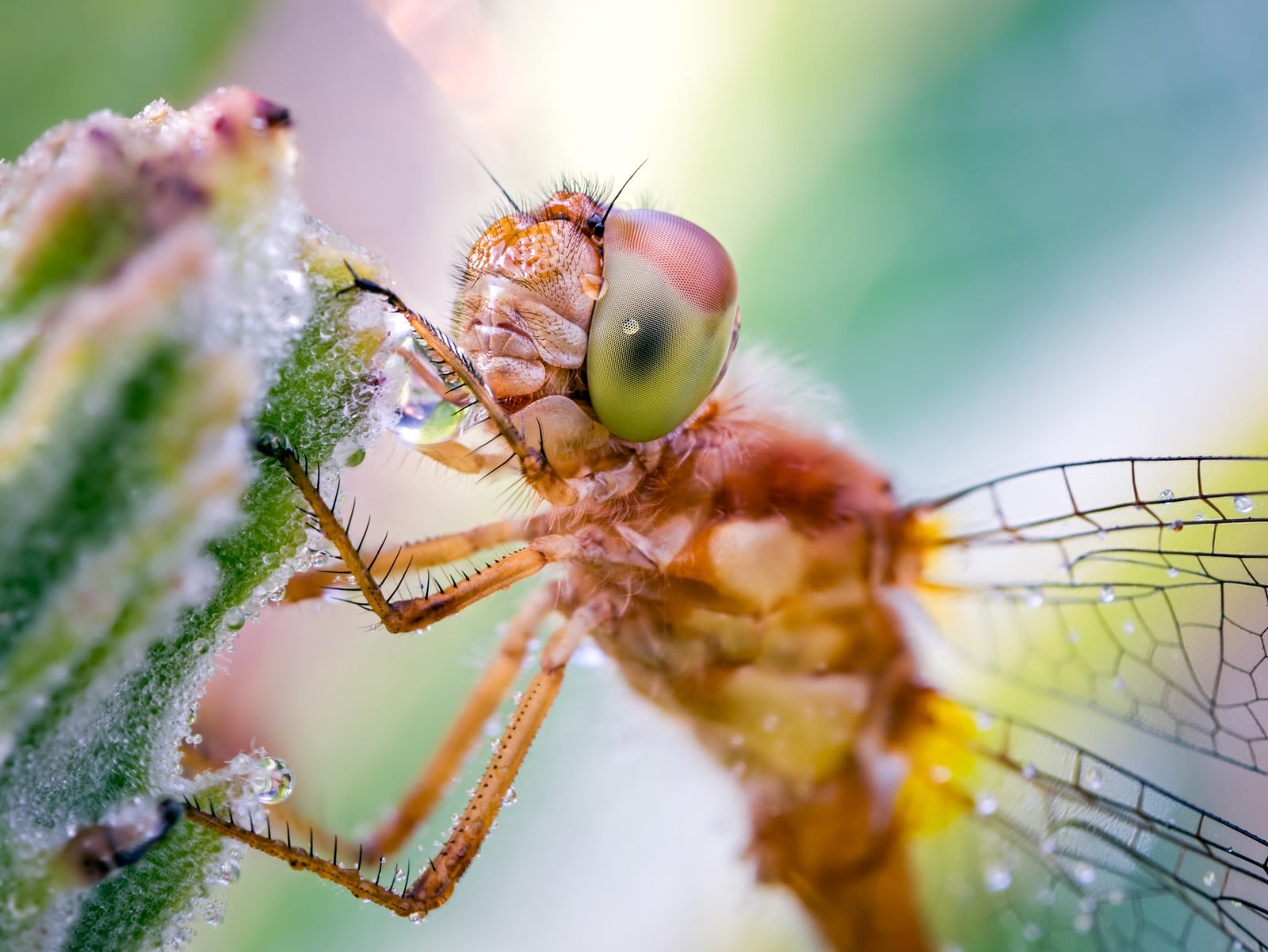
When McGinnis isn’t finding small subjects in the Central American rainforest, he also helps lead multi-day macro retreats with Lisa and Tom Cuchara and other OM SYSTEM ambassadors, on fellow ambassador Steve Morello’s property in southern Maine, as well as other locations. One of his favorite subjects on Morello’s property is dragonflies.
“If you find a dragonfly as the sun’s coming up, they’re not warm yet,” McGinnis advises. “They are cold and they might have dew on their wings, making it harder for them to fly. They’re almost like sitting ducks at that time, and much easier to photograph than in the heat of the day, when they’re busy hunting.”
He also searches his own backyard after dark, where wolf spiders and other hunting spiders give themselves away. Their eyes have a reflective layer that bounces a flashlight beam straight back, a glint known as eyeshine.
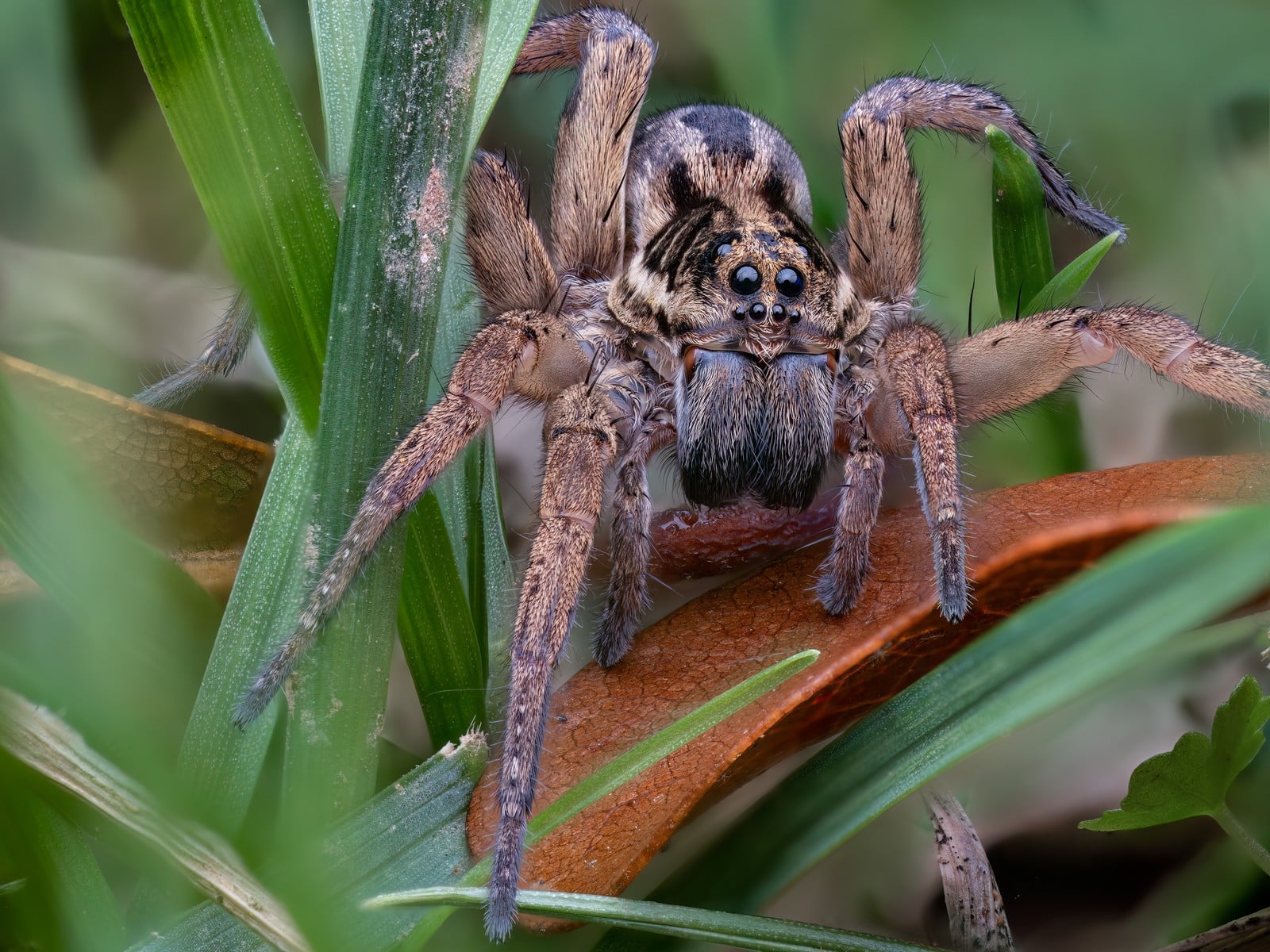
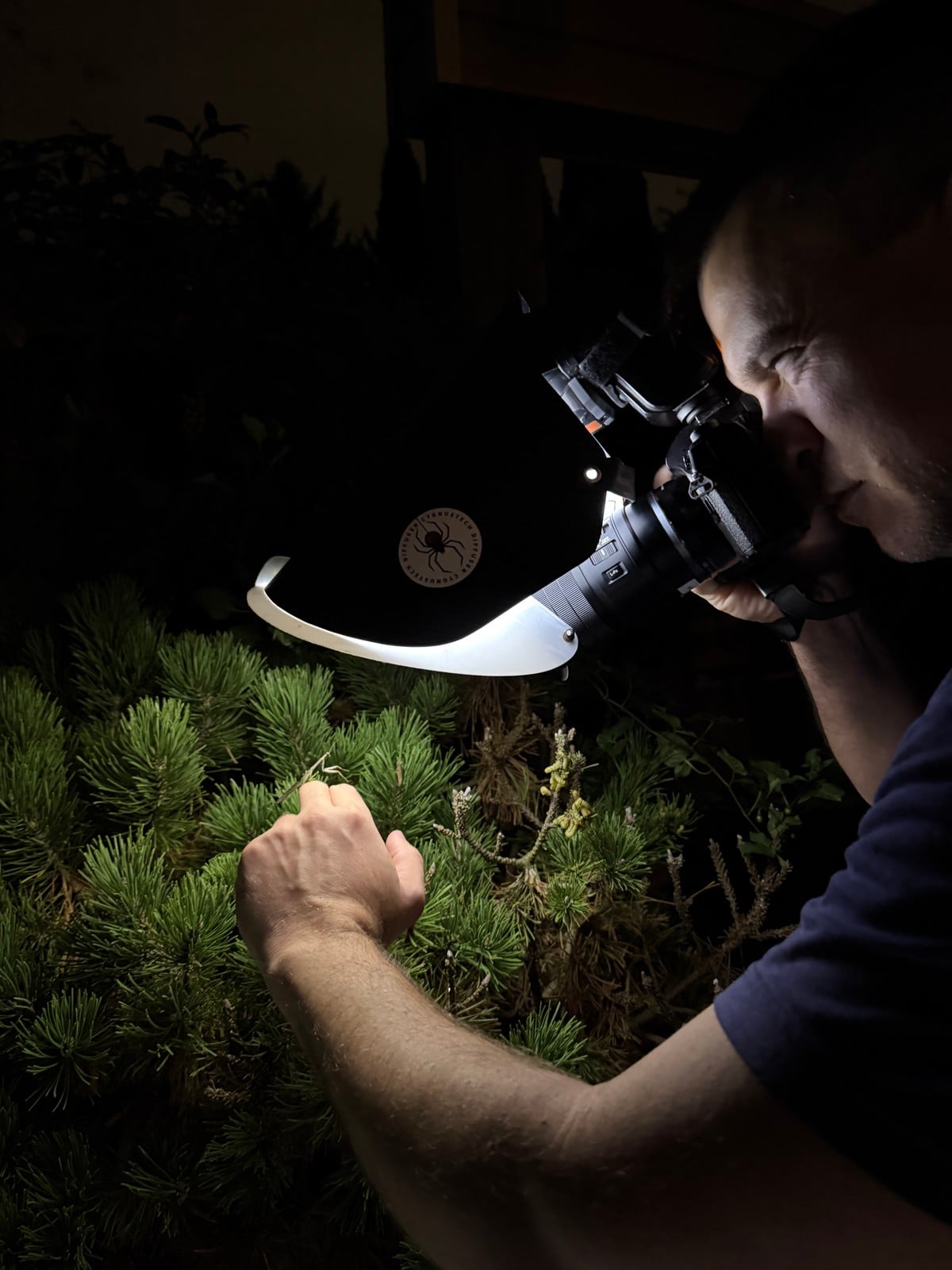
“In my own backyard, I love to photograph spiders and praying mantises after dark,” he continues. “Spiders hunt at night, and they are easier to find than most people realize. If you hold your flashlight up to the side of your head and scan the grass about 10 to 15 feet ahead of you, the eyeballs of a spider will flicker back at you. In the pitch black, all you’re looking for is those little diamonds in the grass. Having the flashlight right to the side of your eye keeps your line of sight in line with the beam of the flashlight.”
Some of McGinnis’s favorite discoveries don’t happen until he’s back at his computer. “I was trying to get this mantis to cooperate, and I ended up with tons of shots of it in different poses.”
“As I was reviewing them, I noticed a little something else in the shot that was invisible to my naked eye,” he continues. “That mite on its head is very, very tiny, just one or two millimeters. That’s actually happened to me many times, and finding those tiny surprises when I zoom in on the computer is one of the best things about macro photography.”
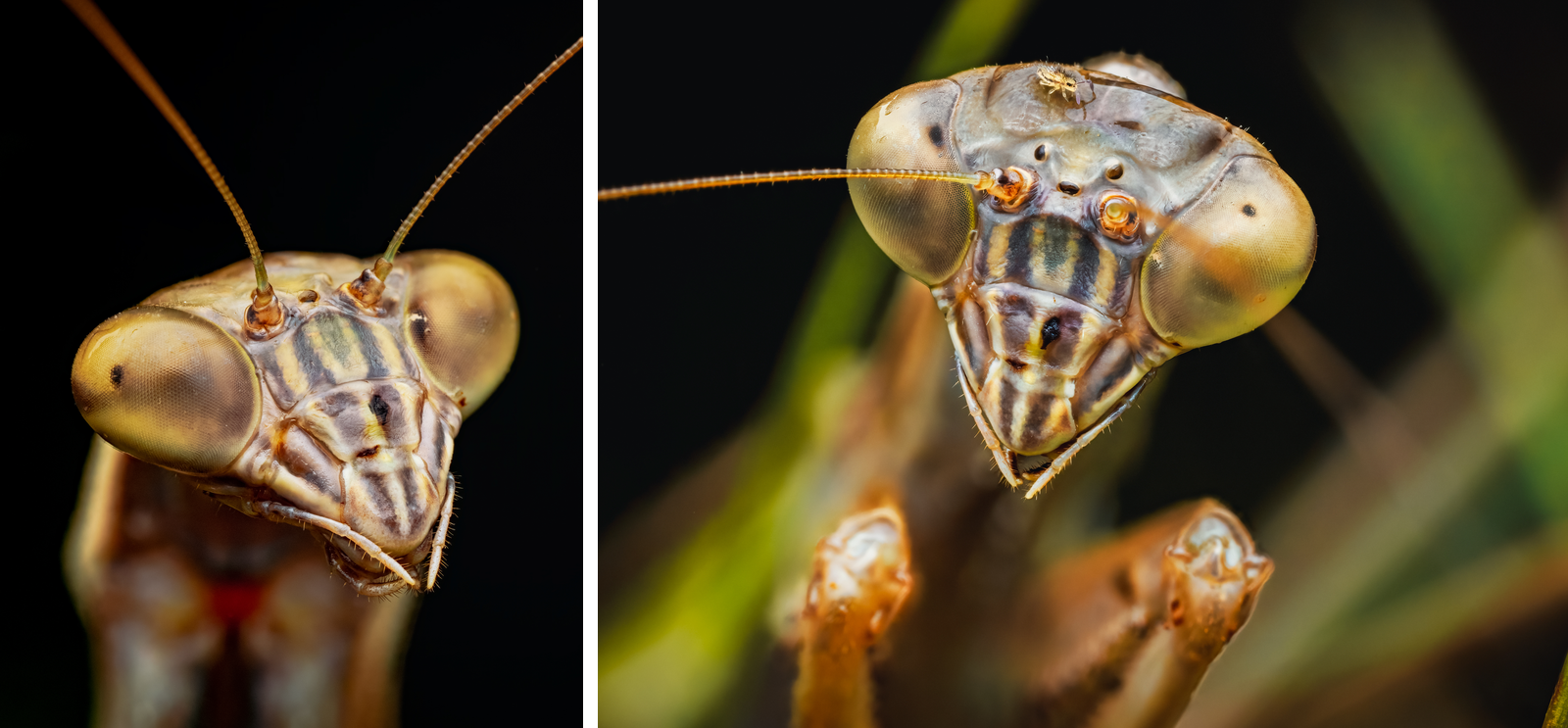
Right: Praying Mantis • OM-1 Mark II • M.Zuiko Digital ED 90mm F3.5 Macro IS PRO • 1/60sec • f/16 • ISO 200 • In-Camera Focus Stacking
McGinnis says this is a great way for both beginners and seasoned macro photography veterans to practice and capture unique photos. “Go outside with a flashlight and scan the yard, and you’re bound to find something. No matter where you live, especially in the summertime, go out after dark with your camera and a light. On a nice, warm summer night, it’s just really fun. I’m exploring this small world, and through that exploration, new things reveal themselves. That’s what keeps me going back. Even if it’s my backyard, a local park, or a tropical rainforest, I’m always discovering new things and finding interesting stories in the small world that most other photographers walk by.”
Full disclosureThis article was brought to you by OM SYSTEM.
Affiliate Disclosure PetaPixel articles may include affiliate links; we may earn a commission if you buy through one.