
25 Years After the World’s Deadliest Terror Attack, Photographers Recall 9/11
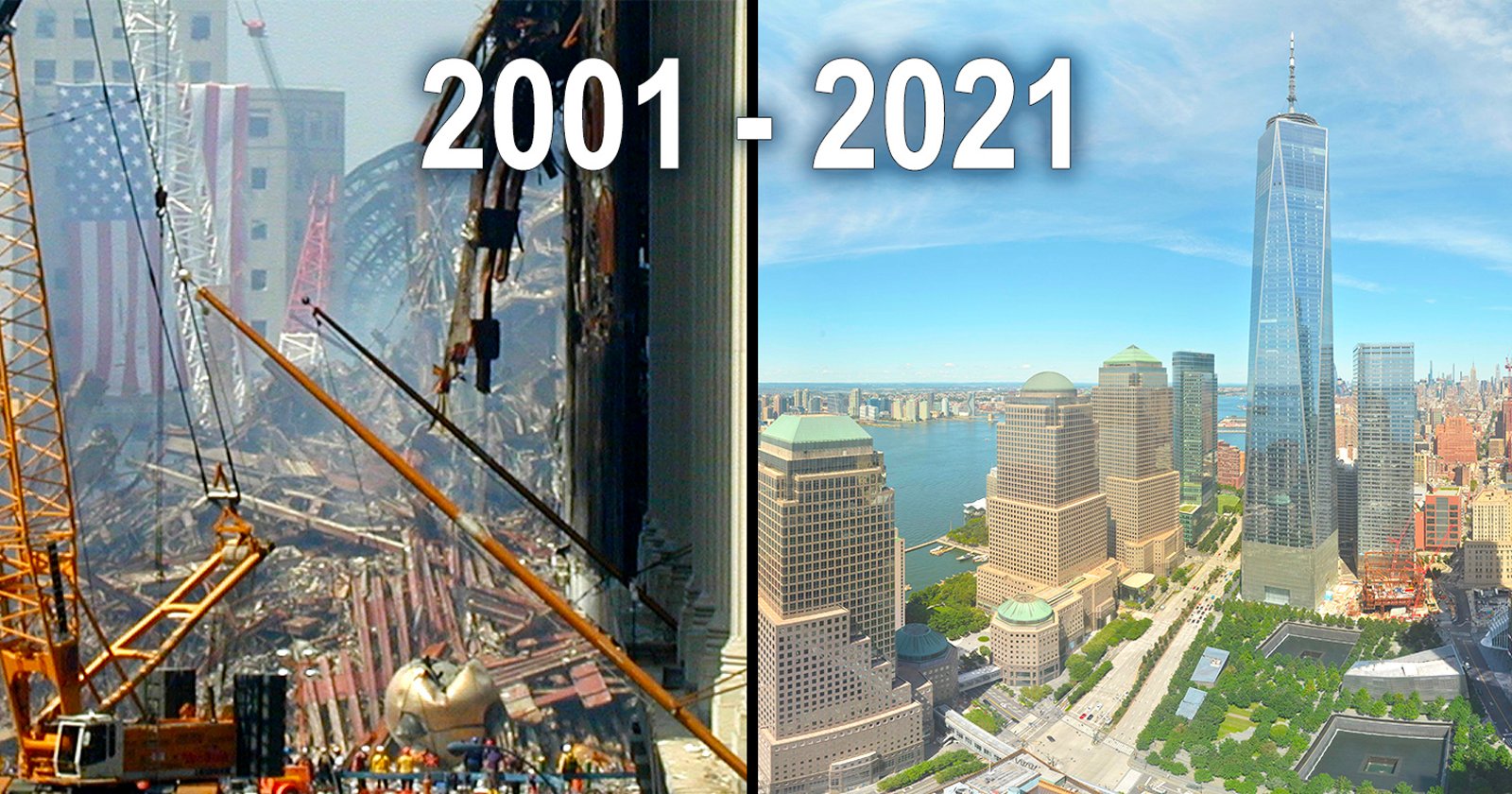
25 years ago today, the United States suffered the largest terrorist attack in world history, killing nearly 3,000 people and injuring countless more. The death toll continues to climb as people succumb to illnesses and diseases related to the attacks. It is widely considered the “most photographed event in history.”
On September 11, 2001, 19 al-Qaeda operatives launched a coordinated hijacking effort, infamously crashing commercial airliners into the Twin Towers in Manhattan, the Pentagon in Virginia, and, due to the heroics of doomed passengers, a rural area of Pennsylvania.
As expected, the terrorist attacks in New York City, the United States’ largest city and massive global media hub, were the most widely photographed. Between the immediate explosions, the towers’ collapse shortly thereafter, and the extensive rescue and cleanup efforts, famous photojournalists from New York City and far beyond raced to the scene to capture defining photographs.
The September 11 attacks happened at a very strange time in photography’s history, which undoubtedly impacted how the event was photographed. Smartphones were still years away, meaning that most people didn’t have a camera on them at all times. Digital cameras were nascent technology, and relatively few professionals and newsrooms had transitioned to them by September 2001. Video streaming was not a thing.
Atrocities and horrors have been a part of human history for millennia. During a fraction of that time, cameras and photographers have demonstrated their unique power to freeze time and preserve the human experience. For documenting precious family milestones, capturing the beauty of nature, and making art, this ability to preserve is photography’s greatest power. In the case of photographing violence, war, disaster, and terrorist attacks, though, it’s not always obvious if the camera is a gift or a curse.
Photographers Remember 9/11
For photojournalists, capturing history as it happens is the ultimate mission. It is not about voyeurism or exploitation, but to bear witness for humanity itself. September 11, 2001 is perhaps the strongest example of that in the 21st century. There were a lot of witnesses.
“I feel grateful that I was able to contribute to the visual record of the day. In my career today as a documentary filmmaker, I often revisit the lessons from this period. I think about how to document tragedy with proximity and sensitivity. How to share reality, even when it’s horrible, while keeping the humanity of the people caught in the middle of it,” recalls Yoni Brook to The Washington Post.
Brook was just a 19-year-old New York University student at the time but had spent the summer before 9/11 interning at The Post‘s photo department.
“I may have stood in that same spot for five hours. It was a helpless feeling. There was nothing I could easily see or access. Nothing I could contribute and little to report on. But I knew that I needed to remain. Just in case something happened. Just in case I am the only one still close enough to witness,” said Post photographer Michael Lutzky, who was on-site at the Pentagon on 9/11.
“What stays with me, when I choose to let it surface, is the mass helplessness,” Lutzky continues.
“I could see and feel the fear and pain of the people around me, and I tried to capture that in my images. I had covered wars, disasters and terrible events in Central America and all over the world before that day. I had seen its consequences and documented its victims. However, after each of those assignments, I always came back home to a safe place. This time was different,” adds Post photographer Juana Arias, who was also at the Pentagon.
“This is history, this is history,” Getty photojournalist Spencer Platt tells Axios he was thinking on the morning of September 11, 2001.
“At this point, some other photographers and I began attempting to get to the base of the towers; as photojournalists, we are trained to get as close as possible. The NYPD likely saved a lot of lives that day, including my own, by blocking us from getting closer in that area,” recalls Getty photographer Mario Tama to Axios.
Platt captured the moment when the hijacked United Airlines Flight 175 from Boston crashed into the South Tower of the World Trade Center at 9:03 AM ET. He shot it from his apartment in Brooklyn with a digital back while watching the North Tower burn.
Like many fellow photographers that day, Platt had to balance being a New Yorker and a photojournalist.
“I think I shifted throughout the day from being a civilian witness to a photojournalist and back to simply being a witness. We had no physical or mental preparation for the event, unlike many of the hard news stories we cover. In the end, I, along with so many other New Yorkers, was simply there, living, breathing, and experiencing one of the saddest and most visually dramatic days in American history. To put a journalist cap on and somehow suppress the civilian, father, husband, and American in you is an impossible task. Some were able to do it better than others,” Platt says.
Many photographers who were in Manhattan on September 11 are no longer alive to recount their stories. For just one professional photographer, Bill Biggart, it’s because he died at the scene.
Biggart was walking his wife, Wendy Doremus, and their family dog through Union Square when the first plane hit. The photographer rushed home to get his camera and ran 20 blocks to the World Trade Center. At this point, people didn’t yet realize that it was a terrorist attack. When Doremus heard the news, she tried to call her husband, The Observer reports.
Biggart told his worried wife that he was okay, and that he was there with firefighters. Minutes after the call, the second tower came down, and Biggart was killed. He was 54 years old.
“Getting the camera back was almost more emotionally devastating than getting Bill’s body back. That was his life, his soul in his images,” Doremus recalls.
With the help of one of Biggart’s friends, photographer Chip East, 154 of Biggart’s film photos were recovered from his camera and body. Biggart’s last photos show the second tower collapsing, and Biggart’s photos were just added to the permanent collection at the Imperial War Museum in London.
“Bill was courageous and fearless in his efforts to get the story. And he used to say, ‘If you have fear, then you can’t do this kind of work’,” Doremus says.
Associated Press photographer Richard Drew took one of the most haunting and disturbing photos from the 9/11 attacks, which is sadly a very high bar to clear. Drew’s famous photo shows a still-unidentified man falling to his death from the World Trade Center.
The widely published photo is also extremely controversial, with some decrying it as grotesque. 25 years later, the photo remains hotly debated and very polarizing, pushing against the very edges of photography’s value and ethics.
For Drew, a Pulitzer Prize-winning photographer who was so close to Robert F. Kennedy when he was assassinated in 1968 that he was spattered by blood, it was another tough assignment in a long time of brutal work.
Drew tells USA Today that he couldn’t see the people jumping to their deaths from the World Trade Center when he first arrived, but he could hear them.
He brought his camera to his eye, zoomed his lens to 200mm, and started shooting. In one of these images was “the falling man.”
“We’re seeing him in the last moments of his life,” Drew says. The photo hit the wire later that day and ignited a debate about photography that persists today.
Ultimately, the immediate backlash to the photo’s publication meant it all but vanished from the public eye. Drew says his colleagues describe the photo as “the most famous photo nobody has seen.”
“It messed me up pretty bad,” Drew said of his experiences on September 11 five years ago. “I still take note of every plane I hear flying overhead, wondering if it’s friend or foe.”
“People ask how I could cold-bloodedly photograph someone dying. I never saw it that way. I made a photographic record of someone living the last moments of his life. And every time I look at it, I see him alive,” Drew said in 2021.
Although not technically a photographer, NASA shared a letter from Expedition Three Commander Frank L. Culbertson, who was the only American aboard the International Space Station on September 11, 2011.

‘One of a series of pictures taken of metropolitan New York City (and other parts of New York as well as New Jersey) by one of the Expedition Three crew members onboard the International Space Station (ISS) at various times during the day of September 11, 2001. The image shows a smoke plume rising from the Manhattan area. The orbital outpost was flying at an altitude of approximately 250 miles. The image was recorded with a digital still camera. Please note: The date identifiers on some frames (other than those that indicate Sept. 11, 2001) are not accurate due to a technical problem with one of the Expedition Three cameras.’ | NASA
“The world changed today. What I say or do is very minor compared to the significance of what happened to our country today when it was attacked,” Culbertson wrote on September 12, 2001.
“It’s horrible to see smoke pouring from wounds in your own country from such a fantastic vantage point. The dichotomy of being on a spacecraft dedicated to improving life on the earth and watching life being destroyed by such willful, terrible acts is jolting to the psyche, no matter who you are. And the knowledge that everything will be different than when we launched by the time we land is a little disconcerting,” Culbertson continued on September 13, 2001.
The Cost Photographers Are Willing to Pay
It is truly an impossible task to share stories from every photographer who documented the September 11 terrorist attacks and their aftermath. The quotes above are just a small sample of stories from the past 25 years. Photojournalists are driven to document important moments as they happen, no matter the risk or danger.
It’s not just the danger at the time, either. Photojournalists who documented the 9/11 attacks were forever changed. There is only so much human suffering, pain, and tragedy someone can see before it takes a real emotional toll.
For those of us fortunate enough to pick up a camera for enjoyment or relatively safe work, it’s nearly impossible to imagine what it’s like to be behind the viewfinder, lens pointed at death and destruction. We have collectively decided that someone has to do it, someone has to pay that price.
On September 11, 2001, many courageous photographers paid a very heavy price, and 2,977 people, including photographer Bill Biggart, paid the ultimate price.
Nothing can ever bring those people back, but photos can help keep their stories and the story of the United States of America itself alive.
Image creditsFeatured photo by Michael Moran, licensed via CC 2.0.
Affiliate Disclosure PetaPixel articles may include affiliate links; we may earn a commission if you buy through one.