Photographer Tosses His Leica Away From ICE as He’s Tackled to the Ground
Photojournalist John Abernathy was tackled by ICE agents in Minneapolis last week and his last-ditch effort to save his camera was successful thanks to fellow photographer Pierre Lavie, who captured Abernathy’s camera-saving toss in a now-viral image. Lavie’s powerful portrait reflects the importance of photojournalism, captures the risks photographers face in the field, and, to the benefit of Leica, shows how rugged the company’s cameras are.
Online commenters are already wondering whether Abernathy and the photographer who captured the image of Abernathy, Pierre Lavie, could win a Pulitzer Prize for their work on the ground in Minneapolis.
Tensions in Minneapolis are at a boiling point following the killing of 37-year-old Renee Good by ICE agent Jonathan Ross. The killing, which the federal government has controversially claimed was justified, has led to significant civil unrest and ongoing protests in Minnesota and beyond. Photographers like Abernathy and Lavie are on the streets documenting the protests and ongoing interactions between protestors and federal law enforcement agents.
A Poignant Portrait of the Fight for Truth
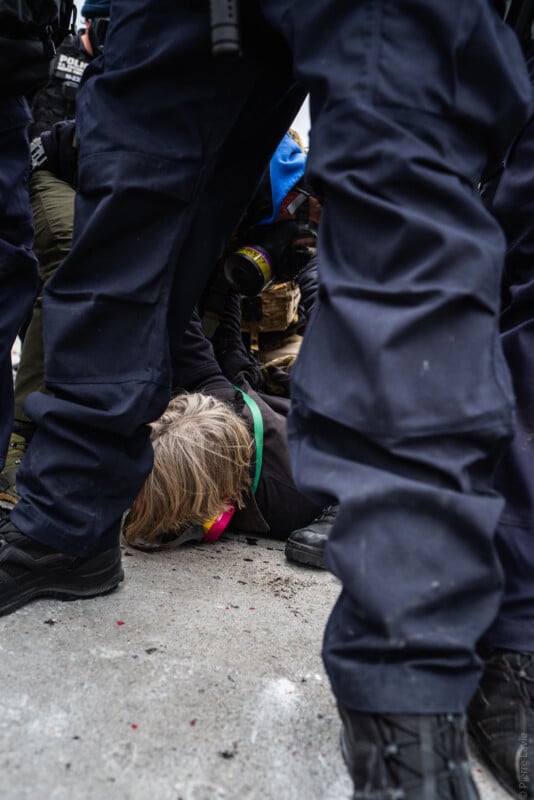
When photographing protests and ICE activity last week, January 15, Abernathy was violently tackled from behind by ICE agents and quickly surrounded by what Abernathy describes as “about 50 border police.”
While being tackled, Abernathy made the swift decision to throw his camera, a Leica M10-R with a 28mm lens, and his phone toward Lavie while pinned to the ground.
If ICE agents got their hands on Abernathy’s camera, it would be impossible to predict what would have happened to it or his images. While photojournalists and citizens have First Amendment rights that should prevent law enforcement from deleting photos from a camera, or even accessing them without a warrant, Abernathy’s fear is entirely reasonable. If ICE agents deleted Abernathy’s photos, he may have had little recourse, whether or not it was illegal.
Lavie captured the sequence of events, and 17 of his photos are presented in chronological order below, showing the lead-up to Abernathy being tackled to the ground, Abernathy throwing Lavie his Leica camera and phone, and the result of Abernathy being pepper-sprayed in the face. Looking at the EXIF data for the photos, the time from when Abernathy was first hit from behind by federal agents to him throwing his Leica M10-R took about five seconds. Just a few seconds later, Abernathy threw his phone. And then he was surrounded and vanished into a throng of federal agents. From being pushed from behind to being fully restrained took about eight seconds.

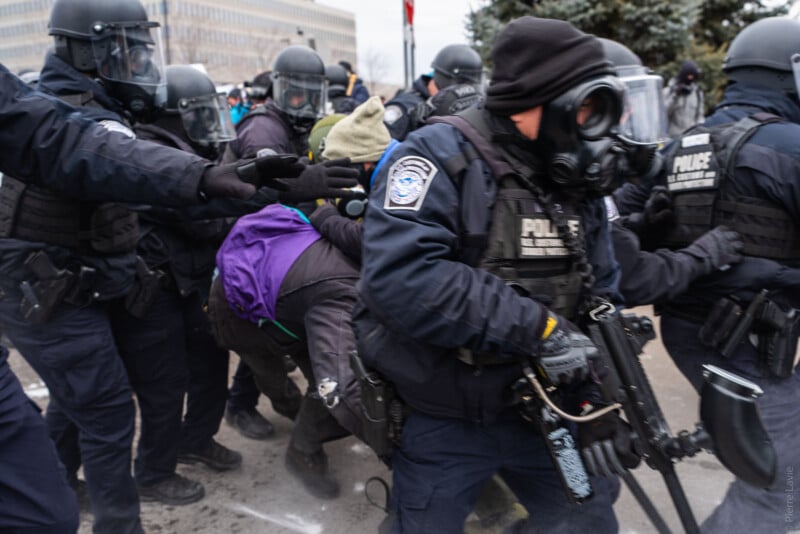
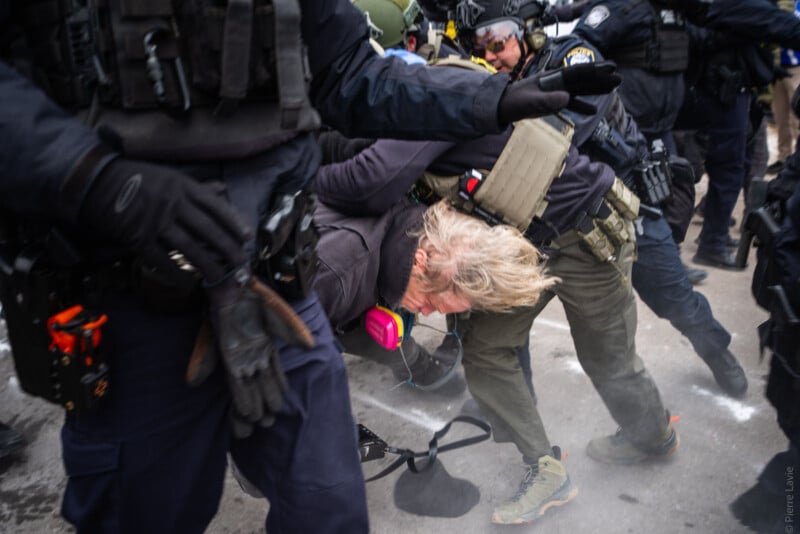
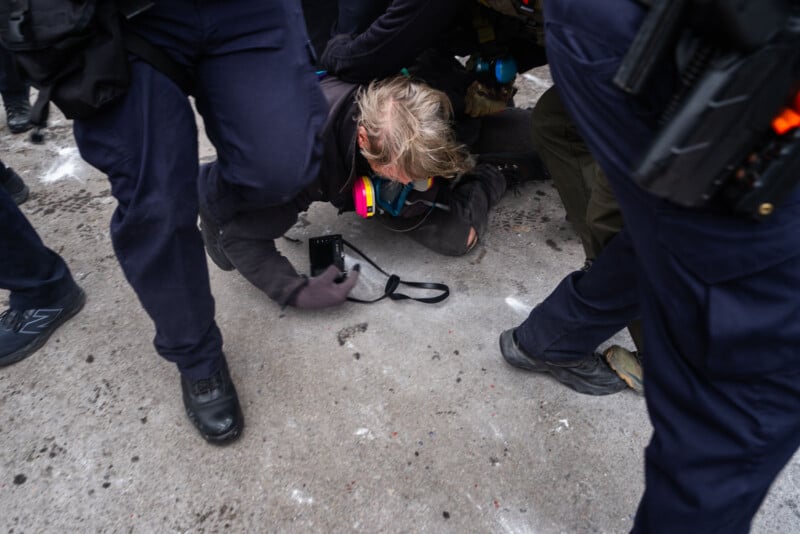
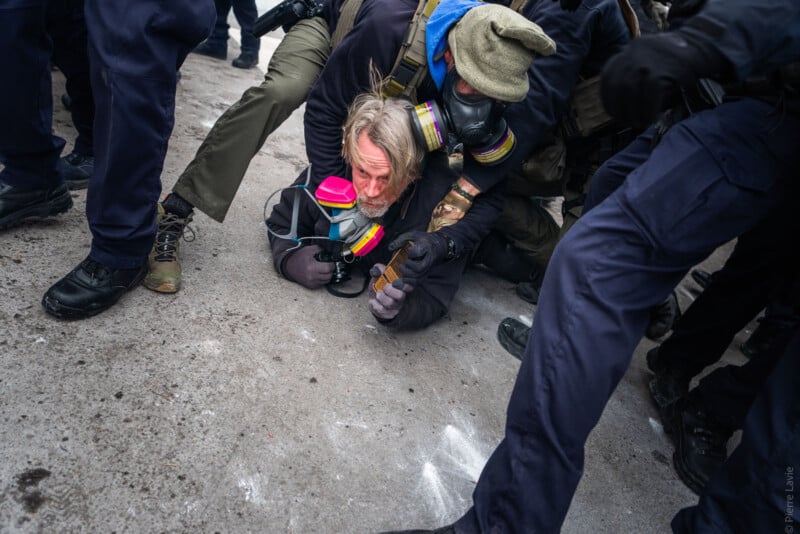
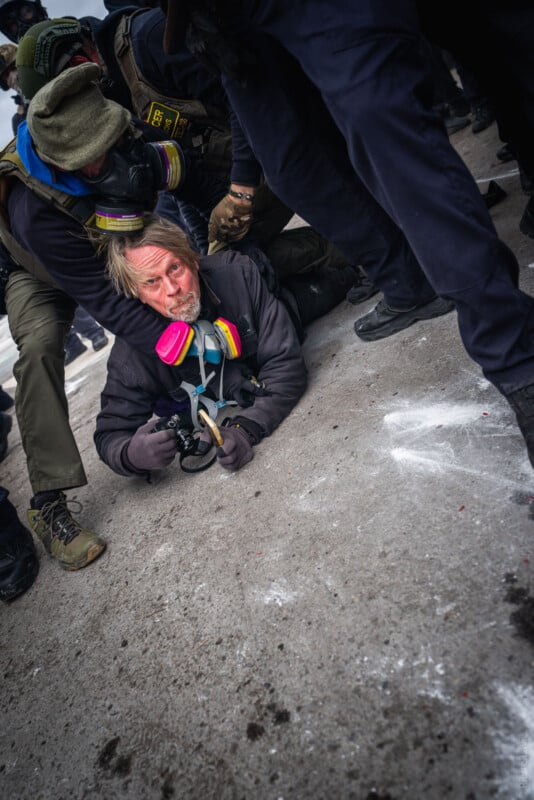
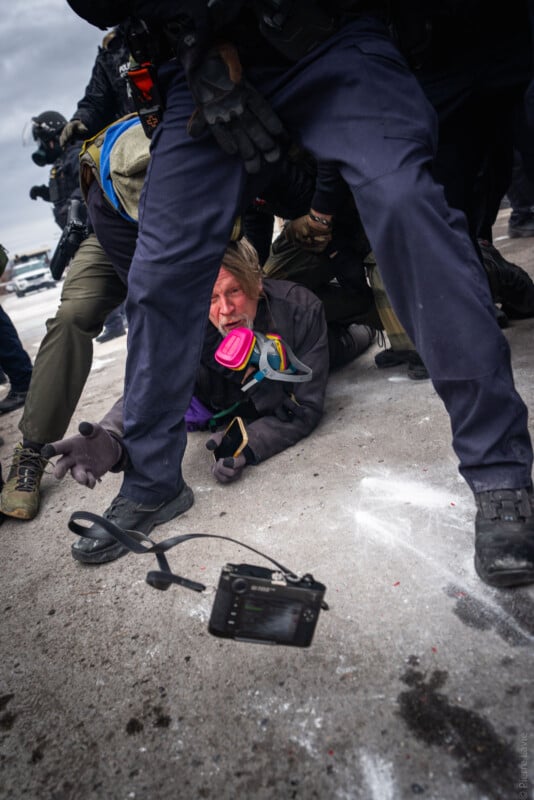
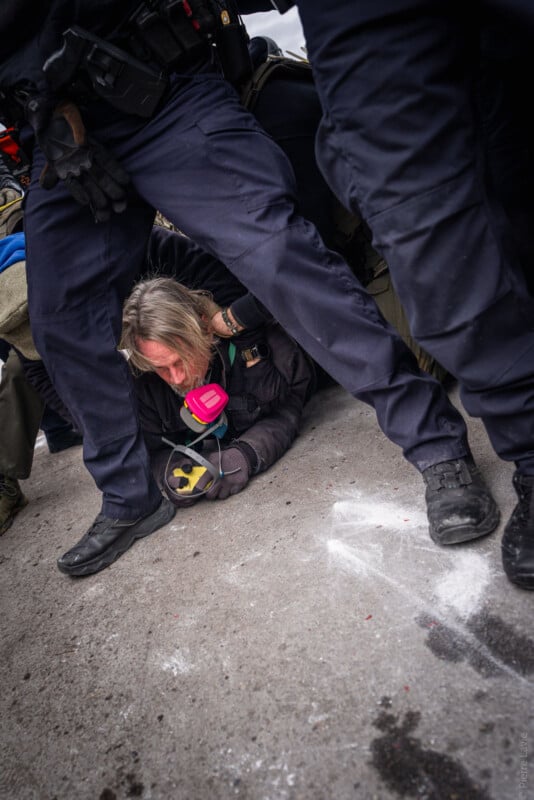
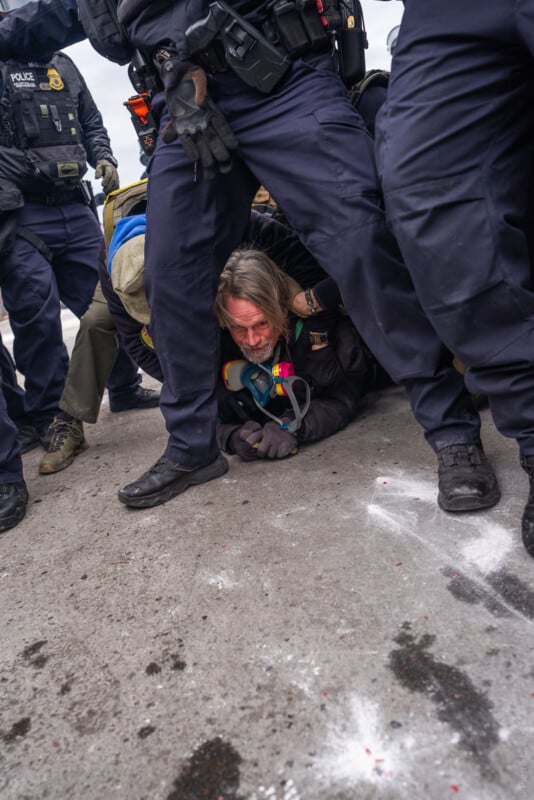

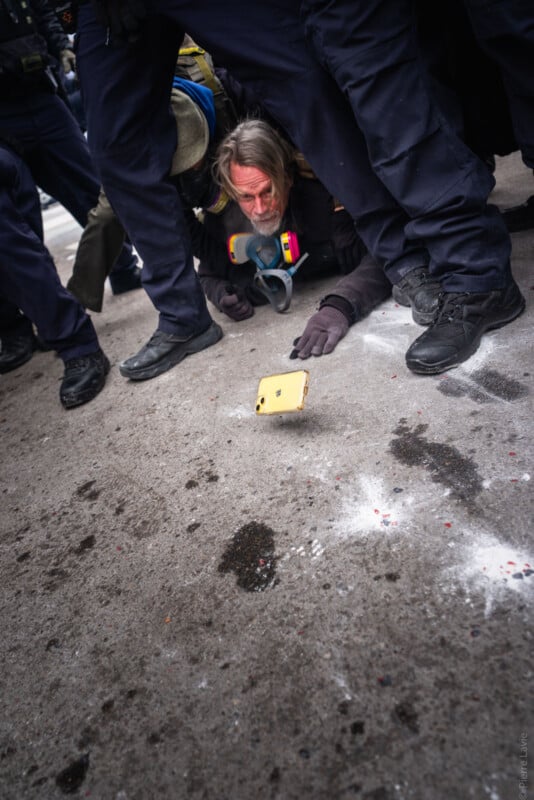
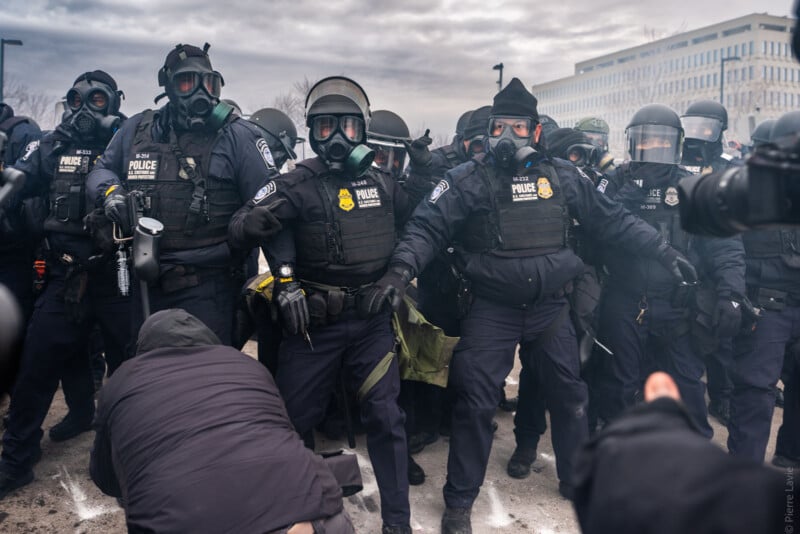
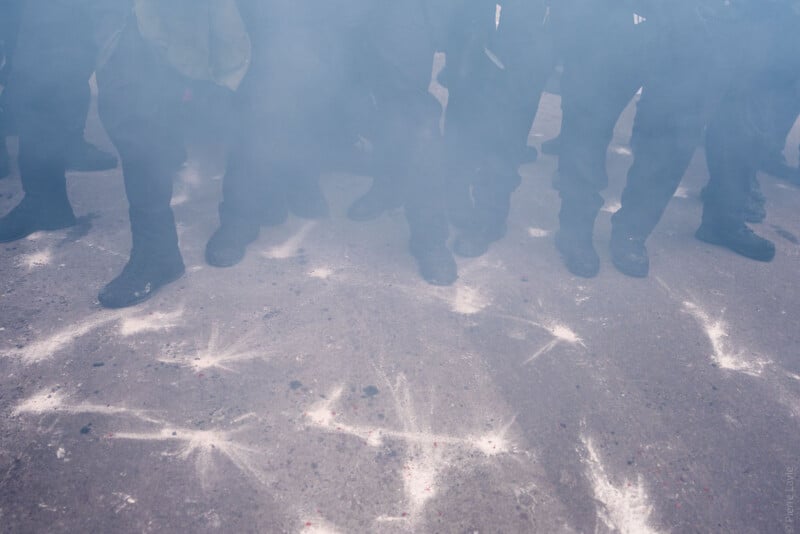

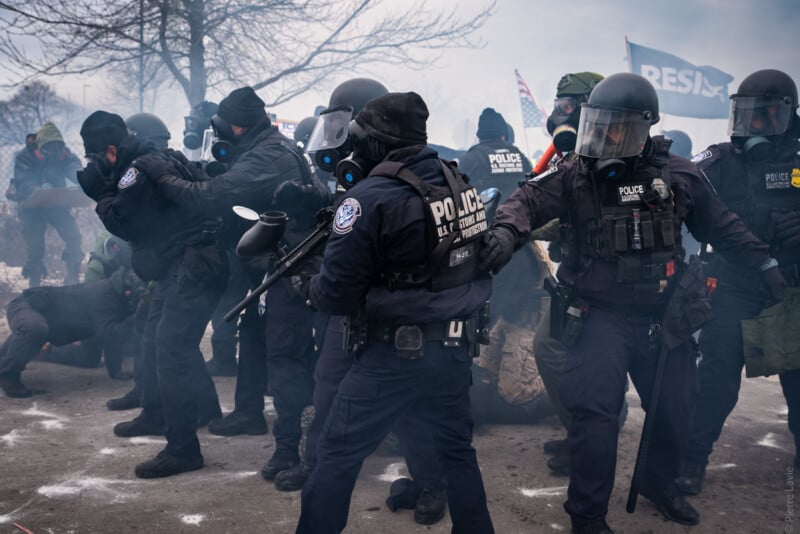

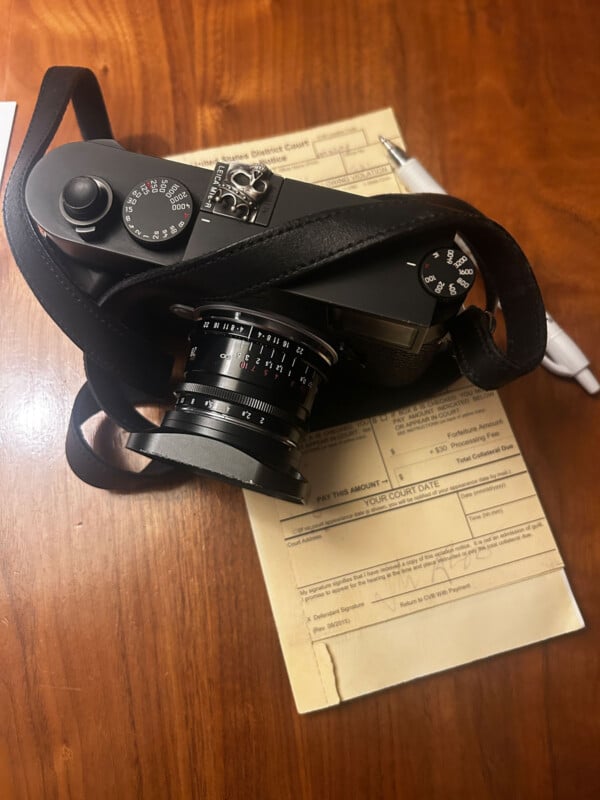
“When I threw [my camera], somehow it miraculously landed on the base plate which is a non-Leica hand grip,” Abernathy tells PetaPixel. “When I finally got it back, there were just a few scratches some of them sort of deep on the base plate.”
From Peaceful Protest to Being Tackled, Restrained, Detained, and Charged
As for how the situation went from peaceful but tense to chaotic and violent, Abernathy tells PetaPixel that far-right agitators arrived on the scene and instantly ratcheted up the energy.
“[Law enforcement] did a couple of pushes again, and at some point, I didn’t know they were coming and I was facing away from them and they hit me from behind and I was on the ground. I literally didn’t know what happened. I’m looking at the ground wondering… it took me a while before I was present with what was going on,” Abernathy says.
“They were screaming at me. I felt at least two knees on my back and they’re like, ‘We got you because we saw you bear spraying people. And I’m like, ‘No, you didn’t.’ And they said, ‘Yes, we did.’ And they’re screaming at me to put my hands behind my back but my arms are underneath me and I think my elbows are underneath me at one point and their knees are on top of me, holding me down. It’s not exactly easy to get my arms out but they’re yelling at me and they set off tear gas, I don’t know exactly where it was, but I would assume a foot or three feet because it was a dark cloud that was hard to see through,” the photographer continues.
“I’m gagging and literally thought I’m going to pass out. I couldn’t breathe. I was thinking I only have a couple of breaths left and I don’t know what’s going to happen after that. I had taken that last shot and I threw my camera. I lifted my head up and saw one photographer taking photos. I threw my camera and then I threw my phone.”
Abernathy remarks that a moment that very clearly stands out for him among a sea of blurry ones is his disappointment that he only threw his phone maybe a foot or two.
‘I’m gagging and literally thought I’m going to pass out. I couldn’t breathe. I was thinking I only have a couple of breaths left and I don’t know what’s going to happen after that.’
“Of all the disappointments, my biggest disappointment was that I didn’t throw my phone very far and the agent’s foot went down on it. It’s a seemingly insignificant moment, but it stood out in my head in that intense moment for some reason. It’s so bizarre.”
What felt like an eternity to Abernathy, from him being hit from behind to being on the ground to being pinned and throwing his camera and phone, took less than 10 seconds.
“That’s insane to me,” Abernathy says of the timeline PetaPixel outlined. “I remember so many things in that brief moment. That’s insane to me. There’s so many things that went through my head. It was literally everything that went through my head. That’s mind blowing.”
Two Vastly Different Perspectives Captured by Two Photographers Just Feet Apart From Each Other
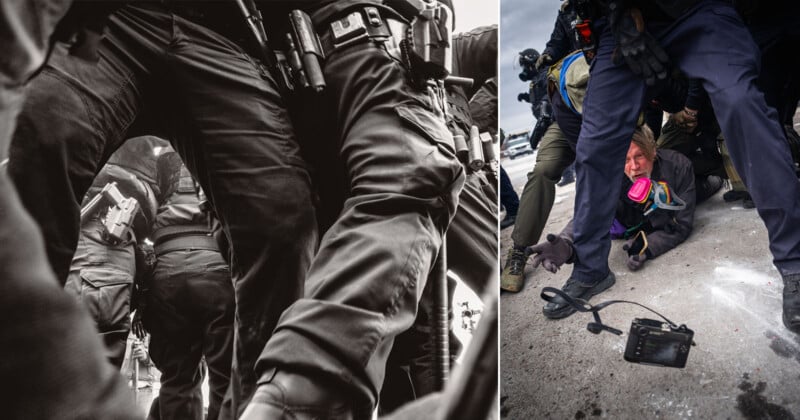
Sometime in the five seconds from being tackled to throwing his camera toward one of the few faces he could see, photographer Pierre Lavie, Abernathy took a photo from the ground, showing his perspective of being detained by ICE and Customs and Border Patrol (CBP).
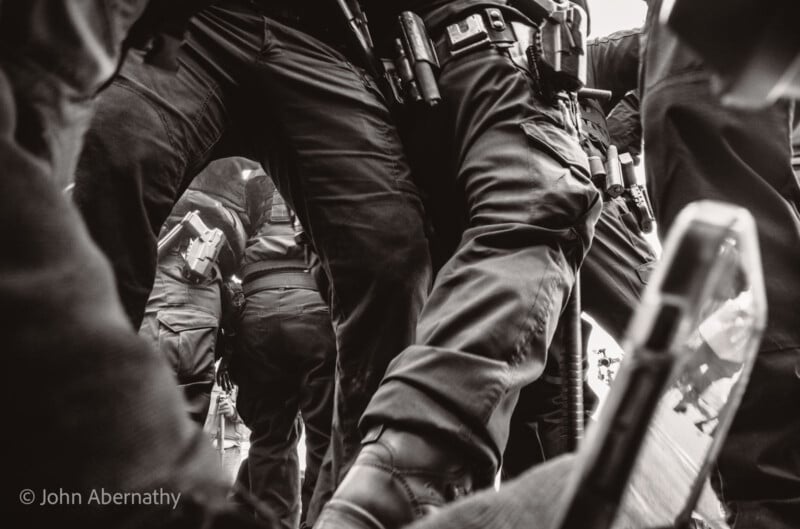
“There are so many things going on [in my photo],” Abernathy says. “I’ve had people comment, send me comments about that image over and over everyday and some of them are people that have been detained and have said, ‘This is the photo that makes me feel how I felt when I was detained.'”
As Abernathy tells PetaPixel, his and Lavie’s photos are mirrored images. On the one hand, Lavie’s photo shows Abernathy, in a moment of desperation, throwing his camera to preserve his images and keep it out of ICE’s hands, where it is impossible to know what would have happened. Abernathy’s photo, taken just a couple of seconds after being tackled and about that long before he threw his camera to an unknown fate, shows the same scene from just a few feet away but from an entirely different perspective.
“They show two different perspectives of the same thing. Nobody’s really seen the photo from the inside, from being taken by ICE. So that one photo stands out,” Abernathy remarks. “And [Pierre’s] photo stands out because it’s showing the struggle, not only of journalism, but the struggle of how do we as individuals fight against this, this big army of whatever you wanna call ’em. I don’t know.”
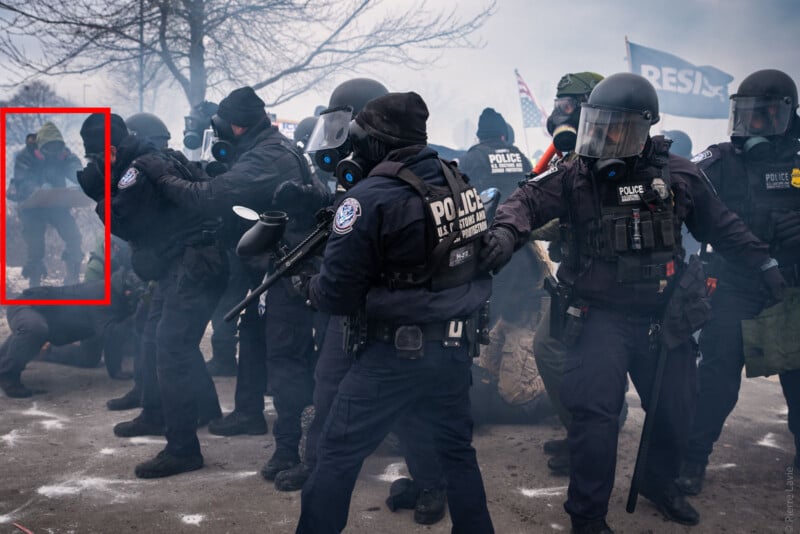
There was even a third perspective of this, as sketch artist Isabelle Brourman was on the scene drawing the events as they happened, including Abernathy being pepper-sprayed in the face. Brourman even captured the details of Abernathy throwing his camera and an agent stepping on his phone. It is a remarkable scene, and Brourman can be seen in the background of one of Lavie’s photos, wearing a hood and a gas mask, drawing.
After a lengthy, successful career as a commercial photographer, where Abernathy had complete control over everything, being out on the streets as an independent journalist has meant having nearly no control. This is especially true when being forcibly restrained on the ground while unable to breathe or see clearly. And yet, Abernathy’s singular image is picture-perfect. The composition, the lines, the way all the legs fit together like a terrifying, suffocating puzzle are remarkable.
“For all those things to line up, and how symbolic it is, the angle of the legs, how aggressive it feels, the guns, my phone being right there, not looking through the camera, just pointing it and shooting is like, it’s just, I don’t know. It’s just… how stuff lines up is amazing,” Abernathy laughs.
”This is the photo that makes me feel how I felt when I was detained.”
An Unexpected and Unprecedented Whirlwind of Mostly Support
While Abernathy readily admits he would have happily avoided the situation altogether — he was shot twice by less-lethal rounds, which “hurts like hell,” and he has wounds and chemical burns and has daily eye drops on his schedule for the foreseeable future — he has been extremely touched by the support and the response he has received online.
He has also received countless of hate messages, primarily on Facebook.
“But the hate doesn’t bother me anymore. I don’t really care. Those people don’t have a clue what’s going on and the love I get far outweighs all the hate I’m getting… which is insane thing for people to hate me for taking pictures, for getting tackled. They hate me because I was tackled. Like, okay.”
For someone who has spent his career on one side of the camera, it is quite the dramatic shift to wind up on the other side of it, especially in a viral, powerful portrait.
“It’s pretty crazy,” Abernathy says, clearly emotional, of the response to Lavie’s portrait of him and the photo he captured while being pinned. “I get tears in my eyes almost every day from comments that are coming in. Just super, super kind, super thankful what they think of me when they don’t know me.”
“Just thinking about it now, it’s overwhelming. I’m so grateful for all of it. I’m grateful for Pierre. I’m grateful for the photo. I’m grateful for the incredible outpouring of people saying how good I’m doing and, or not how good I’m doing but how good it is that I’m standing up for America against this… which I’m not actually,” Abernathy catches himself. “I’m not standing up, but the symbolism of this photo is intense.”
Abernathy is clear that he was there not as part of any protest but as a journalist there to do a job, like he is whenever he is capturing photos of protests, as he did just two days after being tackled, tear-gassed, pepper-sprayed, shot with less-lethal rounds, detained, and ultimately cited.
The citation, by the way, is for “impeding and obstructing normal access,” a charge Abernathy calls “bullshit” and notes he will “not be pleading guilty” to. The punishment is a fine if Abernathy is found guilty.
‘I’m so grateful for all of it. I’m grateful for Pierre. I’m grateful for the photo.’
From Strangers to Friends
Speaking of Pierre, Abernathy did not know Pierre Lavie before January 15. He only met him after he tracked down his iPhone and the Leica M-10R. Abernathy’s wife remotely tracked the phone from Florida, and Abernathy’s neighbor, Madeleine Dittmer, drove John to meet Lavie.
“I didn’t know if someone stole or if someone kept it for me,” Abernathy says of his camera and phone. At first, he didn’t know who might have had his stuff, whether it was an ICE agent or the photographer he’d thrown his camera toward.

Thankfully, Pierre Lavie had both the phone and the camera, and Dittmer grabbed a portrait of the fateful meeting. Abernathy and Lavie quickly bonded and “know each other really well now,” as Abernathy says.
In addition to Abernathy’s wife tracking down John’s phone, his daughter also plays an important role in this story. Abernathy’s daughter, Pieper Lynn, handles his social media accounts for him, a monumental task these days, and has expressed significant pride in her dad’s work.
“My dad’s the guy who throws his Leica so the truth survives,” she wrote on Instagram. “ICE tackled, tear-gassed, shot rubber bullets, maced directly in his eyes, and detained him at the Whipple Federal Building on Jan 15th. Photographers & journalists should not be treated as threats for documenting what they witness.”
‘Just Trying to Get the Story Told As Best I Can’
John Abernathy’s commitment to documenting the truth, no matter the risk, has resonated with many, as has Pierre Lavie’s exceptional photos of the moment Abernathy threw his Leica and was pinned to the ground and then surrounded by ICE agents. After being tackled, restrained, and tear-gassed on the streets of Minneapolis, Abernathy wasted no time getting back to capturing photos. He has been out in the field in the days since, capturing more images with his now-mythical Leica, and has no plans of stopping.
“This is just me out there, taking photos without support of a newspaper or agency,” Abernathy tells PetaPixel. “Just trying to get the story told as best as I can.”
“The world needs to see what’s happening here,” Abernathy says.
Image credits: John Abernathy (Instagram, Threads, Bluesky), Pierre Lavie (Instagram, Threads)