Artist’s Collection of Weird Google Street View Images Gets Major Exhibit
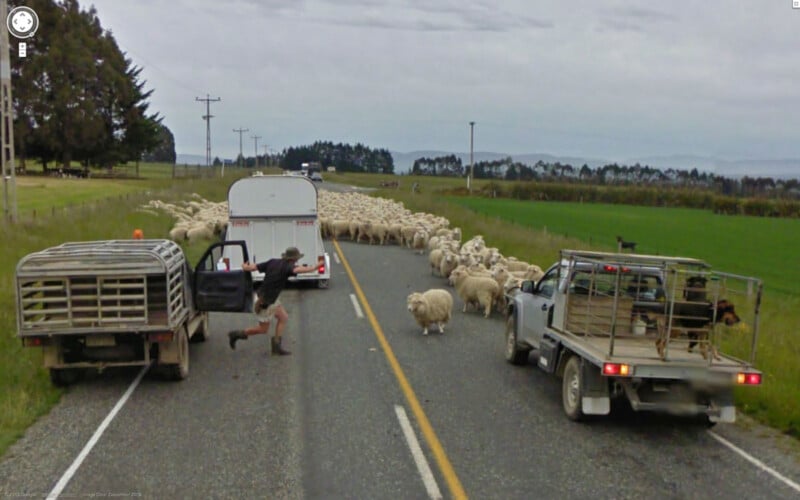
A flock of sheep blocks a rural road as trucks wait; a person is running toward the sheep, and a dog stands in the back of a truck. The scene is surrounded by grass fields and cloudy skies.
State Highway 6, Lowther, Southland, New Zealand, 2013.

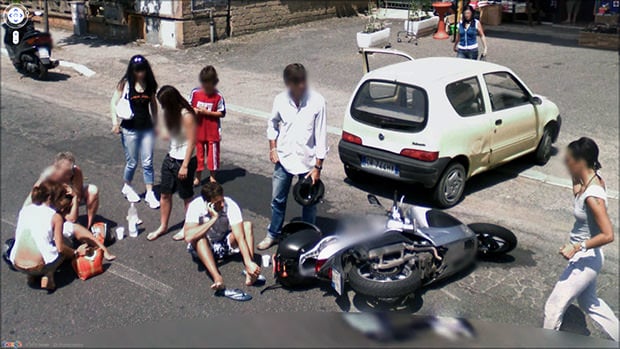
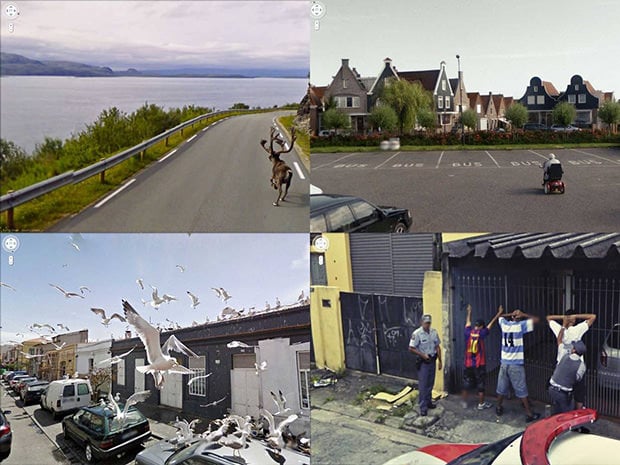
When Google Street View rolled out in 2007, it became the “world’s photographer.” Since then, artist Jon Rafman has been collecting moments captured by Google’s Street View cars.

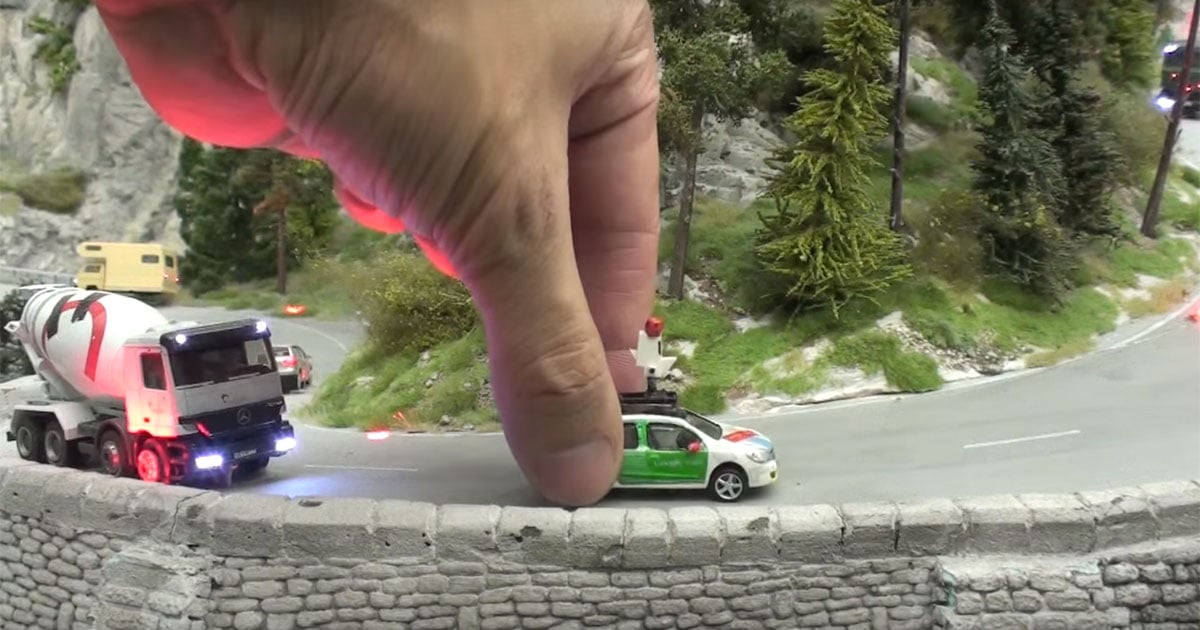
The project is named Nine Eyes to reflect the nine cameras that are fitted to Street View cars. “Unlike traditional photography, these images have no author. The camera records everything but understands nothing,” says the Louisiana Museum of Modern Art in Denmark, where Rafman is currently exhibiting his project.
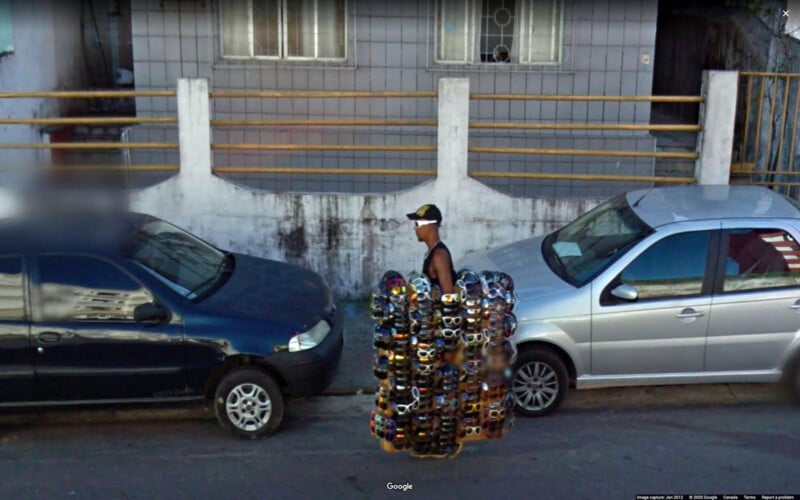
A street vendor walks between parked cars wearing racks full of sunglasses around his body, selling them in an urban area with a tiled building in the background.
275 Rua Conde de Porto Alegre, Brazil, 2020.
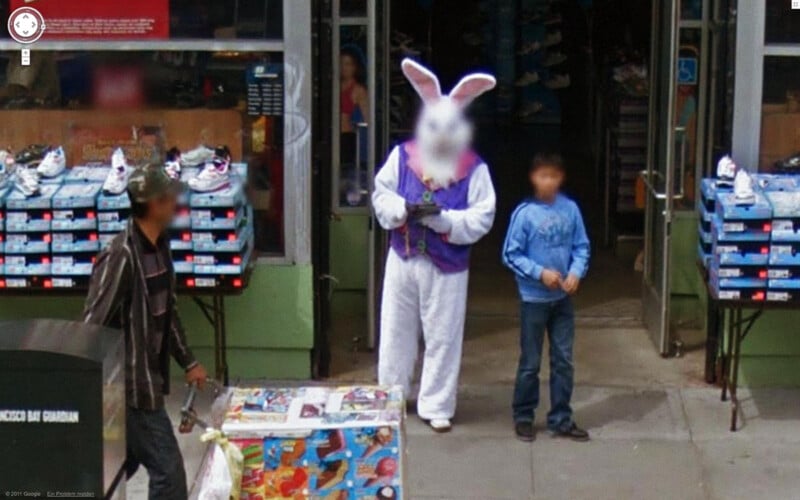
A person in a white bunny costume stands outside a store, next to a child in a blue jacket. Shoe boxes are stacked outside the entrance, and another person walks by on the sidewalk.
2609 Mission Street, San Francisco, California, USA, 2011.
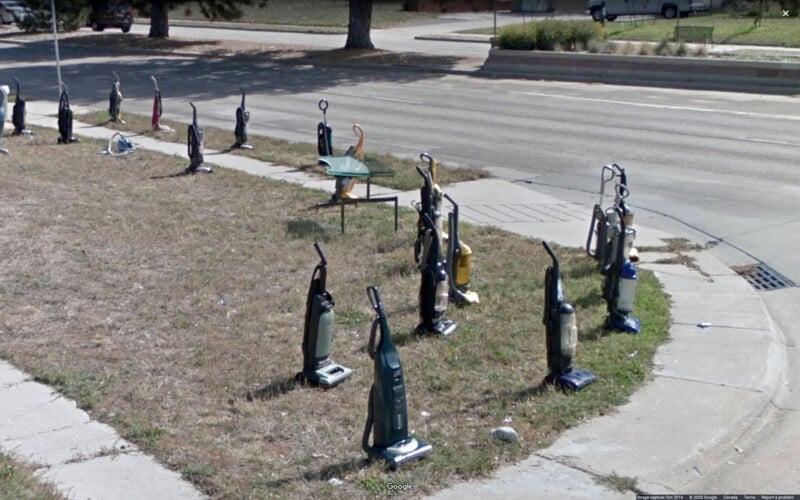
A grassy lawn next to a street displays dozens of upright vacuum cleaners arranged in rows, with a small green sign and a flamingo lawn ornament in the background.
Pontiac St., Denver, Colorado, USA, 2020.
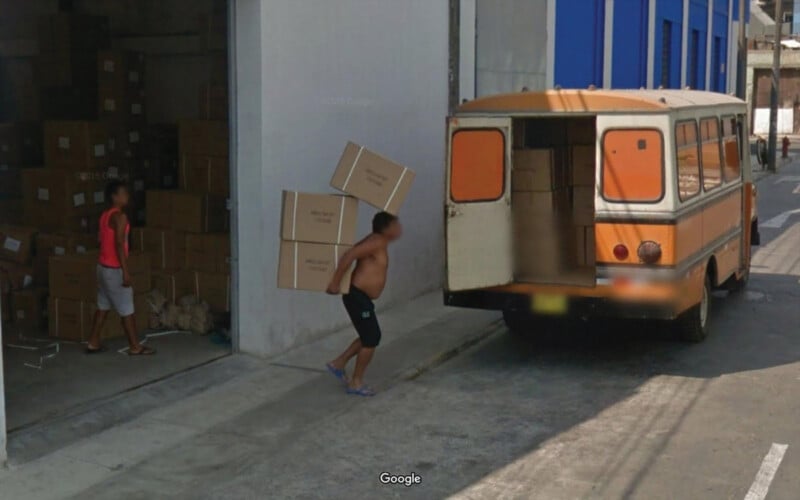
A shirtless man carries a stack of boxes on his back from a warehouse to an orange van parked outside. Another person stands in the warehouse doorway surrounded by more boxes.
Jirón Puno, Lima, Peru, 2018.

Since 2008, Rafman has been carefully selecting images from Street View, starting an archive taken from blogs and websites. He also joined the culture by finding pictures himself.

Rafman says that the cars with nine eyes are indifferent about what they photograph. But by curating them in this way, he develops the images in a way akin to how photographers used to develop photos in darkrooms.

“There are the glitches in the technology that points to the artificiality of Street View, the happy accident of the error that creates something beautiful,” says Rafman. “There is also the more noir, hard-boiled street life scenes like the man with the gun, the prostitute, the drunks, all of the seedy underbelly. There is romantic imagery, the surreal, Jeff Wall-like images. There is ironic imagery, there’s the abject, there’s the beautiful, all the different poles of existence.”
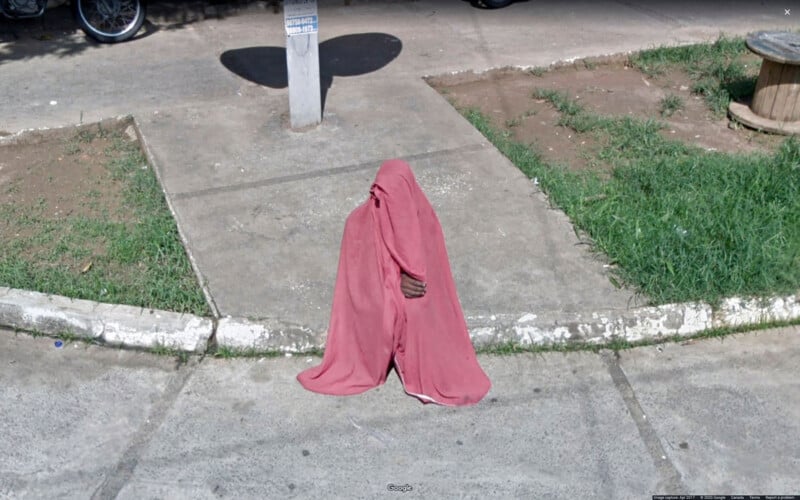
A person sits on a sidewalk wrapped completely in a large pink blanket, with only their hand visible. They are positioned near a curb, with grass and a wooden bench nearby.
Praça Conselheiro João Alfredo Salvador, State of Bahia, Brasil.
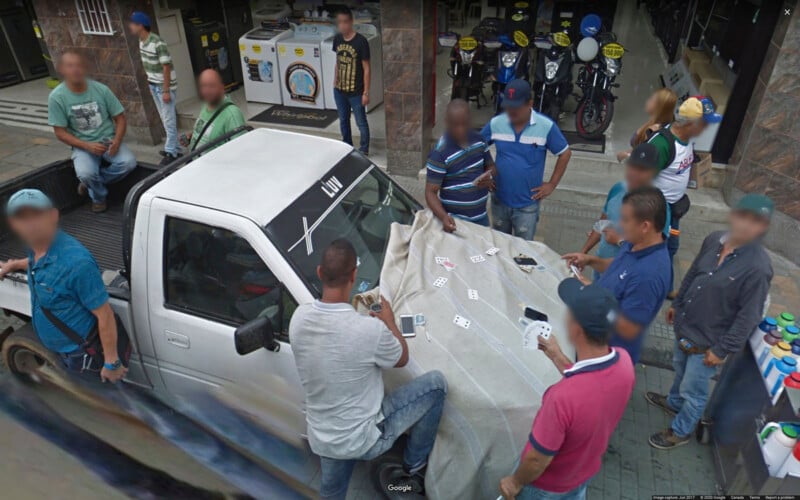
A group of people gathered around a white pickup truck parked on the street, playing cards on a cloth spread over the hood. Several onlookers and parked motorcycles are visible in the background.
Medellín, Antioquia, 2019.
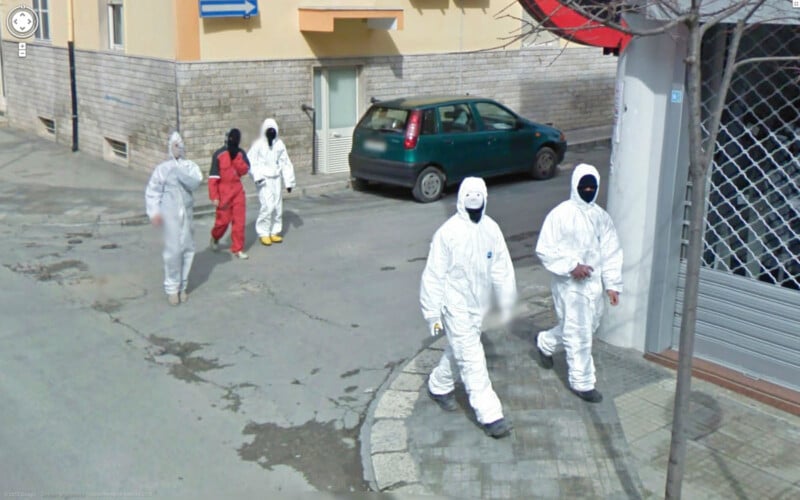
Four people in white hazmat suits and masks walk on a sidewalk, while two others—one in red and one in black protective suits—walk behind them on the street near a corner building with parked cars.
Via Guglielmo Marconi, Grottaglie, Puglia, Italy, 2013.
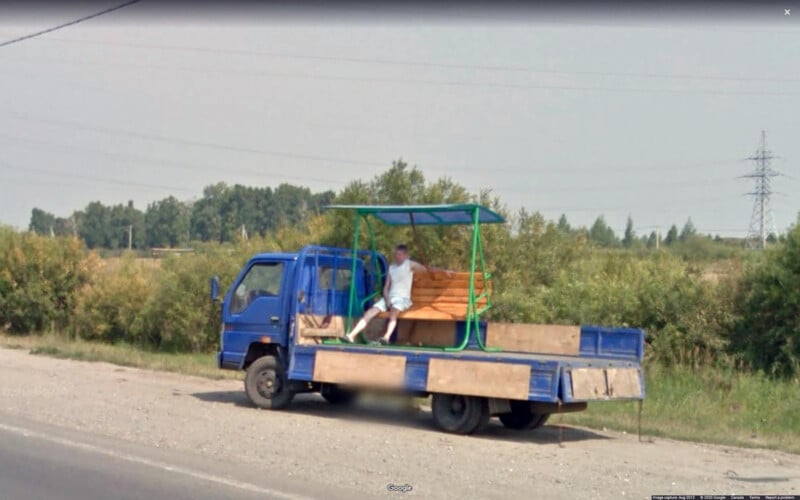
A blue flatbed truck parked on a roadside with a wooden park bench and a shelter on its bed. A person is sitting on the bench. Trees and power lines are visible in the background.
Salairskiy Trakt, Tyumen, Tyumen Oblast, Russia, 2020.
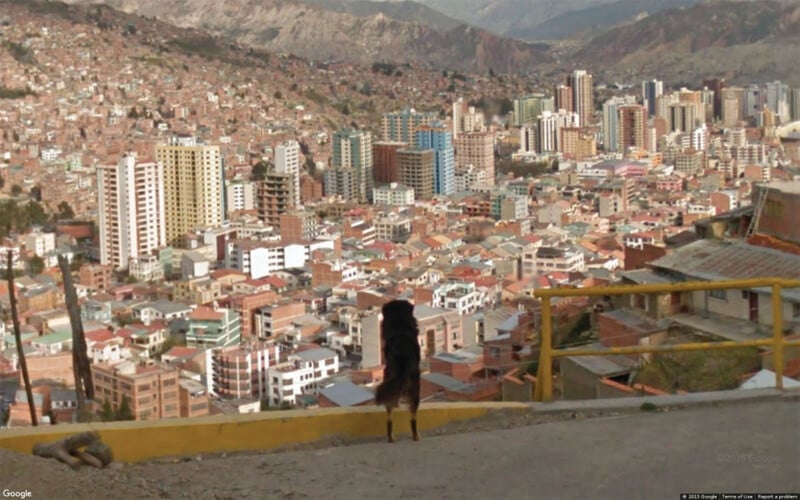
A dog stands on a paved path overlooking a densely built city with many tall buildings and colorful houses, set against a backdrop of mountains.
Av. la Bandera, La Paz, Bolivia, 2015.

The exhibition at the Louisiana is called Report a Concern, a nod to the message Google used to place in the corner of all its images. It is the first full presentation of the Nine Eyes archive, and as well as the images, it also features new AI-based pieces.

“It explores how technology, surveillance, and memory shape our sense of reality in the digital age,” says the museum. “Nine Eyes invites the viewer to look again, not just at the world, but at the way technology sees it for us.’

The exhibit is at the Louisiana Museum of Modern Art in Humlebaek, Denmark, until January 11, 2026.


Image credits: Jon Rafman / Louisiana Museum / Google
Discussion